Know Any Literary Animal Lovers?

Hi there PureJeevan readers! We wanted to let you know that Jim's new novel CHROO is available on Amazon. It's a crazy adventure involving a billionaire heiress, her Chihuahua BFF ("Chroo") and a host of human and animal characters. Find out more on Amazon! Here are some links:

As Pure Jeevan blog readers probably know, we're big fans of running ongoing series. A good blog can never have too many, really. So today we mark the official kick-off of another super series. We're calling these articles "Pure Jeevan Guides."
Guides to what , you may ask. Well, to various topics of interest to raw foodies, of course!

I was reminded about a video I saw some time ago, after seeing a similar video on my dear friend Bunny's blog. What you are about to see is AMAZING!!
Take the time to meet...

Yahoo recently ran a photo series on their "omg!" channel entitled "Celebrity Slim-Down Secrets." It actually has a nice set of before and after photos of celebrities who have lost weight. The set is here.Featured are Kelly Osbourne, Seth Rogen, Jennifer Hudson, Jerry Ferrara, Kirstie Alley, John Goodman, Jordin Sparks, Jason Segel, Drew Carey, Sara Rue, amd Kevin James. ?Most reported using personal trainers, changing up their diets, and getting more exercise (or some variation of those three).
We didn't read any reports of raw food diets in the story, but looking at before and after pictures is probably always a good idea, if only for visual inspiration. It's nice to see a broad range of people turning their health around, too. Some are younger celebs; others in their 40s, 50s, and 60s. So, it's nice to know that major changes are possible at any age.

So it's time to continue that discussion on the aforementioned fringe one percent -- those people who will not accept your conscious intention to pursue your own health via this path. Please keep in mind during this discussion that we're only discussing just that one percent, not people in general. So, this is, I hope, relatively rare.
To begin, I'd like to stress a few points:

Yesterday we talked about attending raw food meetups / potlucks. Today we'll focus on...
*Hosting* Raw Foods Meetups
There are two main ways to host a raw foods meetup. The first would be through the meetup.com web site. If there is no raw foods meetup in your area, you're going to need to launch one. (See the Meetup web site for details.) If there is a group, you'll need to sign up and get to know the moderator, as you'll need to announce your meetup through that person.
Read more: Raw Meetups: What to Bring, How to Host Them (Part 2)


It's not much longer before I'll be serving all kinds of delicious foods to those attending the 3-Day Raw Food Spiritual Ashram Retreat! I've been working on the recipes and taking pictures to include with the bound materials going home with everyone attending the retreat.
As you read this, calming violins open a familiar tune and that sweet mellifluous voice of Etta James soon enters your mind: "At laaaaaaaaassssst. My looooove has come along....." Great tune, right ! Well, it's appropriate here because, at LAST, here's the long-awaited Episode #9 of Know Your Food! That's right, friends, today we're going to explore the wondrous FIG in all of its sweet, soothing glory. One taste and happiness blossoms within you, washing over your entire being... We only wish that the following video was as professionally rendered as this paragraph of evocative prose... (but, we promise we'll get there one day).
In case you missed the actual nutrition info in that video (what little there was, LOL), here's the transcript:
The other day I made a recipe from "Rainbow Green, Live-Food Cuisine" by Dr. Gabriel Cousens. I modified his recipe a bit and what resulted was amazing. Perhaps the original recipe tasted even better, but this is what I did with it.
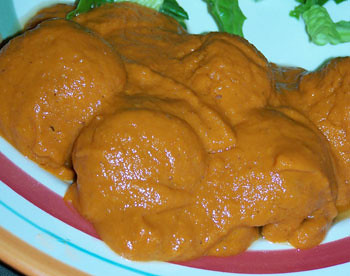
We had a wonderful weekend that started with a raw food potluck in our home (through the Pittsburgh Raw Food Meetup group). There were about twenty people and so many lovely raw food dishes! I haven't checked the camera, yet, but I hope someone remembered to capture some pictures of the food and guests. It was all very yummy, including the beet pasta I made with a cream sauce. I also made some carob peppermint sweets that KDcat formed into bite-sized balls and arranged them on a platter. A friend of mine told me that the people who show up for raw food potlucks tend to be genuinely nice people, and she was right. It was a pleasure meeting everyone and I look forward to next month's meetup.
The rest of our weekend was spent with our guest, Devaki, who just left a few minutes ago to return to the ashram. She played some beautiful music on the harmonium and she and some other lovely guests filled our home with the beauty and energy of Kirtan chanting. Some of the chants were in English, too. I thought I wouldn't like them as much, but they were just as beautiful as the Indian ones. One of my close friends who was here for the Kirtan told me that I was glowing after the chanting! I love the blissful feeling that comes from chanting and meditation.

I'm not sure I'm getting enough carbs 'cuz I eat very little grains or beans and I am always worried of overdoing fruit.
Well, rest assured that if you are consuming enough calories with your diet, and not exclusively eating fats and proteins, you are most likely getting enough carbohydrates. Carbohydrates exist in just about anything you can eat. By simply eating enough food during the day, you can easily meet your body's carbohydrate requirements.
There are two classifications of carbohydrates: simple and complex. Grains and beans fall under the complex category, while fruits fall under the simple category.
Read more: Am I Getting Enough Carbs Without Beans and Grains?

Q. I recently read the following on Dr. Micahel Eades' (dr. protein power) blog & would appreciate your opinion:
Have you any comments on the RAW FOOD movement and particularly Dr. Cousens claim of a ?cure ?Dr. Eades' response:
I don t know anything about Dr. Cousens. I do know that people in the raw food movement seem to believe the raw foods deliver ?natural? enzymes unaltered by cooking to the GI tract to help it do its work. Problem is these ?natural? enzymes are made of protein and are denatured (the same alteration process as cooking does with heat) as soon as they hit the stomach acid. The fact that proteins can t make it through the stomach without being completely altered is why diabetics can t take insulin pills and have to get their insulin via injection. Insulin is a protein, just as enzymes are, and it can t make it through the stomach without being denatured.