Know Any Literary Animal Lovers?

Hi there PureJeevan readers! We wanted to let you know that Jim's new novel CHROO is available on Amazon. It's a crazy adventure involving a billionaire heiress, her Chihuahua BFF ("Chroo") and a host of human and animal characters. Find out more on Amazon! Here are some links:
Jim here... Recently, a commenter on this blog, Lannette, mentioned being a cardiac rehab nurse. For some reason, reading this set my wheels spinning in various directions, among them onto the topic of meat consumption in the world. To begin, I'd like to recap something I'd said in response to her:
... it *astounds* me how people joke about heart health where I work. People around here routinely return from medical exams and actually adopt rather mischievous grins when they reveal how high their bad cholesterol levels are. It's like they're saying, "I know meat and dairy are bad for me, but I'm going to keep on eating it anyway. Isn't that funny ??!!!" Ummm, no. It's sad. They laugh it off as though there could be no possible future reckoning for them. It's reminiscent, IMHO, of Dr. Viktor Frankl's book "Man's Search for Meaning," in which he describes a psychological phenomenon he termed the "delusion of reprieve." For anyone unfamiliar w/ that, the term describes the phenomenon via which those faced with certain death (or near certain death) mentally construct some way out of it. They are deluded into believing that they'll have a reprieve from the inevitable. So, it's exactly the same to me -- these people see the heart attacks coming. They simply refuse to do anything about it, refuse to change their habits, deny what their blood work says to them. Why? Because they think "I'll be okay. Sure, this leads to heart disease in most people, but not in *me* because I'm a strong guy, I'm macho, I'm not as fat as some other person here, etc." Mostly, it's the meat, I think. It's got a powerful hold on our society...
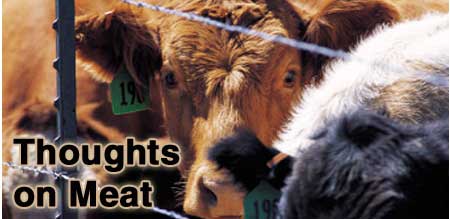
So, today I wanted to write a little bit on the topic of meat consumption. This is an enormous issue, in my opinion. If you're reading this, it likely means you're already at least a vegetarian, so I do not need to quote you any saddening statistics on the horrors of the meat industry. In fact, before writing this, I decided to visit the PETA web site quickly in order to glean a few slaughterhouse facts. But, in no time, I became markedly depressed, so I'll largely avoid focusing on specific negative imagery here.
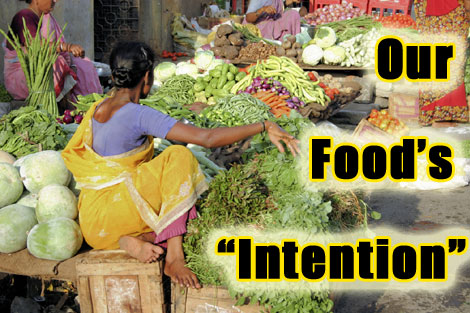
Jim here... During one of our marathon sessions at a Border's book store, I recall reading somewhere about the notion of a fruit's "intention" to be eaten. It's been a few years since I've read that, but I immediately resonated with the notion that many fruits, nuts, vegetables, and seeds are actually evolved to be eaten by other living beings and, therefore, to consume them (or their fruits and seeds) is to participate in a wonderfully nonviolent act that is in perfect harmony with a kind of primordial Earthen symbiosis. Whether these plants, vines, trees, etc. feel a conscious intention to have their fruit eaten by others is a matter of metaphysical conjecture. But, within the context of discussing vegetarianism, the argument is certainly relevant and fairly strong.
 If you walk up to a farm animal, it may be impossible to estimate what's going through its mind, but I feel intuitively that it isn't, "Please kill me and eat my flesh." In other words, there's no "intention" present in that scenario. On the other hand, it's very easy to imagine that a tree produces fruit, knowingly or not, in order to produce offspring. Throughout the entire evolution of that tree, part of that reproductive process has involved animals (including humans) eating the fruit and then "redistributing" (which is a nice way of putting it, I suppose) the seeds naturally.
Thanks to everyone who has offered, so far, to help us out with our project (mentioned in yesterday's post). If anyone else thinks they'd like to help, we're looking for as many people as possible! We'll fill you in soon, just be sure to send us your email addresses if you haven't already done so. Thanks!
Here are more pictures of some of the foods we've been eating. Over the past year, we've pretty much been eating simple foods (except for the time I was preparing meals for the Raw Food Retreat). However, recently KDcat has been doing some extreme yo-yo eating between raw foods and packaged/unhealthy cooked foods. The back and forth has been causing her to experience a bit of a tummy upset. So, I've decided to make our meals a bit more exciting for her---so she'll possibly not feel so tempted by all of the colors and artificial flavors of the packaged "foods" she's been eating.
Talk about color...check out this salad I made earlier today:
I thought I'd put another fun week together here at Pure Jeevan while Wendi is away (although, actually, ALL of our weeks are fun-filled here!). This week, I thought I'd discuss herbs, spices, and essential oils. Of course, I can't cover those enormously important (and huge) subjects in-depth over the course of just one week, so I created that little banner (above) so that we can re-use it from time to time.
Herbs are fascinating, aren't they? Sometimes, you don't even consciously know why you use the ones you do but, invariably, there's a reason. Sure, sometimes recipes call for a specific flavor. But, often, there are other reasons as well -- such as to support digestion, or to provide a warming or cooling sensaiton. This type of thing is critical in ayurvedic principles, as we touched on recently on this blog, where the spices could be present for digestive or medicinal purposes, or of course as a preservative.
I'd like to talk with you about diet and experimenting. I've been learning about natural healing and foods/health since I was a very young woman. Somewhere along the line I knew that what I was eating was either making me feel better, or worse, and that food was related to health (it was more than just to fuel the body). It was with this knowledge that I stepped into the realm of natural healing and stumbled around for most of my life.I've learned about vegetarianism, herbs, the negative effects of dairy on the body, veganism, essential oils, Ayurveda, harmful chemicals in and around our foods, and so very much more. I don't claim to be an expert on any of these topics, they are just part of my overall bank of knowledge and experiences from which I pull to live as healthy as possible.

We're going to be running the above banner for a few days as we bring you highlights of the raw food scene in the beautiful Florida Keys.
A worker at our local Food Co Op was talking about making his own dehydrator. I mentioned that I saw a link to a site that told about how to create one and I'd share it with him. When I found the link, just now, I thought maybe some of you might be interested in checking it out, as well.
?The page isn't vegan-friendly (there is ground meat in the one picture), but if you've been wanting a dehydrator and don't want to spend the money on the more expensive ones...this might be a great option.
We've been extremely busy, but KDcat and I did take some time to make some dehydrated food the other day. We rarely ever use the dehydrator, so we've been eating different foods than we normally do and enjoying it.
We didn't take pictures of everything, but here's a list of what we dehydrated:
* kale chips
Jim here... I'd like to mainly talk about organics today, but thought I'd wrap that subject into a longer, rather quirky piece on ranking produce on some sort of a scale that would indicate how awesome (or awful) it is. See what you think...
Have you ever thought of arranging produce into a sort of "heirarchy of quality"? Well, I'm not going to attempt to do that here, but I would like to discuss the concept for a moment in order to at least explain what I'm getting at. While I've not yet attempted to do this exercise, I nonetheless occasionally envision a large chart or something that conveys my feelings about how I personally rank the quality of fruits and vegetables I put into my body. This all probably sounds vague, so let me share some examples.
Read more: Pure Jeevan's "Produce Buying Tips" Series, #2: Buying Organics
Look at the dinner we had this evening!!!

A bean and rice burrito, taco with all the toppings, tomato and pepper salad, and sweet orange salsa! Yum, yum, yum!!! I'll be posting the pic again and sharing a recipe on Monday.
Hey Everyone- Just a quick note, in case you're reading our blog and thinking, "Wow, Wendi and Jim usually update daily! What's up ?!!" We'll get back to it pronto, I promse -- maybe even later today! Turns out it's just a TON of work orchestrating a tour like this, especially across a three-hour time zone. But, now that we're getting used to it, I think we can look for some more timely updates. The latest is from Corvallis, Oregon. But, we're also going to talk about Portland a lot more soon! So, stay tuned! -Jim
Original Comments
Below, we have included the original comments from this blog post. Additional comments may be made via Facebook, below.
On March 4, 2010, wrote:
I hear ya. I do keep checking in though, and I'm looking forward to when you get your groove.
I really feel for you, Jim. Your girls gone, having to keep track of their movement, run a household on your own and still work that stupid job. Poor baby. Just know that I am thinking of you, and sending you love from New Mexico.
And Wendi, AAAaaaaaaaaaaaaaah! I can hardly wait 'til you get here!
Terri
On March 5, 2010, wrote:
We are getting all ready here for W and K! so far we have the following guests for Cru:
Bueller of Bueller's Kitchen, Lori of Inspire2Act, Ingrid of Raw Epicurean, Dianna Harrelson, LA Raw meetup organizer and raw teacher, Puki (friend of Courtney Pool), and a few other folks .. and ME!
xoxoxo deb