Know Any Literary Animal Lovers?

Hi there PureJeevan readers! We wanted to let you know that Jim's new novel CHROO is available on Amazon. It's a crazy adventure involving a billionaire heiress, her Chihuahua BFF ("Chroo") and a host of human and animal characters. Find out more on Amazon! Here are some links:

I'm excited about something that one of my friends has been working on. Melissa is gifted in so many areas, one of which is wild edible identification. She recently told me she was working on something that would help a lot of people and I was excited about her new project. Well, now it's ready to be shared with everyone!
Take the time to meet...

Jim here... When you're a committed raw foodie, certain activities that most other people consider routine can become somewhat difficult if you don't apply a bit of forethought and planning. Take traveling, for example -- specifically, flying.
What if you're flying out of town -- say, to the Florida Keys (wink, wink) -- and want to make sure you'll have enough to eat during the day-long trip? What if you also want to bring along some staple raw food items as well ? What if some of these are generally refridgerated ? How can you accomplish all of that?

Here's another brief video from our travels. Since time for editing is limited, I think I'll just run some more of the shorter vids this week and then get into the longer, more in-depth interviews next week. So, this is a short, fun conversation I had with Steve, who tends the raw juice and smoothie bar at Cousin's Incredible Vitality raw restaurant in Chicago. Here's the vid:
Read more: Pure Jeevan Interviews Steve from Cousins Raw Restaurant in Chicago
All this month, Jim has been experimenting with a low-fat, raw vegan diet. He discusses his reasons for trying a low fat diet, and how he s been feeling with the changes, in his first and second posts so far this month.
Many of you have heard us mention the famous low-fat, raw vegan 80/10/10 diet here on our blog. Well, today I d like to highlight the individual behind that diet. So?
Here's an update from Wendi. I think this can be considered, with 99% confidence, the big announcement:
Of course, there's that 1% chance that something unexpected will happen. But, Portland feels right. It always has for us; we nearly moved there in the late 1990s. We had books on Portland back then, and I was buying their newspaper each week to hunt for jobs. It just never panned out, though. I suppose we were meant to live in Pittsburgh for a spell. It would be easy for me to list many reasons why Pittsburgh served a purpose for us. But, yeah, I think we're Portlanders at heart. So much about that city resonates with us. It'll be a homecoming, for sure! I want to reiterate a few things that I'd written in comments recently, slightly clarified in places.
Read more: Pure Jeevan Perceives Peace, Purpose, and Prosperity in Populous Portland!
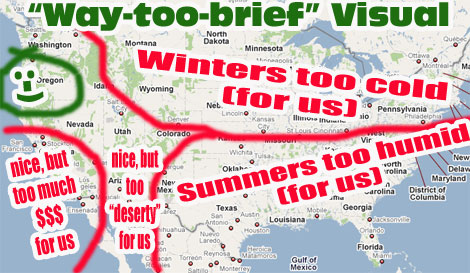
Well, I hope we're finally approaching the true end-game of our whole move. We now have our home listed with a new realtor (no longer going it alone as a "for sale by owner" scenario), so we're hoping that a renewed effort (and a lower price) will attract a buyer. The market seems to be perking back up a little as well, which certainly can't hurt anything.
Thanks to everyone who sent in suggestions for places we should consider moving to. I assure you that we researched each and every one to an almost ridiculous degree. There are more amazing places to live than we ever knew, and we were delighted to learn about some areas with which we weren't very familiar -- funky little enclaves in Texas, Tennessee, New Mexico, etc. I think we've hinted as to our inclinations before, but I can tell you that, after so many months of intense deliberation, we believe the best domestic home for Pure Jeevan is probably in Oregon.
 What fun it is to share a fun day with like-minded people at a special location, sharing good times, laughter, and delicious, nutritious raw food wonderment. Here are some pics from our outing -- hopefully the first of many such unique outings blending the Pittsburgh raw group with the D.C. one.
We hope this also provides some inspiration for other meetup groups to consider holding joint meetups in some geographically central location.
If you're new to raw foods, you're probably aware that eating this way isn't exactly mainstream. And, while we've talked here before about the importance of connecting with others for inspiration and support, it's true that a lot of that lends itself to participation in virtual worlds such as Twitter, Facebook, Give It to Me Raw, and other communities, blogs, and sites where raw foodies hang out.

Jim here... A little over a month ago, we couldn't contain our excitement about an online contest to win the best job EVER -- living as caretaker of a tropical island in Queensland, Australia, on the Great Barrier Reef for 6 months (and being paid $100k for the task!).
The deadline has come for this and, as we promised, we BOTH applied. My video was the first to be processed. So, we posted a screenshot above, which you can click to go view it (or just click here) -- and also please vote and rate it a 5!!! (I've heard that the rating system can get a little screwy on that site -- that you need to wait for it to load and maybe mouse over the rating part first. But, a 5-star rating would really help, as would the traffic, even if you don't watch the entire video.
Sorry for the strange behavior of this site over the past few weeks, friends. As a former professional web programmer, and always a?bit of a mad hacker, I'm usually really great at keeping the web end of Pure Jeevan running very smoothly.
But, this is a Wordpress blog -- and so you have things like plugins and widgets and themes and updates, all interacting (and sometimes conflicting) with one another. I've noticed lately that this blog home page has developed all sorts of peculiar issues, not the least of which is a very slow-loading tendency.
Read more: Hopefully Pure Jeevan Loads a *Little* Faster Today!

Today's Jim's birthday!
This photo is from Saturday night. We had a sleepover birthday party to celebrate Jim's big day. The Pure Jeevan home was filled with loving friends, amazing raw food dishes, and vibrations from some fun group drumming!
Happy, happy birthday, Jim! May all your wishes come true and your life always be filled with health, love, laughter, and friendships! I love you!
Guess what's pulling into Pittsburgh tomorrow evening? Here's a hint (if you don't already know after reading the title of this blog post!):
Read more: The Kale Whale Kickoff Event: Kevin Gianni in Pittsburgh!