Know Any Literary Animal Lovers?

Hi there PureJeevan readers! We wanted to let you know that Jim's new novel CHROO is available on Amazon. It's a crazy adventure involving a billionaire heiress, her Chihuahua BFF ("Chroo") and a host of human and animal characters. Find out more on Amazon! Here are some links:

To help keep all of you inspired, we ve asked some
remarkable individuals to share their raw food stories with you. Enjoy!

We began this series with one possible psychological explanation of obesity, moved on to a possible philosophical explanation, and will now cover one that could be both of those, or could find classification within the emotional and/or spiritual realms. ?Wendi has often told me of hearing Dr. Gabriel Cousens speak in Sedona, Arizona, a few years ago. One remark in particular stuck with her. This may be a slight paraphrase, but Dr. Cousens said:
"There's never enough food to feed a hungry soul."
As we all know, physical hunger happens when our bodies need food -- when our stomachs are literally empty and aching for fuel to sustain our life. But, what about non-physical types of "emptiness"? Surely, we experience a kind of hunger in these cases as well.
Here's a letter from Wendi to the Pure Jeevan family. I prettied it up a little with some color and graphics. -Jim

Hi there, lovely Pure Jeevan family! I'll be away from the computer for a month, working on some deep healing. It's time to go within and really hear what my body and spirit are saying.
Read more: Wendi's Taking a Break... A Peek Into How She's Been

Jim here... I'm back from Raw Spirit Festival East with roughly 4 Gigs of pictures and videos to sort through, as well as 17 pages of handwritten notes about my rawsome experiences. So, tomorrow, I'll begin the task of sorting through it all and posting all sorts of fun stuff (photos, videos, and tales of adventures).
For now, all I'll say is that Rawbin Anderson, RSF East Manager, did a spectacular job in orchestrating the whole event. Here's Rawbin:
If you've been following us for some time, you'll know that we are continually working on projects that will either serve our raw food community or educate others about the health benefits of a raw food lifestyle. If you are new here, or just getting to know us, you can read a summary of what we accomplished last year and a summary of the projects we're currently working on. We're serious about our goal to inspire others to learn about and embrace the raw food lifestyle and community. I've always been someone who helps others, who senses in what direction they are headed and then offers inspiration to keep them moving. I love the work we do as Pure Jeevan and it is extremely rewarding to receive so much gratitude from many of you. But, guess what? Sometimes I get tired!
Sure, some of you may be saying, "But, wait! People who eat raw foods are supposed to be power houses of energy -- able to continually keep active and never run out of steam." Well, that is very true. So, I take it back. I'm not really "tired" like I said -- my body is able to wake up in the morning, easily fall asleep in the evening, and go about its daily work without feeling like it's run down.However, I am feeling like I need a rest from all that I've been doing. Maybe I don't need to sleep hours and hours, because my body isn't truly tired. None of my being is truly tired -- my body, mind, spirit, and emotions are feeling great, actually.
However, I still feel like I need a break from my routine. On top of that, I've been feeling uncomfortable in the cold weather even more this year than I did last year. It hurts all the way down, deep inside my bones. I feel like it will take a lifetime to thaw from the cold I've been feeling here in Pittsburgh. The sun rarely shines, and the snow and ice are brutal on someone eating only raw foods. My instincts told me two years ago that it was time to move to a warmer, sunnier climate, but that hasn't happened yet (even though we are patiently working on it, as Jim pointed out in an earlier post).

A few years ago, my dear friend Melissa and I decided to split the cost and order a raw food home study course (then known as The Dr. Ann Wigmore Program).Let me tell you, this was not a cheap program that we purchased, but at that time there wasn't as much free information available on the Internet like we now have.
Was it worth the cost? Well, kind of. Since we had both been reading and learning so much about raw foods (she had actually been raw for a long time many years before), much of the information wasn't new to us. However, if someone was newly learning about raw foods, the program would probably have been fantastic. The quality of the materials we received wasn't great (photocopies of photocopies that were sometimes difficult to read, and some videos that were blurry or difficult to hear), but at least we had a lot of information at our fingertips.
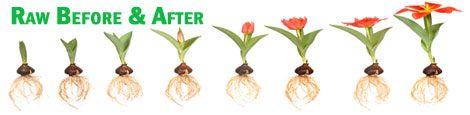
Yesterday, we covered the concept of "unsubscribing" from unhealthy practices. This was of course based on the common Internet practice of subscribing and unsubscribing to various things like newsletters and email lists. I receive quite a few of these each day, many raw foods ones and many non-raw ones. Among the non-raw, one that has been interesting to me lately is called the Art of Non-Conformity, penned by Chris Guillebeau. Basically, Chris' site chronicles his adventures in reaching his personal goal -- to travel to every country in the world! Along the way, he writes about all sorts of out-of-the-box things, as the blog name implies.
Today, he posted something that is remarkably insightful and applicable to our subject matter here, even though his context was completely different. The entry, entitled simply "Before and After," discusses the drinking water problems in much of Africa, focusing for the moment on Liberia. Atop the piece (the "before" picture) is a muddy water hole, the only source of drinking water for one village. The next picture (the "after" shot) shows a different, very happy village obtaining fresh, clean water from a newly installed well. Chris closes his article with the following quote:
Yesterday's post was a little "heavy," don't you think In it, we shared a bit of the stress we were experiencing related to our pending move. There was just so much data to pore through (and yes, we're still feeling that stress)!?
At times like these, it's often good to step back, breathe, and make sure you're not ...well, freaking out -- which makes today's "Take the Time Tuesday" installment absolutely fitting, for we would like you to meet a raw foodie who goes to great lengths to ensure that your "Vitamin L12" levels stay well into the superhero range. Without further adieu, then...

Jim here... An unusual occurrence prompted this post, and I'm unsure as to whether it's significant. I've talked about some of my favorite non-raw items before -- things that were tough to leave behind as I embarked upon this raw foods journey. I think I covered pizza in a relatively recent post.
Corn chips were another. In fact, after Wendi went 100% raw and I more or less began to follow her dietary choices, I clung to corn chips for dear life for quite a long time. I began eating a LOT of salsa in those days. Sometimes, that would be all I'd eat for lunch -- just an entire jar of salsa and a bag of corn chips (though, by then, I'd at least usually buy the organic ones and, quite often, a baked variety of chips as well).
When I finally decided I'd be better off transitioning to an all raw lifestyle, I figured my love affair with corn chips had come to an end. Farewell beautiful chips, I thought. I'll never forget our delicious crunchy time together. And that was that. I never looked back.
But then, at a local raw foods pot luck, I met a raw chef who had more or less perfected a raw corn chip recipe. Could it be , I thought. Has this delicacy returned to me after all, as though via some sweet culinary destiny? Ahh, my friends, that was a glorious day. Chips and salsa had returned to me in an enlightened raw form. I could enjoy them once again, guilt free. And enjoy them I did -- usually using a local shop's "Peruvian Purple Corn" (a living, sproutable, dried corn product).
Alas, fate stepped in once again. "Thou may partake of these crisps any time thou wishest," fate boomed. "Yet, in order to do so, thou must prepare them thine self using thine Vitamix and requiring an enormous flax-sticky mess with extended clean-up time, and thou must have parchment paper available at all times, and thou must exercise great care and patience in using your Excalibur, for these chips must dry for many an hour before ready."
Yeah, it was a bit of a chore to produce them. So, as the novelty of chip making and eating wore off, I slowly decreased the frequency of going through the messy, time-consuming hassle of preparing them. Until yesterday, it had been literally months since I made a batch. But... we'd ordered a few pounds of the corn from Natural Zing lately, and I found myself with some extra time the other night. So...
Now, I'm going to pause for a minute for a tangent on digestion. I know a great majority of people, it seems, complain of various digestive disorders. As a result, we have many raw foodie specialists schooled in the nuances of food combining. Oddly, I never paid much attention to these discussions, nor offered input on these matters, because they simply weren't relevant to me.
In fact, I likened my own digestive system to some kind of nuclear powered garbage disposal. It didn't matter what I ate; digestion wasn't a problem for me. So, for example, I'd routinely finish off heavy meals, and then follow them with a huge slice of juicy watermelon (a major no-no according to common wisdom). It just never bothered me.I always joked that, even though I'd been raw for ages, I could still probably go eat a Big Mac (not that I would) and be unaffected by it.
So powerful was my stomach acid that, admittedly, I sometimes privately *worried* whether this might mean something was wrong with me. I mean, shouldn't some of the things I was eating make me sick? Was it "good" to not be made sick by what is generally regarded as poor food combining choices? Do people commonly suffer from problems of efficiency as well as deficiency ? I still do not really know the answer to these questions, and suspect the answer is rather complicated, anyway. Fortunately, it doesn't matter now because...
Something finally made me sick!? I'm laughing now about that, but I spent most of the evening in terrible stomach pain after having over-indulged in some of those (in)famous raw purple corn chips.
So, what happened ? That's an interesting question for me. Here are some possibilities: (1) Perhaps my hyper-active digestive system *was* in fact a problem, and now it's beginning to normalize. Perhaps, had I been healthier all along, I would have been made sick by some of my food choices, but now my health is improving!? (2) Perhaps it's a fluke and I simply shouldn't have eaten mass quantities of corn and flax so late at night. (3) Perhaps my body is improving in its ability to communicate with me, and/or that I'm getting better at listening, and that the message here is that corn is not something my body gains nourishment from -- at least, not in this dried-reprocessed-redried form. After all, some leading raw food authorities, like Gabriel Cousens, aren't fans of corn (even fresh corn!).
Oh sure, there may be other explanations (e.g., "a bad batch of corn"). But, I'm actually most interested in #3, above. Even though this is an extreme example (more intense than it needed to be), I'd like to think that I'm getting better at knowing what I'm being nourished from and what I am not. I'd like to think that this is a latent sense that can be developed, much like our ability to know things by feeling and intuition rather via pure rationality all the time.
But, with food, I think it's a matter of inventorying your physical sensations head to toe, and also as a whole. How is the food you're eating making you feel? Do you feel satisfied or still hungry? Do you feel light or is the food sitting kind of heavily? Do you feel energized or dragged down? How's your mental clarity? Do you feel spacey or more grounded? Do you feel noticeably happier or more sad than before? How are all of these things mapping out over time? Is your weight moving in a positive direction for you? Are your illnesses improving? Food is medicine, after all; it has all of these effects and many more!
For now, I think I can safely check purple corn off of my own personal list of foods that make me feel good. I suspect my old assertion about "being able to eat a Big Mac without any side effects" no longer applies -- and maybe this is a good thing. I think perhaps it signals some progress in my journey toward optimal health.
In any case, I think this kind of purposeful introspection is healthy, and something we should all strive to do more often.How about you? Had any similar experiences? What have you learned from them?
Original Comments
Below, we have included the original comments from this blog post. Additional comments may be made via Facebook, below.
On April 15, 2009, wrote:

End of day 4:
Yesterday I decided to go ahead and consume what my body was telling me it wanted: cooked, fermented rice and lentil pancakes. Well, the restaurant nearby that makes the Uthappam doesn't serve them until 5pm and it was lunch time. So, I ordered the simpler, steamed, fermented rice and lentil patties called Idli.

A partial group picture from the retreat.
The 3-Day Raw Food Spiritual Ashram Retreat was a success! All my time and effort that went into creating the event was well worth the experience. When Leela Mata and I discussed a possible raw food retreat about a year ago, I had no idea how to go about creating such an event. I have never done anything like this, so I approached it by asking myself: "What would I want if I was attending a raw food spiritual retreat " From there, I created a retreat that I would love to attend, myself. In fact, when it was completely organized and guests began signing up, I wished that an identical event existed that I really could take part in, as well!