Know Any Literary Animal Lovers?

Hi there PureJeevan readers! We wanted to let you know that Jim's new novel CHROO is available on Amazon. It's a crazy adventure involving a billionaire heiress, her Chihuahua BFF ("Chroo") and a host of human and animal characters. Find out more on Amazon! Here are some links:

We began this series with one possible psychological explanation of obesity, moved on to a possible philosophical explanation, and will now cover one that could be both of those, or could find classification within the emotional and/or spiritual realms. ?Wendi has often told me of hearing Dr. Gabriel Cousens speak in Sedona, Arizona, a few years ago. One remark in particular stuck with her. This may be a slight paraphrase, but Dr. Cousens said:
"There's never enough food to feed a hungry soul."
As we all know, physical hunger happens when our bodies need food -- when our stomachs are literally empty and aching for fuel to sustain our life. But, what about non-physical types of "emptiness"? Surely, we experience a kind of hunger in these cases as well.
With love in my heart, I present this gift to the entire raw and living foods community:
Original Comments
Below, we have included the original comments from this blog post. Additional comments may be made via Facebook, below.
Jim here... Happy Sunday morning, everyone!? We don't normally post on weekends, but we're sharing this video as a special gift for my mom on Mother's Day.As Wendi likes to say, "Every day is mother's day!"? But, I do like to do something a little special for my own wonderful mom. So, check out this video of a recipe Wendi (mostly) and I created for her. If you remember my reaction to the soup we made recently, it may not surprise you to hear me say that this sauce is the "best #$%^&*^%! sauce I've ever tasted!"
We're typing up and formatting this recipe for Pure Jeevan family members (you know, those who subscribe to our mail list). So, once it's ready, we'll be adding it to the queue of mailings we sent out to keep everyone inspired. This recipe is a keeper!
So, what did you think about there being snow in New Mexico? Were many of you thinking it was more of a consistant hot climate like I used to think?
We left New Mexico, renewed, and headed to Oklahoma. Here's where we left off yesterday:
Read more: Visiting Penni Shelton & Russell James in OK: Pics and Vids!

We're loosley going to be picking up some of the ongoing themes we used to cover here on the blog. For the Take the Time Tuesday theme, we asked our readers to take the time to meet or learn about an individual, product, company, etc., that we think may be of interest to you. For today's entry, I'd like you to:
Take the time to meet...
In a recent post we announced that we were interviewed by Rhio for her Hooked on Raw with Rhio radio show that airs on NY Talk Radio (formerly known as Tribeca Radio). Rhio is an amazingly talented woman; we encourage you to check out her Rhio's Raw Energy site that has a lot of helpful information about the raw and living foods lifestyle.
Rhio talked with us about all of the projects we've been working on. She was particularly fond of the All Raw Directory, but she was also thrilled about our cross-country raw food tour and the raw food publishing company that we'll be starting in the near future. She asked us about our successes with the raw food diet, about our daughter, and so much more. If you have the time, we'd love for you to listen to the interview and let us know what you think! It was our first professional interview and we enjoyed it!
Here's a link to check out interviews that Rhio has conducted: Hooked on Raw with Rhio/NY Talk Radio.
Read more: Podcast Available: Rhio's Interview of Wendi and Jim Dee
 After leaving Salem, Oregon, Wendi and KDcat drove less than an hour to the city of Corvallis where they met up with their hosts the Zander's -- Joni, Steve, Bekka, and Stephanie -- a fellow unschooling family Wendi had come to know in an online forum. It was great to be in their company and we loved them right away,? Wendi wrote. ?Their home is absolutely beautiful on a really cute lot with plenty of plants and trees around ? including the most delightful flowers that smelled divine (I think they were called Daphne).
Corvallis is the city we ve mentioned multiple times -- the city that feels like it s the right fit for us. Well, it lived up to our dreams in just about every way. It s a progressive, hip town with a lot going on. The people are friendly, the weather is beautiful, the land is gorgeous, and there are lots of unschoolers. Access to fresh, ogranic, raw foods doesn't seem to be an issue anywhere in Oregon, according to reports from the road so far. While they've been away, we've talked quite a bit each night about what they're finding -- and fresh organic produce seems pretty much everywhere out west. "The west," wrote Jim Morrison, "is the best." (Surely he was a raw foodie.)
Jon Gold, owner of the Sunny Side Up Cafe (a vegan and vegetarian restaurant there) and an unschool father, put together a little gathering of unschoolers for KDcat and Wendi. They were able to meet some local unschoolers and ask questions. There was also a gathering one day at the cafe where KDcat was able to do some art at a table with some other unschool teens. It's definitely a creative, easy-going town with some fantastic people in it!
Today, for Take the Time Tuesday, I'd like to introduce you to an online social networking Web site for those with similar interests to get together, meet, and hang out in the physical world. If you haven't already heard about it, check it out!
Take the time to meet....

 Yesterday was a ton of fun, wasn't it? Sam loves all of the comments, so if you haven't viewed her video, please do -- and let her know how much you enjoyed it!? For today, we just wanted to announce the addition of a permanent new button along the right sidebar of our blog. As you can see, it links to this post from a few weeks back when we first announced a call for guest raw chefs. There, you'll find the details on hosting a segment of Makin' It Monday, just like Sam did.
By the way, just last week, we passed a noteworthy milestone that we didn't mention -- our 500th blog post here at Pure Jeevan. That's a lot of raw foods coverage, right ! Well, we're really still getting started when it comes to the level of information and inspiration we're planning for Pure Jeevan -- so it's great to add new features like this now, as we're able to. Of course, once our home sells and we're finally able to move on to the next phase of our lives, we envision Pure Jeevan exploding with more content than ever before. What fun it'll be to be able to devote ourselves full-time to spreading the word about raw foods!
Original Comments
Below, we have included the original comments from this blog post. Additional comments may be made via Facebook, below.
Read more: Be Part of Pure Jeevan's Makin' It Monday Video Series!
Today in Pure Jeevan's home we are celebrating one of the best days of the year---KDcat's birthday!? How she has blossomed over the years...
?

I thought I'd share some recent pictures with all of you. Let me know what you think!?
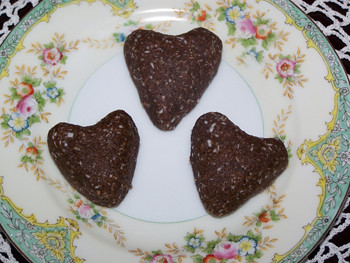
Carob Peppermint Hearts
This is a recipe I created to take the place of a packaged raw cacao dessert that Jim loves. I don't like to eat cacao, because it disturbs my heart, so I use carob. A new raw friend asked for a recipe for this dessert, because she loved it so much, but I don't have one. I dump walnuts, coconut, agave, and peppermint oil into the food processor and mix until it's a consistency that can stick together. For Valentine's Day I shaped the mixture into hearts. Sweet!?