Know Any Literary Animal Lovers?

Hi there PureJeevan readers! We wanted to let you know that Jim's new novel CHROO is available on Amazon. It's a crazy adventure involving a billionaire heiress, her Chihuahua BFF ("Chroo") and a host of human and animal characters. Find out more on Amazon! Here are some links:
Rawbin brings healing laughter and an unusual gift to unwell Wendi Dee.
Are raw foodists invincible to the common cold? I have to admit that I kind of assumed that was the case. If it's true, at what point does the invincibility kick in? I've been raw for over three years (over two at 100%) and yet the past few days have found me overcome with sneezing, sore throat, runny nose, and fatigue.
My first thought, once my throat started to hurt, was: "Did I eat anything different recently that I'm reacting to in a negative way " But, nothing had changed.My diet is relatively clean, with the exception of the times when I consume too much nut dip. So, when the sneezing and runny nose were added to the sore throat, I knew something else was going on. I had to admit it: "I'm not invincible."

We're here to inspire you...that's our overall focus here at Pure Jeevan. So, when we ask you what you'd like us to do more of, less of, or to consider doing here on the blog ... we take your responses to heart. Of course, it's impossible to please every single person since we all have different personalities and needs. However, we'll always do our best to create a balance in order to inspire as many individuals as possible.
Below are suggestions for what some of you'd like to see happening here on the blog, along with some responses from us. If you have more suggestions, please send them our way anytime. We read everything that comes in and will always give your suggestions serious consideration.
Jim here... Whether you've had the pleasure of knowing Wendi for decades as I have, or have only recently met her, I think you'll be absolutely stunned by this inspirational video. It demonstrates, in undeniable pictures, the power of raw and living foods -- and not only the physical healing that takes place when you adopt this lifestyle, but also the height to which this lifestyle helps lift your spirit.
Read more: Wendi Dee's Raw Food Weight Loss Transformation Video
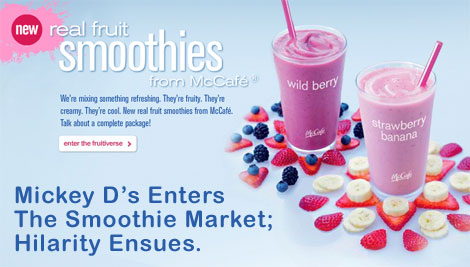
Driving to work today, we noticed that McDonald's has launched its latest product aimed at the health-conscious demographic. In case you haven't heard, you can now purchase fruit smoothies at Mickey D's! Sounds like real progress, right? Well, let's take a closer look and see if they're really as healthy as they sound.
McDonald's is not exactly known as a healthfood destination. After all, a typical lunch at the Golden Arches these days might well include something like an Angus Bacon & Cheese, Large Fries, and a Large Coke. ?Together, that's 1,600 calories, 64 grams of fat, and 2,400 mg of sodium, 99% of which is from highly cooked, highly processed, non-organic, factory-farmed, nutrition-barren source materials . (Add on another 75 calories and 550 more mg of sodium if you plan to go through, say, five packets of ketchup along with those fries.) (Source) And, some people eat that daily!
Read more: The Anatomy of a McSmoothie & Pure Jeevan Calls for New Term for "Smoothie"

We've promised many of you that we'd share some ideas for the whole family (especially the children), so here's one idea that might prove particularly popular. In a household of two former English majors, it's only natural that we've always adored and admired alliteration. So, we may be biased to believe that these "Breathtakingly Bejeweled Blueberry Banana Breakfast Bowls" will be as beloved by your beauteous bellies as they are by ours. See what you think!
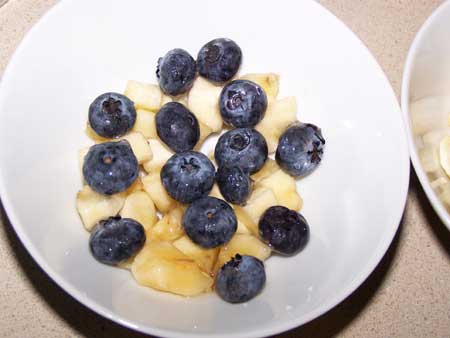
Read more: Breathtakingly Bejeweled Blueberry Banana Breakfast Bowls
Well, here's my latest update on my nine days of mono meal eating. I have a headache this evening and I'm headed to bed early. I'm hoping the headache is a detox symptom and that it will be gone when I wake up.
April 9, 2008
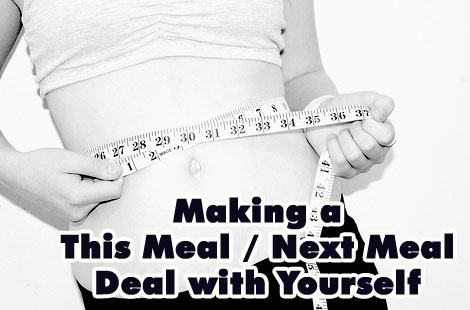
Wow, could this really mark 800 raw food blog posts ! ?We must be obsessive orthorexic raw foodies to have achieved that level of focused health editorial journalism! Post #800 deserves to be something really useful (not that the others aren't or do not deserve this), so we'd like to pass along a fun idea. I guess all of that talk of Donald Trump yesterday got me thinking about making deals. We make deals with others, of course, but I think we also sometimes can make them with ourselves.
I'm so glad to be out of the corporate business world these days, but I did pay attention while there, and perhaps even learned a thing or two. Today's post is related to that in a way. You see, I was once at a sales training seminar when the speaker advised following a "this job / next job" strategy with clients. What that means in business is that, when you're in the middle of one job working for someone -- say, for example, you're a printer working on a brochure for a company -- you would make a point of saying something like, "Hey, this brochure is going great. I was wondering what else is coming in the near term so that we can make sure to be ready for it."
A few of my friends have recently reached some special personal milestones in the raw food world. Congratulations go out to...

Sam: ONE YEAR RAW!!!
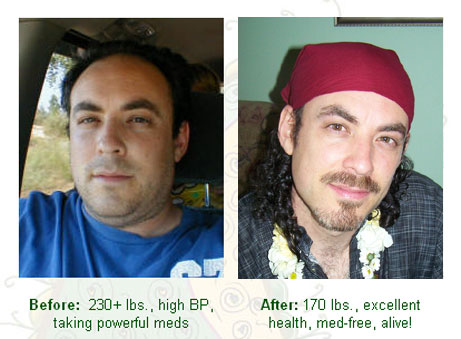
Jim here... Sorry for being away for so long. We've got SO much going on these days, it's mind-boggling! More on that later, as I have something in mind already for today...I should start by clarifying that I've been basically raw for almost 4 years now (high-raw, you might say). During the first nearly-two years, I still ate meat from time to time. Actually, I still ate (and drank) almost everything from time to time -- sugars, processed foods, alcohol, you name it -- only less than I did before, and within the context of a dietary intake consisting of a significantly higher percentage of living foods. In those early years, I'd estimate I was averaging 75-90% raw. Not bad ... I definitely experienced improvements in my health!
 The big change in consciousness didn't follow until two years ago. (This is an interesting point because, as you can see, I wasn't "ready" for a bigger change for two years into eating a lot of raw foods!) I suppose the difference was that, during the early years, I was pretty much raw by default rather than by conscious decision. As Jules said in Pulp Fiction, "... my girlfriend's a vegetarian. ?Which more or less makes me a vegetarian..." Yeah, that was my case back then, too, although I certainly grew into it (and am thankful that I did).
Read more: Reflecting on Two Years of an Exclusively Raw Die

Jim here... Certainly, we're all familiar with the old saw, "You can lead a horse to water, but you can't make him drink," right ? So often, the life of a raw foodie is perfectly captured by that saying. We are, of course, the ones leading our equine brothers and sisters to the sweet trough of raw foods, just as others coaxed us into the barn for our first drink.
Have You Been Led To This Post ??
So, what is this post It's a big old horse trough to which, if you're a raw foodie, you can lead others. Or, if you're someone unfamiliar with raw foods, and have been sent here by another, what you'll find below is the water. No one can make you drink it. And, please don't be offended at my comparing you to a horse because (1) we're all horses, (2) this is all just my strange opinion, and (3) horses are beautiful, magical beings! Being compared to a horse is a compliment!

To help keep all of you inspired, we ve asked some
remarkable individuals to share their raw food stories with you. Enjoy!