Know Any Literary Animal Lovers?

Hi there PureJeevan readers! We wanted to let you know that Jim's new novel CHROO is available on Amazon. It's a crazy adventure involving a billionaire heiress, her Chihuahua BFF ("Chroo") and a host of human and animal characters. Find out more on Amazon! Here are some links:
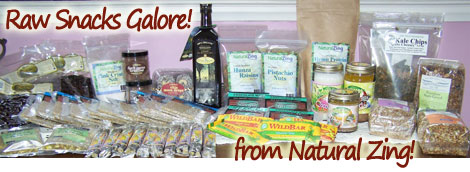
Well, Wendi and our daughter, KDcat, are headed out this evening on a train for their cross-country tour. They didn't seem so sad to leave ... maybe it's because of the bounty they're taking with them! Check it out in the banner above as well as the snapshots below! (I've included a list at the end of many of the products.)
Natural Zing has been Pure Jeevan's favorite online source for all of our raw food supplies. They have been very supportive of Pure Jeevan for over a year, and they continue to amaze us with their love and generosity. You'll be hearing more about Natural Zing during the tour, because they're Wendi and KDcat's official snack sponsors for the trip!

Welcome to Day One of "Dressings Week" here on Pure Jeevan. After finding out that KDcat took it upon herself to film a segment of "Makin' It Monday, Guest Raw Chef Edition," I decided that we should probably spend an entire *week* focusing on salad dressings.
Read more: Makin' It Monday Guest Raw Chef Edition: KDcat Makes Orange Pepper Cilantro Dressing

Jim here... About an hour ago, I purchased $68 worth of ice cream from a local supermarket. Bet you thought you'd never read something like that here, eh ? Well, don't worry -- Wendi and I haven't suddenly decided to binge on dairy products. You see, in my corporate job, I'm often the event organizer; today that meant ice cream gopher.
For some raw foodies, that scenario might seem rather cruel. You may be thinking: Isn't it tough to have to go purchase nine tubs of ice cream, two jars of maraschino cherries, two bags of marshmallows, four containers of flavored syrups, two cans of whipped cream, and numerous boxes of waffle cones ? No, it's not cruel at all. To me, it's now the same as running out for, say, office supplies.
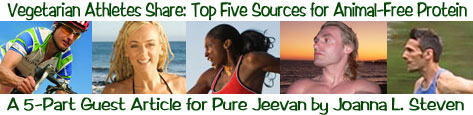
In this special five-part series, Joanna Steven uncovers where some top vegetarian athletes get their protein. Here's part three, focusing on Robert Cheeke's take on this issue.
YELLOW PEA POWDER
In the spring of 2005 this natural body builder became a champion bodybuilder - all on a strict? vegan diet. Robert Cheeke, an activist/athlete raised on an Oregon farm, went vegan when he was 15 years old and transitioned to full on vegan only two months later. Winning titles in Portland, OR and competing at the Natural Bodybuilding World Championships held in California, Robert maintains his intense mass building workout regime on a 100% animal-free diet.
Read more: Vegetarian Athletes Share: Top 5 Sources for Animal-free Protein (Part 3 of 5)
You thought our "Know Your Food" series was dead ?!!? (Or, if you're a new reader, maybe you don't know what "Know Your Food" is yet!) Well, we've been poking around in the archives this week and discovered THREE lost episodes. This is HUGE... It's like one of those stories you hear every few years about some rare Hollywood film being discovered in a vault somewhere (laughing so hard)!
Over the next week or two, we'll be posting these three episodes. Today's episode is PUMPKIN, starring Wendi and her guest Ella (daughter of Melissa and Dave, who run the FoodUnderFoot blog we linked to recently). Once these missing episodes have been aired, this will usher in the dawn of a never-before seen level of production values for the Know Your Food series. The new stuff will totally win every major award available to YouTubers (continues laughing...).
Sure, we know pumpkins aren't in season right now. However, this video is sweet because of our special guest. So, enjoy the Pumpkin episode:


On this beautiful May Day, I am thankful for creativity. We all have a creative ability within ourselves to imagine all kinds of things.In yesterday's post, about asking myself questions in order to make changes in my life, I talked about having an image in my mind of how I wanted my life to be in the near future. I was using my creative abilities to see my future as happy, vibrant, and healthy.

It's nice to meet new people, isn't it? For today's Take the Time Tuesday, I'd love for you to meet someone who's really helping to make a difference in the raw food world in an exciting way.
Take the time to meet...
Sorry for the strange behavior of this site over the past few weeks, friends. As a former professional web programmer, and always a?bit of a mad hacker, I'm usually really great at keeping the web end of Pure Jeevan running very smoothly.
But, this is a Wordpress blog -- and so you have things like plugins and widgets and themes and updates, all interacting (and sometimes conflicting) with one another. I've noticed lately that this blog home page has developed all sorts of peculiar issues, not the least of which is a very slow-loading tendency.
Read more: Hopefully Pure Jeevan Loads a *Little* Faster Today!

When I first decided to try a raw food diet again (I had sampled it for about three months a few years before going completely raw), I wanted to do it in a way to prove that it either does or doesn t work. The best way to do that, I figured, was through consistent blood tests. So, that s what I did. I have continued to document my path to health with regular blood tests. Many of you know that the results have been remarkable. My dramatic shift in weight is the most obvious to others, but there were equally impressive changes going on inside my body, as well.
It has been about a year since my last blood work was done, so I knew I should schedule an appointment to get the testing done soon (since I want to keep the tests somewhat yearly). I tend to always put the testing off, however. As much as I m curious about the results, the truth is that I m terrified of needles. Over the past few months, I was continuing to put this yearly testing off, but something has spurred me to get it done sooner than later.
Read more: Raw Food and Measurable Health: Does Wendi Have Lyme Disease?
It's been an interesting week for us here. We've looked at a handful of ways that people may either become obese, or sustain an obese body -- all largely for reasons outside of dietary intake. The three situations we looked at included maintaining weight as a defense mechanism (Tuesday), becoming obese through worrying about becoming obese (Wednesday), and obesity as basically a physical manifestation of a non-physical longing (Thursday).
Without a doubt, these are just three out of hundreds of possible non-physical contributors to poor health. The idea was merely to start a thread on these things, opening people's minds to possibilities that perhaps they'd never seriously considered.
***** DISCLAIMER: As with all of our posts here at Pure Jeevan, and particularly those coming up over the next week and a half (which will all be tagged with a new term, "Nadi Balance"), please refer to the disclaimer that runs at the bottom of all Pure Jeevan Pages. Wendi and Jim are health researchers, educators, and extreme self-experimenters; not doctors. ******
Nadi Balance: Part III
 To summarize yesterday's post, even though this sounds dramatic, the truth is: Wendi was dying. The first doctor essentially sent her home saying there was nothing wrong. The second doctor confirmed she had Lyme disease, but was too late for his method of healing, since the Lyme had already become chronic at that point. He could only offer understanding of her situation and a trial and error method of conventional medications, which rarely (if ever) heal Lyme patients. A supplement that many raw nutrition gurus recommend as essential to health for all people was actually putting Wendi's body, already struggling with Lyme bacteria, into an extreme state of distress. And finally, our own knowledge of health, diet, and healing (even though extensive and accumulated over 30 years) wasn't adequate for healing Wendi's body of Lyme, either.