Know Any Literary Animal Lovers?

Hi there PureJeevan readers! We wanted to let you know that Jim's new novel CHROO is available on Amazon. It's a crazy adventure involving a billionaire heiress, her Chihuahua BFF ("Chroo") and a host of human and animal characters. Find out more on Amazon! Here are some links:

I need fast & easy meal ideas (esp. breakfast & dinner) -- time is a luxury I don't have (taking 18 college credits, internship, PT job and I started a natural perfume business!). By the end of the day I am so exhausted that I'd rather not eat than go in the kitchen & try making somethin raw.
If you're dealing with exhaustion or fatigue, we'd like to direct you to a recent blog post discussing the subject. As for time being a luxury, we address that, as well, in the same post. You'll always hear the same thing from us about limited time in relation to your diet: Make the time! Your overall health is what's most important in life and it's imperative that you arrange your life so that you have plenty of time to not only prepare healthy meals, but to also eat them in peace without feeling rushed.
With that said, it's also important to realize that eating healthy doesn't need to take hours out of your life. There are plenty of raw food recipes that are not only quick and easy, but also packed with nutrition! We'll share, below, some links for some of our favorite recipes that are quick, easy, nutritious, and delicious! These recipes are located here on our blog.
Here's Wendi in Portland interviewing Wes Hannah, one of the owners of Blossoming Lotus, a vegan restaurant that also serves a lot of delicious raw foods. Wendi said it's worth a trip to Portland just to eat there!
[Sorry about the video quality there. I was having some trouble editing this on an old machine. Wendi took the good one with her on the trip!]
Read more: Wendi Interviews Wes Hannah of Blossoming Lotus Restaurant

We just returned from the East End Food Co-op, where we answered raw food questions for two hours. We were still answering questions on our way out the door, and would have stayed longer but the place was closing. ;-) So, if anyone from this evening stops by our site and you still have questions, just comment here (or send me an email) and I'll be happy to answer them.
I'm more of a one-on-one kind of person, so I was a bit nervous about sitting in front of everyone to answer questions. Jim and KDcat were there to help me, of course, otherwise I probably wouldn't have been there at all. Once people started arriving, I was comfortable. The first people who entered the room were super sweet and I could tell they were genuinely nice people. Then little by little the room filled up, and I was surprisingly comfortable.Maybe in addition to all of the other positive changes in my life, my self confidence is getting better, too!
Jim here... I thought it might be interesting to spend the rest of this week looking at some quotations we've come across that discuss obesity entirely outside of the context of diet. ?While these quotes focus on obesity, it's likely (in my opinion) that the authors' intentions pertain to almost any health challenge (obesity or otherwise).
Today, we're going to quote a well-known author, Marion Woodman. Tomorrow, we'll hear from Rhonda Byrne, Thursday Dr. Gabriel Cousens, and Friday I'll recap with something I posted on Facebook a while back from Tony Robbins.It should be an interesting week -- and, by the way, I'll tie all of this back into raw foods on Friday, and discuss then why the raw food diet makes a lot of sense for healing obesity and other health challenges even if, as these authors imply, one's diet may not be the sole or ultimate cause of one's health challenges.

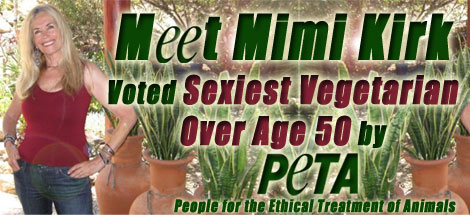
Today for "Take the Time Tuesday," we'd like you to take the time to meet Mimi Kirk, whom many of you may know as the winner of PETA's "Sexiest Vegetarian Over 50" contest last fall. If you're interested in longevity, and how diet influences the way we look, act, think, and exist, then you'll definitely want to listen closely to what this vibrant woman, who is 71 years young, has to say. We spoke with Mimi for nearly an hour this weekend, and are happy to share her inspiring interview with all of you. Below, you can listen right here, or download a podcast MP3 version.
Just a quick notice that we've posted our December 2009 newsletter. Each month, we email a link to our newsletter to all Pure Jeevan family members. (If you're not receiving that, you're mising out on a ton of awesome raw inspiration and information. You can click here to sign up -- it's free!)
We'll be back tomorrow to continue our coverage of the Chicago raw food scene. As I've been saying for a few days now, you won't want to miss these great interviews!?

Let's have a bit of fun today here on the blog. All week long we've been focusing on brain health and minimizing our chances of developing memory loss as we age. So, how sharp is *your* brain right now? What can you remember as the key highlights of ways to increase memory, ways to eliminate memory loss? What else can you remember reading over the past week here on Pure Jeevan's blog about having a sharp mind?
Share your resp0nses in the comments (and don't read those left by others until you've left your own!).
Pardon the video quality there. A.J. and I shot that video at night and, although it looked decent on the camera's preview screen, the actual video came out almost totally black!? However, with a bit of video processing, we were able to salvage it. It's not optimal video, but it's at least watchable (and, hey, also conveys a little of that nighttime festival feeling).
A quick note about veganism before I share some additional info... As we've stated here many times, Pure Jeevan advocates a raw vegan lifestyle. What do we intend that to mean, exactly? Well, strictly speaking, veganism excludes all animal products, both in terms of diet and lifestyle.

Every day I receive countless emails filled with questions about the raw food diet, my own success with reducing nearly 100 pounds and regaining health, and pleas for help by many who feel like they've hit bottom and there's no way up. Some emails have me in tears, because I can completely relate to what many of you are going through. I feel your pain, frustration, desperation.
One thing I've always been good at is listening, truly listening to what others are saying (and being an empath allows me to know what some are saying, even when they many times aren't verbalizing it). Another thing I've always been good at is intuitively knowing how to help others who are asking for advice. Jim used to joke that he wanted me to go into business running an advice column because ever since he's known me, I've been the person everyone comes to for help and advice. So, when I receive so many emails asking for help, it feels natural for me to reach out and connect with those needing help. It's what I do best well, that and spreading love!

The superlatively captivating, one-and-only Bif Naked has been a superstar rock and roll icon, performer, diva, composer, acclaimed actress, sought-after voice-over artist, gifted poet / writer, and even cartoonist(!) for years. But, did you know she's also a raw vegan !
Early in 2009, I remember reading about her breast cancer diagnosis. The story both intrigued and haunted the raw world: ?How could a raw foodie get cancer ! We're supposed to be impervious to such things, right !
Read more: Rawk and Roll: An Interview with Multi-Platinum Raw Rocker Bif Naked
Jim here... Exactly one month ago today, I announced my intention to do a month-long trial of a low-fat raw vegan protocol largely based on the well-known 80-10-10 diet. I posted a half-way point update on May 15th, and now here we are at June 1st already. So, are you ready for the thrilling conclusion
As I've stated before, I went into this experiment rather hard-core, with one full week of zero overt fats, and then gradually introducing a few richer ingredients (although keeping within the 10% fat ceiling). I found much of the past month to be an exercise in restraint and self-control, similar to the issue many people face when going raw while the rest of the family is still eating cooked foods.However, it got significantly easier as time passed.
Read more: Jim's Low-Fat Raw Vegan Month Concludes. Now What?!