Know Any Literary Animal Lovers?

Hi there PureJeevan readers! We wanted to let you know that Jim's new novel CHROO is available on Amazon. It's a crazy adventure involving a billionaire heiress, her Chihuahua BFF ("Chroo") and a host of human and animal characters. Find out more on Amazon! Here are some links:

To help keep all of you inspired, we ve asked some
remarkable individuals to share their raw food stories with you. Enjoy!
Okay, so here's a recipe that may make you raise an eyebrow. "Baked " "Rice " Well, it's not really baked and there isn't really rice in it, but it tastes like a baked rice and veggies dish! I created this one day by mistake and we all loved it.
Baked Rice and Veggies
2 cups pureed sunflower seeds

On March 1st we started a Juice-a-Day Jamboree, to challenge ourselves (and our readers) to include more fresh juice into our diets. We knew we weren't ready for an all-out juice feast, but a juice a day seemed like something we could commit to in our daily lives. So, the Juice-a-Day Jamboree was born. We've been posting periodic updates on our original post about the Jamboree, but figured we'd post periodic juice updates in the main part of our blog, as well, to encourage others to add some more fresh juice to your diets, as well.
We've missed one day of juice since we started the Jamboree. Our original goal was to have our juice first thing in the morning, but we weren't always successful with that. So, we told ourselves that any time of the day is fine, but if we can start the day with a juice we'd prefer it that way. The changes we've been feeling are more pronounced when we begin the day with fresh juice, rather than when we have our juice later in the day.
 ?
?
Well, it's nearing the end of 2009, and I've been unwell for half of the year. (To make a positive statement out of that, I'll add that I've been well for the other half!) It's hard to believe so much time has gone by and about half a year of my life was spent in pain, tears, and sometimes fear (mostly in the beginning of the lyme disease). I'm definitely looking forward to the new year, to leaving this disease behind me while taking the lessons I've learned with me into 2010.
As many of you know, I was very proactive in finding a "cure" to the disease as soon as it was identified. I tried allopathic remedies (antibiotics for about three months), alternative remedies (herbal protocols, vitamin/mineral/supplemental protocols, aromatherapy techniques, healing massage, hands-on-healing, water fasting, prayer/meditation/positive visualization), and so much more. Nothing completely cured my body from the lyme bacteria that seems to have spread throughout my body and found favorite spots to multiply (particularly in my shoulders and arms).
Read more: Wendi's Health Update: Cooked Food Experiment and Great News!

I started jumping up and down last night with excitement when I received a call saying that the bellydancing class I've been wanting to take at Khafif Studios has an opening! Yay!!!

(This will be my teacher, Berna!)
To keep all of you inspired while we are away, we've asked some
remarkable individuals to share their raw food stories with you. Enjoy!

It's day three and all is going okay. I seem to have a bit more energy since it's not all being sapped trying to digest complex meals. The last time I did mono mealing, I received countless emails from Pure Jeevan members who were concerned I was doing something unhealthy. Eating simply for nine days, however, is not unhealthy.
 Did you know the body doesn't need a full range of vitamins and minerals at each and every meal? Somehow many of us were taught that each meal needs to be a complete balance of vitamins, minerals, proteins, fats, carbohydrates and that just isn't the case. What the body needs is a well-rounded diet, overall, to be in a balanced state. If, over the span of a month or two, you've consumed a variety of fruits, vegetables, nuts, seeds, and sprouts you will find that you've met just about all of your nutritional needs.
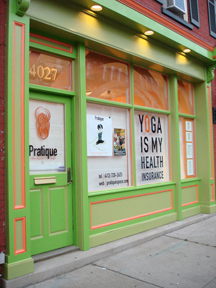 This morning as I was driving from the beautiful Carnegie Mellon University campus to a business meeting outside the city, I had to take a detour at one of Pittsburgh's many bridges. It was a little frustrating because I had hoped to arrive at my destination early enough to grab a green tea at a coffee shop. But, these little delays happen. I'm glad this one did, though, because I soon passed a small yoga studio (called Pratique) where an interesting window decal hangs. It reads: "Yoga is my health insurance."
Many kudos to the clever people at Pratique who apparently crafted this catchy and spot-on message. While this is a raw foods site, not a yoga site, the message is equally apropos here. It essentially means, in my view, that we all have the opportunity to profoundly affect our own health and well being.
In our family, we're currently facing the realistic prospect of taking a literal approach to this concept, dropping formal health coverage! Quite literally, we feel that maintaining a health plan is (almost) a complete waste of money. I'm not posting this to start a debate as to whether those who follow a healthy diet should or should not buy into a plan. (I know all of the related arguments already: Yeah, but what if you cut your arm and need stitches Save that for Facebook or, at least, some other time.) I'm more concerned with reiterating one of our key messages here at Pure Jeevan -- our unwavering ?conviction that physical health and diet are tightly connected. Wendi knows this, I know this, our child knows this, YOU know this... But why doesn't everyone acknowledge it?

 EVERYONE LOVES RAW TACOS!!! So, this week, we're going to show you FOUR "Makin' It Monday" videos instead of just one. These were filmed in Berkeley, CA, at our dear friend Carolyn's apartment. We hope you love these recipes. We actually eat raw tacos quite regularly -- especially when tomatoes are in season.
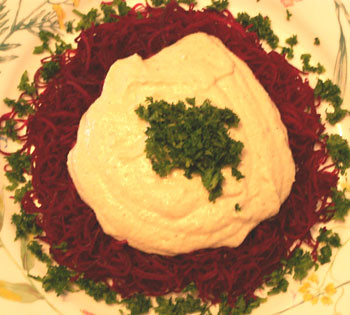
The mono meals ended and I did create that beet pasta with alfredo sauce that I was dreaming about. So, here's the recipe:
BEET PASTA
Jim here... "Do I Need to Eat a Certain Percentage of Raw Foods to Call Myself a Raw Foodist " This seems to be a common question among some people interested in pursuing a raw and living foods lifestyle. I fielded such a question recently online, and thought I'd recap my own answer here, somewhat edited for enhanced clarity:
I know what raw foodism means. And, if you're here, you probably do to, or at least you're interested in it and know the basics. But, to the mainstream population, raw is absolutely unheard of, totally out of the box -- relatively speaking. So, let's begin by taking a look at who in the world has potentially heard of RAW. Let's start more broadly and then hone in.
Read more: Do I Need to Eat a Certain Percentage of Raw Foods to Call Myself a Raw Foodist?