Know Any Literary Animal Lovers?

Hi there PureJeevan readers! We wanted to let you know that Jim's new novel CHROO is available on Amazon. It's a crazy adventure involving a billionaire heiress, her Chihuahua BFF ("Chroo") and a host of human and animal characters. Find out more on Amazon! Here are some links:

?
In this video, Wendi talks with Leela Mata about the different branches of yoga and how diet and raw foods affect the practice of yoga. Of all the branches of yoga, Hatha Yoga is the most popular in the United States.Mata Ji explains that it is through the practice of Hatha Yoga, strengthening the body through the asanas (poses), that you awaken on a deeper level. You will become more open to connecting with your spiritual nature, to realizing more about yourself.

Yesterday's smoothie was superlatively tasty, eh? It was clearly something out of Elvis' more energetic younger years, I think. You're probably wondering: "How does one follow an Elvis smoothie?!" I know ... it'll be tough to do.
Read more: Protein Powder Smoothies Part 3 of 3: The Donald Smoothie

Jim here... Certainly, we're all familiar with the old saw, "You can lead a horse to water, but you can't make him drink," right ? So often, the life of a raw foodie is perfectly captured by that saying. We are, of course, the ones leading our equine brothers and sisters to the sweet trough of raw foods, just as others coaxed us into the barn for our first drink.
Have You Been Led To This Post ??
So, what is this post It's a big old horse trough to which, if you're a raw foodie, you can lead others. Or, if you're someone unfamiliar with raw foods, and have been sent here by another, what you'll find below is the water. No one can make you drink it. And, please don't be offended at my comparing you to a horse because (1) we're all horses, (2) this is all just my strange opinion, and (3) horses are beautiful, magical beings! Being compared to a horse is a compliment!
***** DISCLAIMER: As with all of our posts here at Pure Jeevan, and particularly those coming up over the next week and a half (which will all be tagged with a new term, "Nadi Balance"), please refer to the disclaimer that runs at the bottom of all Pure Jeevan Pages. Wendi and Jim are health researchers, educators, and extreme self-experimenters; not doctors. ******
Nadi Balance: Part III
 To summarize yesterday's post, even though this sounds dramatic, the truth is: Wendi was dying. The first doctor essentially sent her home saying there was nothing wrong. The second doctor confirmed she had Lyme disease, but was too late for his method of healing, since the Lyme had already become chronic at that point. He could only offer understanding of her situation and a trial and error method of conventional medications, which rarely (if ever) heal Lyme patients. A supplement that many raw nutrition gurus recommend as essential to health for all people was actually putting Wendi's body, already struggling with Lyme bacteria, into an extreme state of distress. And finally, our own knowledge of health, diet, and healing (even though extensive and accumulated over 30 years) wasn't adequate for healing Wendi's body of Lyme, either.
I have a need for hot food in winter to feel warm.
We hear this comment a lot from those trying to lose weight. Some joke that they thought their excess body fat would be keeping them warm, but they're still feeling cold and needing hot food in the winter months.
In the past, we've talked about reasons what's going on in the body when hot foods are consumed. Understanding this will help you realize that hot foods are actually not very good for our bodies. When we consume very hot foods, that heat is then inside our bodies, next to vital organs, while the body needs to maintain a temperature around 98.6 degrees. When we have temperatures higher than that right next to our vital organs, it must quickly work to remove that excess heat. It's the removal of this excess heat that causes us to feel warm. It's our bodies trying to stay in a healthy state. We are actually putting our bodies under stress when we do this (the same holds true for eating overly cold foods, like frozen desserts and icy drinks).
Short post today... We're currently dealing w with a pesky kitchen drain issue that's wreaking havoc in our household. Fortunately, a very talented and power-tool-weilding local plumber just fixed the problem. In the process, he seems to have applied those power tools to our bank account -- $175 for less than one hour's work!? (Ouch!) And the kicker is that the current state of our kitchen is "absolutely atrocious."? I'm serious... we're at like DefCon 5 in terms of the disastrous nature of that room -- and as you well know, for a raw household, that's probably 10 times more frustrating than it is for others. (I smell a whole post coming soon on this topic ...)
Today, we mainly just wanted to say that, at the end of our post yesterday, we briefly asked what you would like to see more of here at Pure Jeevan. We have received some great comments and emails in return, and have decided to devote tomorrow's post to responding to / addressing some of the suggestions we received. So, if you have any further thoughts to share about raw foods content you'd like to see more or less of, please let us know either by commenting below, or by email. Wendi is at WendiDee [at] Pure Jeevan.com. Jim is at Rawdiant [at] gmail.com.
Beginning today and running all through next week (and even spilling into the following week!), we'll be running videos from the Raw Spirit Festival (RSF East 2009) held in Upper Marlboro, MD, last weekend. If you've never attended a RSF event, you absolutely must. They're the best ever!
I like this "travelogue" format, so let's continue! Here's Wendi's comments from their adventures in San Luis Obispo, checking out the raw vibes along the CA Central Coast!
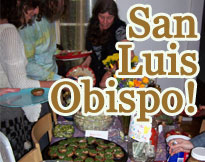 After a very active visit in the San Francisco / Berkeley area, we headed down the coast to San Luis Obispo, CA. There's a pretty active raw food meetup there and we were asked to stop in their town to give a talk to their group.
It was a nice drive south, but the sun is a bit brighter than we're used to (especially when driving long distances). When we arrived in the town, we were overcome by the beauty of the place. It's one of the most beautiful places we've seen in California, so far!
Read more: The Friendly, Mellow, Raw Groove of San Luis Obispo
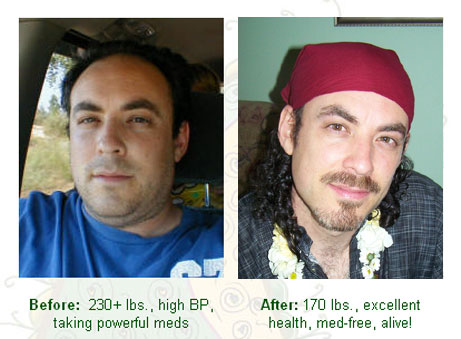
Jim here... Sorry for being away for so long. We've got SO much going on these days, it's mind-boggling! More on that later, as I have something in mind already for today...I should start by clarifying that I've been basically raw for almost 4 years now (high-raw, you might say). During the first nearly-two years, I still ate meat from time to time. Actually, I still ate (and drank) almost everything from time to time -- sugars, processed foods, alcohol, you name it -- only less than I did before, and within the context of a dietary intake consisting of a significantly higher percentage of living foods. In those early years, I'd estimate I was averaging 75-90% raw. Not bad ... I definitely experienced improvements in my health!
 The big change in consciousness didn't follow until two years ago. (This is an interesting point because, as you can see, I wasn't "ready" for a bigger change for two years into eating a lot of raw foods!) I suppose the difference was that, during the early years, I was pretty much raw by default rather than by conscious decision. As Jules said in Pulp Fiction, "... my girlfriend's a vegetarian. ?Which more or less makes me a vegetarian..." Yeah, that was my case back then, too, although I certainly grew into it (and am thankful that I did).
Read more: Reflecting on Two Years of an Exclusively Raw Die

So far, so good, with the mono-meal fasting for Navratri! I mentioned that I'll be sharing an almost diary-like blog entry at the end of each day, to share things with all of you. Well, today's diary entry is quite long. I do share a lot about what was going on with me before the fast, and why I haven't been around much online to connect with all of you.
How's everyone else doing? Are you enjoying your raw food journey? What have you been learning about yourselves, your bodies, and your overall health?


When we found out that there was a raw foods restaurant in Key West, we knew we'd visit for sure. So, after a wonderful lunch of some of their raw staples (raw tacos and peanut noodles), it was no surprise to us that we found ourselves drifting back toward Help Yourself after the sunset celebration at Mallory Square (the main nightly Key West sunset viewing celebration). When we arrived, we asked to interview the owner, Charlie Wilson. She'd just left after working a very long day at the restaurant. But, an emplyee called her anyway and she graciously agreed to come talk with us! So, here's a bit of that conversation:
Read more: The Key West Raw Scene: Pure Jeevan Gets Up-Close and Personal with Charlie Wilson!