Know Any Literary Animal Lovers?

Hi there PureJeevan readers! We wanted to let you know that Jim's new novel CHROO is available on Amazon. It's a crazy adventure involving a billionaire heiress, her Chihuahua BFF ("Chroo") and a host of human and animal characters. Find out more on Amazon! Here are some links:
?
Jim here... A few months ago, I'd posted an article here on the topic of Cognitive Dissonance. This theme seems to crop up from time to time in questions people ask about the raw foods lifestyle. For example, one new raw fooder recently posted a question in a raw foods forum asking whether other raw foodies had reached a place in their lives at which things changed so much that they felt as though they were living a contradiction. Because this struck home for me, I'd like to reiterate my response, somewhat edited, below.


 Day 8:
Let's focus on creativity for a bit. This is an area where many men have been comfortable expressing a feminine quality, especially when done through art and music. I say many, because we all know at least a few men who were raised to believe that a strong, powerful man doesn't spend his time with such frivolous things. Instead, he works hard to earn an income to support his family. In the past, and still sometimes today, creative men were viewed as weaker and less masculine, not practical and in control. The feminine quality of creativity was, however, encouraged in women who were afforded more time for such "frivolity."

It's day three and all is going okay. I seem to have a bit more energy since it's not all being sapped trying to digest complex meals. The last time I did mono mealing, I received countless emails from Pure Jeevan members who were concerned I was doing something unhealthy. Eating simply for nine days, however, is not unhealthy.
 Did you know the body doesn't need a full range of vitamins and minerals at each and every meal? Somehow many of us were taught that each meal needs to be a complete balance of vitamins, minerals, proteins, fats, carbohydrates and that just isn't the case. What the body needs is a well-rounded diet, overall, to be in a balanced state. If, over the span of a month or two, you've consumed a variety of fruits, vegetables, nuts, seeds, and sprouts you will find that you've met just about all of your nutritional needs.
I was standing in line at the grocery store the other day and plopped a package of chicken wings up onto the conveyor belt. The cashier made some sort of smalltalk -- I think she asked whether I liked wings -- which prompted me to say, "Oh, the chicken is for my dog, Julia."
She looked at me, eyebrows raised. "For your dog "

In Part 5 of this 5-Part series, Wendi talks with Leela Mata about meditation and diet. After discussing what meditation is and why people practice it, Mata Ji talks about diet and its effects on the mind. She then gives a brief explanation of how to meditate for those who are new to the practice, and demonstrates how to use a simple mantra (word or phrase) to aid in entering a meditative state.

Who's been making small changes and feeling a bit brighter lately, since we've been talking about brain health? Today, let's continue focusing on some things we can actively do to minimize our chances of developing memory problems like Dementia or Alzheimer's in the future.
Yesterday we focused on heart-healthy tips to increase brain function (since heart disease seems to be linked with Alzheimer's) and I shared a heart-healthy recipe with you. Today, we'll focus on inflammation.
Read more: Extinguish Inflammation: Anti-Inflammatory Recipe

Finally, some super news to share!? On Monday, after a l-o-n-g wait, Wendi finally had her appointment with a actual LLMD. (That stands for "Lyme Literate Medical Doctor."? If this and the news of Wendi's Lyme Disease is new to you, check out this post.)
I'll cut straight to the good part: Her prognosis is excellent! Yes, she's still in a world of pain and misery at the moment, but he believes (based on her blood work and her symptoms) that we've caught this early enought to fully eradicate the Lyme. (At least, that's how I understand it. I'm actually not clear on whether Lyme is ever 100% eradicated, or if it's just forced into dormancy or irrelevancy. Perhaps Wendi can clear that point up later.)

The way your smile just beams
The way you sing off-key

We began this series with one possible psychological explanation of obesity, moved on to a possible philosophical explanation, and will now cover one that could be both of those, or could find classification within the emotional and/or spiritual realms. ?Wendi has often told me of hearing Dr. Gabriel Cousens speak in Sedona, Arizona, a few years ago. One remark in particular stuck with her. This may be a slight paraphrase, but Dr. Cousens said:
"There's never enough food to feed a hungry soul."
As we all know, physical hunger happens when our bodies need food -- when our stomachs are literally empty and aching for fuel to sustain our life. But, what about non-physical types of "emptiness"? Surely, we experience a kind of hunger in these cases as well.
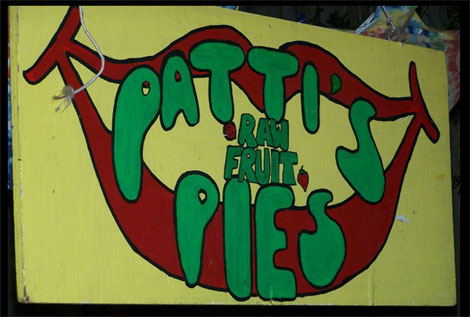
Over the weekend, we visited the spectacular Oregon Country Fair in Eugene and, once again, experienced a joyful and overwhelming sense of recognition that we're living in a place where people are much more accustomed to just being themselves.
Personal expression and nonconformity are so valued here that one becomes quickly enamored of the whole ambiance, which could well explain why more people come to Oregon than leave. The region seems to represent, to many, a chance to finally discover and explore an identity perhaps not completely free from outside influence, but at least free from the undesirable influences that society elsewhere seems to insist upon. Or maybe I'm misreading it all and providing just one of many interpretations.

In a previous Take the Time Tuesday entry, we introduced you to three fantastic raw food snack companies who have offered to donate samples of their products for our upcoming retreat. If you haven't heard about the 3-Day Raw Food Spiritual Retreat, yet, there is still some space for you to join us from May 23-25, 2008! We ve set this retreat up so that it s as affordable as possible. There s a significant savings if you sign up early, too, so be sure to check it out!
Each individual attending the retreat will receive a gift basket filled with delicious raw food treats from some truly fantastic companies. Keep an eye on the retreat page to see other companies that will be sharing delicious raw food snacks with those attending the retreat! Today, we'd like you to...