Know Any Literary Animal Lovers?

Hi there PureJeevan readers! We wanted to let you know that Jim's new novel CHROO is available on Amazon. It's a crazy adventure involving a billionaire heiress, her Chihuahua BFF ("Chroo") and a host of human and animal characters. Find out more on Amazon! Here are some links:


Welcome to Day One of "Dressings Week" here on Pure Jeevan. After finding out that KDcat took it upon herself to film a segment of "Makin' It Monday, Guest Raw Chef Edition," I decided that we should probably spend an entire *week* focusing on salad dressings.
Read more: Makin' It Monday Guest Raw Chef Edition: KDcat Makes Orange Pepper Cilantro Dressing
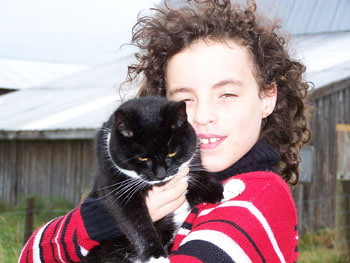
You rarely hear us talk about our daughter here on the blog. Some of you have noticed and asked questions about her through email. I'd like to tell you why we don't write about her very much, because there's something to be learned from it.
First, I usually don't like to write about people unless I get their permission. This is especially true when my daughter is concerned. I respect her privacy if she chooses for me to not share things about her life. Years ago when I knew I wanted to create the Pure Jeevan site, I talked with Jim and our daughter about it. I said it was something I felt drawn to do, that I felt it could help a lot of people, but I wanted it to be a family site if it's something they were interested in doing along with me. Jim agreed to help me at the time, but didn't fully embrace Pure Jeevan himself (now, however, he has become a very active part of this site and all of our projects). Our daughter, however, said from the very beginning that she didn't want any part of it.

Q: How Long Do Smoothies Last?
I responded to a similar question a while ago in an online forum. This issue comes up a lot, acually, so I figured I'd provide our response here on the blog rather than simply through an email reply. Here's that response, reworked a bit for our blog:
Optimally, I suppose we'd all just eat things whole, most of the time, instead of blending/juicing ...
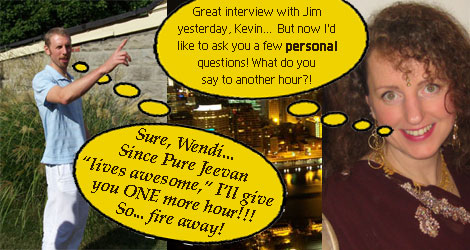
So, did you like Part One yesterday ? Pretty great, right ? Well, today we present Part Two, in which Wendi takes the interview into a more up-close and personal place. In this audio, Kevin shares details about:
-
the first interview he ever conducted
-
what he wanted to be when he grew up
-
what his family thinks of his raw lifestyle
-
his tattoo, Joseph Campbell, and thoughts on life and death
-
spirituality, religion, and guilt
-
the book that opened his mind to a deeper connection
-
running and spirituality
-
his typical day / routine
-
his business expanding
-
what "systems" are and how he uses them
-
the shocking truth about his teen years
-
recent personal development programs he's listening to
-
"taking 1%, applying it, and moving on"
-
mentors and influences
-
the books that shaped his life
-
making shifts in friendships
-
his thoughts on "The Secret"
-
whether he thinks he can do more push-ups than Gabriel Cousens
-
why there was a donkey at his wedding
-
his biggest wish (it's a beautiful one!)
So, what are you waiting for ? Listen NOW!!
Read more: Part *2* of a 3-Part Series Profiling the Multi-Talented Kevin Gianni!
Today I'd like to do something different for Makin' It Monday. I'll tell you what we've eaten today, but I want to hear what's been happening in YOUR kitchen!
This morning I sliced up three bananas, drizzled them with some agave, sprinked a bit of Himalayan crystal salt on them, and then topped them with hemp seeds and sprouted flax seeds with cranberries and gogi berries. I love this breakfast because it feels like I'm eating something a bit complex and more filling than simply eating the bananas plain (which is how I almost always eat them). KDcat had a bowl of oatmeal (not raw), and Jim had a few pieces of fruit.
Read more: Makin' It Monday: What's Happening In YOUR Kitchen?
Welcome to Makin' It Monday, Guest Raw Chef edition. Today, Dave Sokulski of www.BirchCenter.com and www.FoodUnderFoot.com gets a little silly while making some delicious raw cacao treats! Enjoy the video:
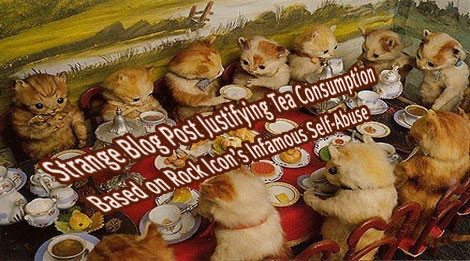
Jim here... Okay, the title and graphic, above, may be a bit silly, as are a few of the remarks I made in the video, below. But, within this rather odd piece a few hopefully noble and economical ideas exist -- especially the ridiculously simple and obvious notion about reusing glass beverage bottles. I'm embarrassed to have lived on this planet for so long and not to have adopted this fun and environmentally friendly practice much sooner.
 We really do take things like glass containers for granted, when we probably shouldn't. Their ubiquity aside, it still takes a fair amount of energy and resources to make a single glass bottle. On the mass scale that they're made, they're obviously super cheap. But, if you had to start from scratch, it would take ages to make a single one, so we should at least appreciate them more and do all we can to make their continued existence as sustainable as possible.
Read more: If Keith Richards Is Still Alive, Then Can I Have a Little Tea?

Hi there, everyone!
We've been getting a lot of emails and comments about two subjects since we posted our itinerary, so we thought we should respond in a way to help answer the questions/concerns that maybe more of you may be having as well.
Note: This entry is not meant for our regular readers. Search engines are directing people to our page when they enter "mono and headaches" and I want to take this opportunity to reach out to those who may not know about this amazing lifestyle the rest of you already know about! ;-) Plus, I want to help them with their headaches.
Mono and Headaches: Looking for Help
Mononucleosis (Mono) is a common viral illness. When children develop mono, it is usually not obvious since it seems like a normal cold. When teens and adults develop mono, however, the symptoms are much more severe. Most individuals will feel better within about three weeks, but fatigue can continue on for about three months! Who wants to feel ill that long? Who wants to feel tired for MONTHS ! Who wants to suffer from such severe headaches ! Not me, that's for sure.

Read more: Mono and Headaches: This Entry is Not For Our Regular Readers

Last night I dreamed of meandering through an unfamiliar cityscape, following some lonely sidewalk next to a river at night, feeling particularly sad and miserable beneath dim yellow street lights. I wore a black suit, carried a highball glass, and was absolutely drunk!
Having crossed the river, I soon realized (even in my dream-drunken state) that I'd been wandering aimlessly. Feeling rather pathetic, I decided to walk back across the river and sober up in a casino that I knew was there. Drunk and depressed, I figured I'd just sit in front of a slot machine for a few hours.

As Pure Jeevan blog readers probably know, we're big fans of running ongoing series. A good blog can never have too many, really. So today we mark the official kick-off of another super series. We're calling these articles "Pure Jeevan Guides."
Guides to what , you may ask. Well, to various topics of interest to raw foodies, of course!