Know Any Literary Animal Lovers?

Hi there PureJeevan readers! We wanted to let you know that Jim's new novel CHROO is available on Amazon. It's a crazy adventure involving a billionaire heiress, her Chihuahua BFF ("Chroo") and a host of human and animal characters. Find out more on Amazon! Here are some links:

Yesterday's post was a little "heavy," don't you think In it, we shared a bit of the stress we were experiencing related to our pending move. There was just so much data to pore through (and yes, we're still feeling that stress)!?
At times like these, it's often good to step back, breathe, and make sure you're not ...well, freaking out -- which makes today's "Take the Time Tuesday" installment absolutely fitting, for we would like you to meet a raw foodie who goes to great lengths to ensure that your "Vitamin L12" levels stay well into the superhero range. Without further adieu, then...
Here's part two of Wendi's travelogue from Sedona:
After leaving ChocolaTree Cafe, and interviewing the lovely Kelly, we went to the famous Sedona Airport vortex spot, but there was no parking, so we drove to the top of the rock/mountain and there was a farmer's market going on. We took a quick video of what was happening up there, to share on the blog. There was a cool musician playing: Vighas Kendzia, who plays piano, native flutes, sax, and more. He's from musicfromthegarden.com and I told him he'd be on our site. So, if you made it here to check out the video, welcome, Vighas! :-)
From there, we headed out to find a vortex spot that Kelly described. I'm not sure if we found the exact spot, but we really enjoyed the place we found. We ate our lunch there and it was DELICIOUS! The water, the trees, the large boulders, the fresh air...it was a very special place. We then drove to one of the more well-known hiking/vortex spots: Bell Rock.The hike in is a bit over a mile, then there is the climbing (which isn't really recommended by the park officials, but it's absolutely necessary to fully experience Sedona!). I gave KDcat some space to explore the area a bit on her own, as this was a very special time for me a few years ago. There is a certain energy and cleansing that happens when visiting Sedona. If any of you are going through changes in your lives, or feel like there is a shift that needs to happen, I highly recommend visiting Sedona for a few days. KDcat felt some powerful personal healing, which didn't surprise me at all. It's a place I'd love to visit every few years, or so, as it definitely holds some sort of healing energy. Maybe it's just the views, or the peacefulness of being away from everything. Whatever it is, I highly recommend visiting Sedona and climbing around on the rocks!
Some of you know about my love of Sedona, AZ, especially those who were following the Pure Jeevan blog a few years ago. It was a visit to Sedona in 2008, for a Raw Spirit Festival, that my life dramatically changed once again. This time it wasn't the food that was healing me, but it was related to the raw food lifestyle. I felt healed on many levels while there in Sedona, surrounded by the beautiful red rocks, cool and sandy earth beneath my bare feet in contrast to the warm sun on my skin, and embraced by a vibrant, loving community of like-minded individuals.
There's a certain magic to Sedona, if you believe in such things (well, I suppose it's there even if you don't believe). ;-) ?For me, I believe that we can many times find scientific reasons to explain much of the magic in this beautiful world, but that doesn't have to diminsh the experiences we have. Sedona is known for its powerful vortex energy, which has a way of stirring up our own energy systems and bringing about healing, balance, awakenings, etc. ?Is this energy measurable through science, or is it more metaphysical in nature? I don't know and to be honest, it doesn't matter to me. There were life-altering changes that took place while I was in Sedona in 2008 which rippled out beyond me and touched the lives of those very close to me, as well.Here's a quick video of a Sedona Farmer's Market and a clip of KDcat and I at an area we claimed to be flowing with vortex energy, even though it wasn't necessarily one of the more touristy vortex destinations.
Read more: Sedona Farmer's Market and Lunch at a Vortex with KDcat

On this Thankful Thursday I am feeling especially thankful for the Internet. Without the Internet I wouldn't be able to learn as much as I've learned about raw foods in such a short period of time. The Internet has connected me with people from all over the world who are also interested in natural health and raw food living. I am part of a larger community, one that would never exist without the Internet.
So, today I am especially thankful for the Internet. What are you thankful for today?
Jim here... I have about 3 free minutes this afternoon to post here, so please bear with me as I type this post as fast as humanly possible. Okay, here's a fascinating video we shot last night. For anyone unfamiliar with live blood cell analysis, definitely check out this video. What they do is take a small drop of your blood (via a painless finger prick) and magnify it like 80 kajillion times. Then, they show you a real-time picture of what's going on in your blood.
Two main points from this:?
April 13, 2008
I noticed that since I ve been eating only mono meals, I seem to be consistently sleeping eight hours a night, as opposed to nine, or more. It s a dreary day today, yet I don t feel like I m tired or down, which is how I normally feel when there s not enough sunshine.
This dish is amazing! We've served it to KDcat's friends before and they gobble it right up!
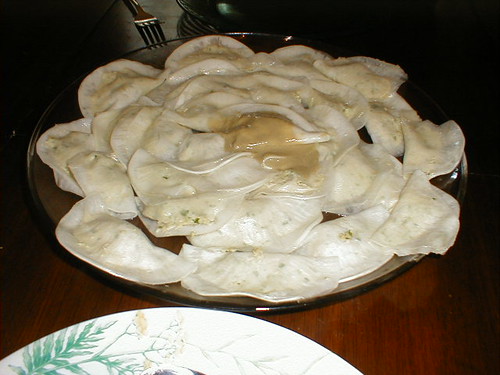
Rawvioli

Two years ago, we were putting the final touches on launching the Pure Jeevan web site and blog. (While the blog archives show material dating back to 2006, the material from '06 and '07 is all pulled from Wendi's "Going Raw" journal, which was kept on another site. We pulled it into this site when we launched it to give those starting out on raw an inside look at one person's experiences in transitioning to a raw food diet.)
?
Wow, it's been four months since we've run an article in our "Produce Buying Tips" series! Well, in today's installment, we want to remind you that our tips don't stop at the grocery store; you want to make sure you store your produce properly once it is at home to keep it fresh for as long as possible. After all, what good is your amazing organic produce going to do you if it goes bad? (That would be some super-expensive compost!)
Since Wendi has a difficult time right now with many motions involving her shoulders and wrists, I've taken over the responsibility of putting our groceries into the refrigerator. (I'm usually the "carry it all into the house" person, and then she likes to put away the refrigerated stuff.) But, wow, who knew so much went into storing vegetables and fruits I had no idea some things required air circulation, while others needed to be kept in sealed bags. Over the years, Wendi has fine tuned a system for keeping our fridge produce as fresh as possible and for maximizing storage time.
Read more: Pure Jeevan's "Produce Buying Tips" Series, #3: Produce Storage
We've got three incredible posts coming your way this week, and we're going to get started right here and NOW with a one-hour interview with the incredible Kevin Gianni. As most of you know, we postponed our RV Tour recently.As part of that, we'd planned to stage a fun event related to the All Raw Directory.We'd planned to air this interview with Kevin (conducted back in December 2008) for that event.
Fast-forward to today and we realize that, like our raw RV Tour, our All Raw Directory promotion will have to wait. It's funny how things trickle down like that. But, all is not lost. This is still an incredible interview -- and guess what ! It's only part one of a two-part interview, as well as a special super-fun surprise we'll be announcing on Friday. We promise: No one in the raw food community will want to miss Friday's post. All we'll say now is that it's a truly unique, limited opportunity unlike anything you've seen here before! Trust us: You couldn't possibly guess what it is!
Read more: Part 1 of a 3-Part Series Profiling the Multi-Talented Kevin Gianni!

Wow, are you in for a treat! I came up with the most delicious soup recipe today! I wanted to make something that didn't require use of the food processor, blender, or dehydrator because I've gotten quite a few emails saying that it's too hard to be raw if you don't have the money for the appliances.
I disagree that it's too hard to be raw without the appliances. It's definitely easier to do it *with* the appliances, but it's not overly hard to do it without. So, from time-to-time I'll try to create recipes that don't use anything more than a knife and a chopping board to show you that it's not too difficult to eat raw. :-)

I am extremely thankful for sleep. I can't imagine striving to sleep only four hours a night. Jim always says he wishes he didn't have to sleep, that he's wasting his life when he sleeps. For me, I've always loved sleeping. I feel so great after I wake up. Not only that, I thoroughly enjoy dreaming. I wouldn't want to miss out on the amazing dream life I've been able to enjoy while I sleep.