Know Any Literary Animal Lovers?

Hi there PureJeevan readers! We wanted to let you know that Jim's new novel CHROO is available on Amazon. It's a crazy adventure involving a billionaire heiress, her Chihuahua BFF ("Chroo") and a host of human and animal characters. Find out more on Amazon! Here are some links:
You thought our "Know Your Food" series was dead ?!!? (Or, if you're a new reader, maybe you don't know what "Know Your Food" is yet!) Well, we've been poking around in the archives this week and discovered THREE lost episodes. This is HUGE... It's like one of those stories you hear every few years about some rare Hollywood film being discovered in a vault somewhere (laughing so hard)!
Over the next week or two, we'll be posting these three episodes. Today's episode is PUMPKIN, starring Wendi and her guest Ella (daughter of Melissa and Dave, who run the FoodUnderFoot blog we linked to recently). Once these missing episodes have been aired, this will usher in the dawn of a never-before seen level of production values for the Know Your Food series. The new stuff will totally win every major award available to YouTubers (continues laughing...).
Sure, we know pumpkins aren't in season right now. However, this video is sweet because of our special guest. So, enjoy the Pumpkin episode:
All this week we're continuing to feature a variety of answers to the question "Are Raw Foodists Crazy" from various friends of Pure Jeevan. If you're just now tuning in, please read the back story and introduction to this, as posted on Monday.But, for now, let's continue with posting more of the excellent responses sent in! Enjoy!! :-)
Jim here... While browsing a thrift shop for a smaller belt yesterday, I was reminded to make a few quick points here at our blog about the raw food diet and weight loss.
Many people are initially drawn to raw foods for the weight loss aspect of this lifestyle. Where most other diets ultimately fail in this area, raw foods usually brings wild success. So, for anyone considering a raw foods diet specifically for the purpose of weight loss, here are a few quick tips centered around the theme of "letting go of your expectations."? You may be wondering, "Why should I let go of my expectations for weight loss " Well, here are two big reasons:
Read more: Letting Go of Expectations For Raw Food Weight Loss
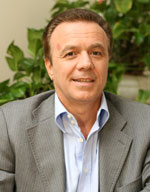 Today's post isn't specifically about raw foods. But, we wanted to post a few videos highlighting some interesting research by an Italian doctor named Tullio Simoncini, who just might be onto something HUGE! Dr. Simoncini treats certain cancer patients with ordinary sodium bicarbonate (baking soda), based on his premise that cancer is a fungal problem and that a solution of baking soda is anti-fungal. Naturally, he's been vilified by the medical establishment for making such a seemingly simplistic claim. But, what if he's right?
Here at Pure Jeevan, we're very much into health research -- not so much with an aim to cure any specific disease or ailment, but rather to understand ways in which our bodies can become what we like to call unbalanced, as well as the ways in which we might return our bodies to proper balance, when necessary. In this way, I suppose that we, like many in the natural health world, feel that the body is amazingly capable of healing itself (in many circumstances) as long as the body is able to find a favorable state from which it can properly do what it naturally wants to -- which is to return the body to an optimal state of health.
Medical doctors don't buy into this theory very much. ?However, it's certainly ironic how, where certain areas of standard medical practice are concerned, what I described above is exactly what doctors do. Take something like a broken bone, for example. A doctor does not normally attempt to surgically repair the bone itself. Rather, the standard and time-honored practice is to set the bone (say, with a cast), and then to let your body heal the break naturally, on its own, making those skeletal connections as only the imponderably complex, ever-evolving wisdom of the human body can facilitate. (True, doctors do often intervene these days with surgery for broken bones. But, their aim there is mainly to position the bones for proper healing, and/or to do things like insert pins in an attempt to improve functionality after healing. Either way, the procedure here still relies on the body's ability to eventually heal the problem.) Standard medical knowledge in this area is without question outstanding -- and this is why most people in the natural health world have little problem with going to see a medical doctor for emergency treatment.
Read more: Is Cancer a Fungus? Considering the Work of Italian Dr. Tullio Simoncini
Jim here... It's been nearly half a year since we posted a long meditation on living patiently, noting the unique, sometimes-at-odds dovetail that exists between (1) experiencing the zen of patience and (2) living the electrically charged life of raw foods. While we're STILL living with the same patience we talked about, I have to admit there have been times when we've been in not-so pleasant touch with some real frustration about getting our home sold and finally moving on to all of the exciting stuff we have planned for us and for you.
Wendi and I are absolutely ecstatic about taking our raw foods message to the next level -- and not just "next level" meaning more a few more blog posts and videos, but a true quantum leap in terms of our immersion into this world and commitment to advocating the lifestyle. It just gets a little tough, even when practicing patience, to be kind of stuck in the starting gate.
Read more: Pure Jeevan Heads Out of Town: Raw Roadtripping Vids to Come!
As promised, here's another question I'd like to openly address here instead of via Wendi's email system. This one also comes up from time to time, and I told this person to watch out for my two cents on this issue. So, here it is. The reader asks:
... During your transtioning to a raw food diet & the loss of so much weight, what if any exercising were you doing along the way

To keep all of you inspired while we are away, we've asked some
remarkable individuals to share their raw food stories with you. Enjoy!

KDcat and I returned from the ashram last night filled with peace and motivation to move forward with our current goals (more about this in the upcoming newsletter). However, we also returned to a home with next to no produce in it (well, compared to what we normally have available). What to do? There's no way to run to the co op today (only one car in our home) or this evening, so it's time to be creative. Let's take a look at what Pure Jeevan has in the fridge and on the counter, and we'll see what we can create!
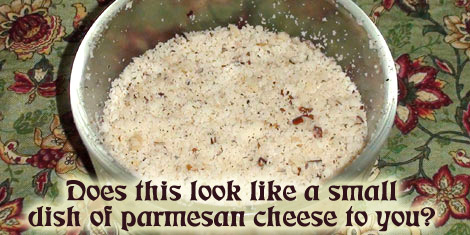
Back when we ate cooked foods (especially way back when our menu was not exclusively vegan), parmesan cheese seemed to be a staple of our existence (especially for Jim). We'd sprinkle it liberally on pasta dishes, salads, soups, and more.
As is typical for many raw foodies, you often realize after going raw that it was not always necessarily the food itself that you craved (no matter what it was); often it was simply the texture, the spices, the various flavors and tastes, etc. And that realization leads raw chefs to wonder whether the same experience can be recreated using only raw ingredients.
Read more: Quick Raw Tip: Making Your Own Raw Vegan Parmesan Cheese!

Jim's mother, JoAnn, LOVES pasta. I'm sure many of you can relate to that---pasta is a big part of the cooked diet and just about everyone loves it. When going raw, many individuals say they just can't do it because they miss pasta too much. Well, that's no longer a problem. There is a raw way to make pasta and you are going to love it if you haven't experienced it, yet!
As a gift for Mother's Day, we sent a pasta-making tool to JoAnn along with a pasta sauce recipe we created for her (see the Paradisio Pasta Pomodoro entry). To make it easier for her to learn how to create pasta, and to answer some of the emails we've been receiving about the device we used to make the pasta, we have put together a two-part video showing how to make delicious, beautiful raw pastas! You'll learn how to use two different pasta-making devices, as well as how to use a simple vegetable peeler to create delicious noodles!
Do you need to be 100% raw to release excess weight and regain your health There's no difinitive answer for that question because we are all unique. Sure, our bodies function pretty much the same way, but there are still enough differences that make it difficult to answer a question like that for it to be true for every single individual.
Most of us have heard of, or know, someone who doesn't eat a healthy diet, who smokes cigarettes and/or drinks alcohol, doesn't get enough rest, and also lives a stressful life---yet that person still has a healthy body and is over 80 years old. People like that seem to have resiliency built into their genes. Sure, who knows how long a person with such resilient genes could live or how vibrant a life that person could enjoy with a healtheir lifestyle. But, the fact remains that it seems no matter what a person's lifestyle is like, if you are born with resilient genes you are pretty much invincible to most illnesses.
A majority of the population isn't born with such impressively hardy genes, however. Most bodies can withstand the stresses of an unhealthy lifestyle until middle age. At that point, however, the body begins to show signs of ill health (excess weight gain, aches and pains, and the start of many diseases such as diabetes or high blood pressure). For a majority of those individuals, some healthy lifestyle changes can make a huge difference. Many individuals regain their health simply by changing their diets to include less fat and more vegetables, and by increasing their amount of exercise. Sure, it's a bit of work to make such changes, but if many people are committed to improving their health those simple changes can make a drastic difference in their lives.