Know Any Literary Animal Lovers?

Hi there PureJeevan readers! We wanted to let you know that Jim's new novel CHROO is available on Amazon. It's a crazy adventure involving a billionaire heiress, her Chihuahua BFF ("Chroo") and a host of human and animal characters. Find out more on Amazon! Here are some links:

Q. I recently read the following on Dr. Micahel Eades' (dr. protein power) blog & would appreciate your opinion:
Have you any comments on the RAW FOOD movement and particularly Dr. Cousens claim of a ?cure ?Dr. Eades' response:
I don t know anything about Dr. Cousens. I do know that people in the raw food movement seem to believe the raw foods deliver ?natural? enzymes unaltered by cooking to the GI tract to help it do its work. Problem is these ?natural? enzymes are made of protein and are denatured (the same alteration process as cooking does with heat) as soon as they hit the stomach acid. The fact that proteins can t make it through the stomach without being completely altered is why diabetics can t take insulin pills and have to get their insulin via injection. Insulin is a protein, just as enzymes are, and it can t make it through the stomach without being denatured.

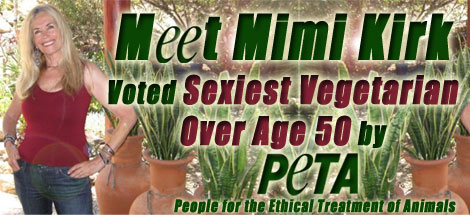
Today for "Take the Time Tuesday," we'd like you to take the time to meet Mimi Kirk, whom many of you may know as the winner of PETA's "Sexiest Vegetarian Over 50" contest last fall. If you're interested in longevity, and how diet influences the way we look, act, think, and exist, then you'll definitely want to listen closely to what this vibrant woman, who is 71 years young, has to say. We spoke with Mimi for nearly an hour this weekend, and are happy to share her inspiring interview with all of you. Below, you can listen right here, or download a podcast MP3 version.
***** DISCLAIMER: As with all of our posts here at Pure Jeevan, and particularly those coming up over the next week and a half (which will all be tagged with a new term, "Nadi Balance"), please refer to the disclaimer that runs at the bottom of all Pure Jeevan Pages. Wendi and Jim are health researchers, educators, and extreme self-experimenters. ******

Nadi Balance: Part IV...

Jim here...Well, something awful happened today at Pure Jeevan, something utterly shocking to any raw foodie on the planet -- our Vitamix container broke! I know, I know... breathe with me: Deep breath in... deep breath out. There, that's better. It's going to be okay, I just know it!
Here's what happened:? The agitator assembly (the metal part at the bottom that connects to the blades inside the container) wore out. It blew some kind of bearing or something, lost its internal oil, and started making an infernal noise when we blended our morning smoothie. It was pretty clear we'd blended up our last elixir in that container.
A worker at our local Food Co Op was talking about making his own dehydrator. I mentioned that I saw a link to a site that told about how to create one and I'd share it with him. When I found the link, just now, I thought maybe some of you might be interested in checking it out, as well.
?The page isn't vegan-friendly (there is ground meat in the one picture), but if you've been wanting a dehydrator and don't want to spend the money on the more expensive ones...this might be a great option.

On special Mondays, you sometimes see a regular feature here on Pure Jeevan's blog called Makin' It Monday. We always have so much fun doing this series, and it's been a huge hit both here on our blog and on YouTube.
We thought of a way to make the special Mondays even more special! Guess how? By seeing YOU in our Makin' It Monday raw food recipe videos! So, here's an open casting call for anyone in the Pure Jeevan family (that's you!) adventurous enough to prepare a raw food recipe on video to be featured in our Makin' It Monday series!
We have something special for today s Makin? It Monday! Remember Terilynn, the brilliant chef behind The Daily Raw Caf , whom we introduced you to not long ago? Well, this weekend she posted a recipe challenge open to anyone willing to participate. We here at Pure Jeevan are always up for an adventure, so thanks for the challenge, Terilynn!
The rules were simple: Use the list of possible ingredients, create a raw vegan food dish, and send pictures and information about your dish to The Daily Raw Caf . Here s the list for the challenge, with the items we didn t have available crossed out:

Is low fat more expensive? When I was eating a lot of nuts and seeds, in the back of my mind I kept saying, "Someday you'll eat less of these nuts and seeds, and you'll save a lot of money." I really believed that to be true because organic, raw nuts and seeds are outrageously expensive.
For one hundred days, I'm transitioning to a lower fat raw diet. I'm down to fats only in the evening, and for the next ten days those fats will only come from avocados, young coconuts, and possibly some hemp seeds. If I'm not hungry for the fat, however, I'll go without it. That hasn't been the case yet, though. By dinner time I'm ravenous and wanting to eat heavy, dense foods to calm the hungry beast in my belly. Even though I've been including some fats in the evening, I'm eating significantly less than I normally would if not doing this challenge. So, I've been eating more fruits and vegetables to get the calories I normally received from nuts and seeds.
Recently, the wife of a friend of ours decided that she wanted to lose 20-25 pounds. As far as we know, she follows pretty much a "Standard American Diet." We've heard that she doesn't care for red meat, but she does eat other meats, plus a good deal of dairy (which, we believe, she regards as a healthy food choice). She's apparently tried a number of exercise regimens, and a few fad diets, with no luck on losing these 20-25 pounds. (Frankly, we haven't seen her many times, but would not have guessed that she had 25 pounds to lose. But, we'll save "self image" as a topic for for further posts.) In any case... Frustrated, she decided to see a hypnotist!
Our friend accompanied his wife to the initial consultation. He said it was actually interesting. The hypnotist basically sits you down and walks you through some fundamental psychology, demonstrates a few of the primary principles of suggestion (e.g., showing you how easy it is to, say, imagine the sourness you would experience when biting into a slice of lemon), and then lays out how the program works.

Let me take you down,'cause I'm going to
Strawberry Fields.
Many of our visitors go directly to our raw food recipes section of the blog. They must be terribly disappointed to find only a few recipes there. We ll continually add more, but for now there are only a handful. So, it is with extreme pleasure that we introduce you to someone you are going to love!
Take the time to meet...