Know Any Literary Animal Lovers?

Hi there PureJeevan readers! We wanted to let you know that Jim's new novel CHROO is available on Amazon. It's a crazy adventure involving a billionaire heiress, her Chihuahua BFF ("Chroo") and a host of human and animal characters. Find out more on Amazon! Here are some links:

Hi everyone. Did you miss me on Friday? Was your entire day absolutely hinging on evaluating the quality of the raw salad dressing recipe that you very rightly expected to see demonstrated right here? ... and then I posted nothing at all! Well, missing one day isn't so bad, really. I think it's the first one I've missed since Wendi stepped away from the blog temporarily. Anyone want to guess what happened? ... Yep, a nasty case of the flu took me down!?
O, my raw friends, I thought I was a goner Friday -- thought for sure I had th' deadly swine. But, being the resilient, nearly infallible raw foodie that I am, I totally kicked it's porcine rear end, and am now supercharged and ready to rock and roll once again here on Pure Jeevan's blog!
Read more: One for Lucy: Raw Thai Coconut Curry Salad Dressing!

Jim here... Conventional wisdom says we shouldn't judge a book by its cover, right? Well, what about recipes? Should we judge them by their names?
When KDcat was young -- well before we followed a raw diet -- her friends sometimes scoffed at our typical vegan fare. After all, few kids would voluntarily eat "Pasta with Spinach Sauce."? But, we discovered, change the name and suddenly they're lining up for seconds. Instead of "Spinach Sauce," Wendi came up with "Jungle Sauce"! How exciting, right?
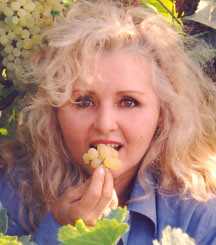
If you are in the Pittsburgh area this weekend, you are in for a real treat! Rhio will be visiting with us and she'll also be meeting with others during her two-part presentation for the Pittsburgh Raw Food Meetup on Saturday.You don't have to be a member of the meetup to enjoy this presentation. Below is information about the event you won't want to miss!
Two-Part Presentation by Rhio includes Dinner
***** DISCLAIMER: As with all of our posts here at Pure Jeevan, and particularly those coming up over the next week and a half (which will all be tagged with a new term, "Nadi Balance"), please refer to the disclaimer that runs at the bottom of all Pure Jeevan Pages. Wendi and Jim are health researchers, educators, and extreme self-experimenters; not doctors. ******
Nadi Balance: Part III
 To summarize yesterday's post, even though this sounds dramatic, the truth is: Wendi was dying. The first doctor essentially sent her home saying there was nothing wrong. The second doctor confirmed she had Lyme disease, but was too late for his method of healing, since the Lyme had already become chronic at that point. He could only offer understanding of her situation and a trial and error method of conventional medications, which rarely (if ever) heal Lyme patients. A supplement that many raw nutrition gurus recommend as essential to health for all people was actually putting Wendi's body, already struggling with Lyme bacteria, into an extreme state of distress. And finally, our own knowledge of health, diet, and healing (even though extensive and accumulated over 30 years) wasn't adequate for healing Wendi's body of Lyme, either.

Sometimes you meet someone and you just know they have tapped into something special, something most of us search for but never quite find. That was the case when I met this lovely woman I'd like the rest of you to meet. There's a centered peace about her, down deep in her core, and yet she's overflowing with an energy that I've never seen matched by anyone else. She's delightfully insightful, intelligent, and playful all at the same time. ?
Take the Time to Meet
Jim here... Until our home sells (SOON!!!) and Wendi and I launch ourselves into the world as full-time raw food teachers / lecturers / inspiration providers, I'm more or less stuck in the corporate world during the day. While much of what happens in this Dilbert-esque environment is, as many of you likely know, absolutely meaningless, there is nonetheless the occasional pearl of wisdom to be pried from the clammy jaws of the 9-to-5 world. I was, for example, just reminded of a story I heard at a seminar once. Not surprisingly, the seminar pertained to the art of money making. However, there's another more fulfilling message to it as well.
A large modern newspaper company still uses these ancient printing presses from the 1950s -- huge old monstrosities with enough belts, pulleys, and greasy gearboxes to make any modern-day steampunk enthusiast squeal with delight. One day, not long after the old press manager finally leaves the company, the main press breaks down. Manuals are consulted, technicians brought in, engineers asked to take a peek. No one can bring the beast back to life. But there's a woman on the Internet who specializes in these babies -- and, guess what, she's local! So, they call her in. She listens to their problem and says she can fix it, but it's going to run them $5,000.

We began this series with one possible psychological explanation of obesity, moved on to a possible philosophical explanation, and will now cover one that could be both of those, or could find classification within the emotional and/or spiritual realms. ?Wendi has often told me of hearing Dr. Gabriel Cousens speak in Sedona, Arizona, a few years ago. One remark in particular stuck with her. This may be a slight paraphrase, but Dr. Cousens said:
"There's never enough food to feed a hungry soul."
As we all know, physical hunger happens when our bodies need food -- when our stomachs are literally empty and aching for fuel to sustain our life. But, what about non-physical types of "emptiness"? Surely, we experience a kind of hunger in these cases as well.

Jim here with a weird little story for today... I was at a business seminar early this morning and someone I know came up behind me at the buffet and said, "I'm getting in line behind you to see what you eat. You've lost weight and I want to lose weight, too."
"Well, it's no secret," I replied. "Just chow down on all of this great fruit they have." (I'd already piled my plate high with honeydew, cantaloupe, pineapple, and strawberries.)
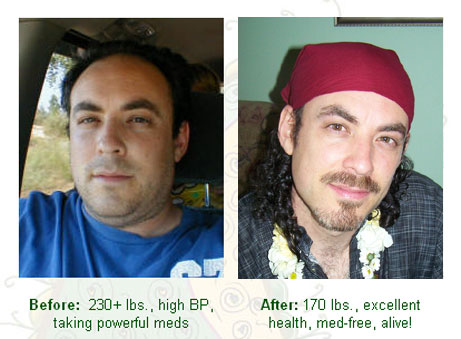
Jim here... Sorry for being away for so long. We've got SO much going on these days, it's mind-boggling! More on that later, as I have something in mind already for today...I should start by clarifying that I've been basically raw for almost 4 years now (high-raw, you might say). During the first nearly-two years, I still ate meat from time to time. Actually, I still ate (and drank) almost everything from time to time -- sugars, processed foods, alcohol, you name it -- only less than I did before, and within the context of a dietary intake consisting of a significantly higher percentage of living foods. In those early years, I'd estimate I was averaging 75-90% raw. Not bad ... I definitely experienced improvements in my health!
 The big change in consciousness didn't follow until two years ago. (This is an interesting point because, as you can see, I wasn't "ready" for a bigger change for two years into eating a lot of raw foods!) I suppose the difference was that, during the early years, I was pretty much raw by default rather than by conscious decision. As Jules said in Pulp Fiction, "... my girlfriend's a vegetarian. ?Which more or less makes me a vegetarian..." Yeah, that was my case back then, too, although I certainly grew into it (and am thankful that I did).
Read more: Reflecting on Two Years of an Exclusively Raw Die

Let's have a bit of fun today here on the blog. All week long we've been focusing on brain health and minimizing our chances of developing memory loss as we age. So, how sharp is *your* brain right now? What can you remember as the key highlights of ways to increase memory, ways to eliminate memory loss? What else can you remember reading over the past week here on Pure Jeevan's blog about having a sharp mind?
Share your resp0nses in the comments (and don't read those left by others until you've left your own!).
I received an email from one of our lovely Pure Jeevan family members. Joanne is subscribed to our mailings and she received the ice cream cake recipe I had created for Jim back in January. Well, take a look at what she did with the recipe! It's LOVEly!

Hi Wendi!I took Jim's birthday cake recipe to the next level.