Know Any Literary Animal Lovers?

Hi there PureJeevan readers! We wanted to let you know that Jim's new novel CHROO is available on Amazon. It's a crazy adventure involving a billionaire heiress, her Chihuahua BFF ("Chroo") and a host of human and animal characters. Find out more on Amazon! Here are some links:

Jim here... It's not often that we're able to recommend a movie that's perfectly relevant to the raw food lifestyle. But, if you're a raw vegan and haven't seen The Curious Case of Benjamin Button, we highly recommend this film. Not only is it wonderful, but it's also, for much of the film, a nice metaphor for living the raw foods lifestyle.

If you like raw cauliflower and fresh mint, I recommend you try this dish! Jim and KDcat don't like raw cauliflower much, so this dish wasn't a big hit with them. I, however, consumed the entire dish before the end of the day! I LOVED it!
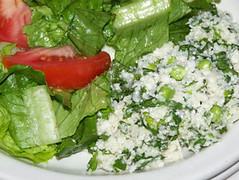
Read more: Makin' It Monday: Refreshing Cauliflower Mint Salad
Jim here again... So, instead of Episode 1 of "Know Your Food," we present Episode 0.5, which documents the high drama of launching a video blog. Quite intense, my friends... Recall yesterday's installement -- when we captured the initial moment of inspiration in our library? Well, today's installment is a "confession cam" one, just like you see on every reality TV show ever produced.
The question is: Will we EVER actually launch our nutritional web show? Stay tuned...
Read more: Pure Jeevan Nearly Launches New Series. See Episode 0.5.

As this is a holistic web site, it's important that we take time every so often to feature pieces on other aspects of human health besides diet. So, today's subject is unrelated to raw foods, but is directly related to your health. (Don't worry: We'll get back to raw foods on Monday!)
Today I want to share a super-valuable lesson I learned when I was just 21 years old. Back then, Wendi worked within the advertising department of a large newspaper. She helped me meet the paper's photography editor who, in turn, approved an internship for me during my senior year of college. So, several days per week for one semester, I hung out with professional newspaper photographers. It was a lot of fun -- and with real darkrooms, too (as this was way before the age of digital cameras).

 Six months ago, we devoted a week's worth of coverage here on Pure Jeevan to diabetes. You'll find diabetes statistics, raw food resources for diabetes, stories of people who have beaten diabetes using a raw foods diet, an audio interview Wendi and I did about diabetes, and more.
We also linked several times to the Movement to Reverse Diabetes Naturally, where people could pick up copies of two amazing DVD documentaries, "Simply Raw: Reversing Diabetes in 30 Days" and "Raw for Life." Through an enormous effort during those weeks back then, the RDN Movement spread the word about raw foods to literally thousands of people!
Read more: "Raw for Life" and "Simply Raw" on Special This Week

Thanks to Bitt, yesterday, for pointing out that one possible misinterpretation of yesterday's post (on celebrity weight loss) could be that "thin = healthy." I'm sure that, while there are countless wonderful benefits to being a famous actor, one of the less wonderful aspects of that life must be the pressure to remain young, thin, attractive, etc. It would seem realistic to me to assert that, additionally, women are held to even more objectified standards than are the men out there (although, in fairness, note that 6 of the 11 stars profiled in the Yahoo feature linked to yesterday were in fact men).
In any case, the post's intention was never to imply that one's weight is necessarily the best indication of one's overall health. After all, we all know thin people afflicted with serious health challenges.
 Today's post isn't specifically about raw foods. But, we wanted to post a few videos highlighting some interesting research by an Italian doctor named Tullio Simoncini, who just might be onto something HUGE! Dr. Simoncini treats certain cancer patients with ordinary sodium bicarbonate (baking soda), based on his premise that cancer is a fungal problem and that a solution of baking soda is anti-fungal. Naturally, he's been vilified by the medical establishment for making such a seemingly simplistic claim. But, what if he's right?
Here at Pure Jeevan, we're very much into health research -- not so much with an aim to cure any specific disease or ailment, but rather to understand ways in which our bodies can become what we like to call unbalanced, as well as the ways in which we might return our bodies to proper balance, when necessary. In this way, I suppose that we, like many in the natural health world, feel that the body is amazingly capable of healing itself (in many circumstances) as long as the body is able to find a favorable state from which it can properly do what it naturally wants to -- which is to return the body to an optimal state of health.
Medical doctors don't buy into this theory very much. ?However, it's certainly ironic how, where certain areas of standard medical practice are concerned, what I described above is exactly what doctors do. Take something like a broken bone, for example. A doctor does not normally attempt to surgically repair the bone itself. Rather, the standard and time-honored practice is to set the bone (say, with a cast), and then to let your body heal the break naturally, on its own, making those skeletal connections as only the imponderably complex, ever-evolving wisdom of the human body can facilitate. (True, doctors do often intervene these days with surgery for broken bones. But, their aim there is mainly to position the bones for proper healing, and/or to do things like insert pins in an attempt to improve functionality after healing. Either way, the procedure here still relies on the body's ability to eventually heal the problem.) Standard medical knowledge in this area is without question outstanding -- and this is why most people in the natural health world have little problem with going to see a medical doctor for emergency treatment.
Read more: Is Cancer a Fungus? Considering the Work of Italian Dr. Tullio Simoncini

Wow, so much happened in Chicago that it's taking literally weeks to show it all to you!? But, hey, it's also a lot of fun to share this stuff. Wasn't that a great talk yesterday with Kathy and Danny Living !? If you haven't seen it, definitely scroll down and watch!
Here's another one for you. Meet Hatice Yavuz, co-owner along with Chef Mehmet Ak of Cousin's Incredible Vitality, another great raw destination in the Windy City. "Hatice" is a Turkish name, in case you're wondering. The "c" is pronounced like a "j" -- so, her name sounds like "huh-TEE-jay." Our interview with her ran a little long, so I'm going to have to break it into two parts. Here's part one:
Read more: Pure Jeevan Visits Cousin's I.V., Interviews Co-Owner Hatice Yavuz (Part 1)
Can you believe it's mid-October already ? Here in Pittsburgh, for those lucky few who may have fig trees, that means harvest time! Well, almost. Take a look at this video we made about figs!
As stated in the video, we did a previous installment on figs in our Know Your Food series (which will definitely be returning once we finally sell our home and become full-time raw food inspiration providers!). Please visit that link for nutrition and other information on figs.
I was standing in line at the grocery store the other day and plopped a package of chicken wings up onto the conveyor belt. The cashier made some sort of smalltalk -- I think she asked whether I liked wings -- which prompted me to say, "Oh, the chicken is for my dog, Julia."
She looked at me, eyebrows raised. "For your dog "
We all know what "greens" are in general. For example, no one questions whether lettuce, kale, spinach, or chard are greens. But on the other hand, all of those items *are* also clearly green in color. With that in mind, what would you make of the following two questions I (Jim) recently pondered -- tagged as "reader questions" so they're easily found in the future by other equally inquisitive people ;-) -- that seem bizarre, but are really quite interesting?
1. Are non-green greens (e.g., purple kale) still considered greens2. Are vegetables with green skins (e.g., cukes, zucchini) considered greens? (After all, they're green!)