Know Any Literary Animal Lovers?

Hi there PureJeevan readers! We wanted to let you know that Jim's new novel CHROO is available on Amazon. It's a crazy adventure involving a billionaire heiress, her Chihuahua BFF ("Chroo") and a host of human and animal characters. Find out more on Amazon! Here are some links:

Have you ever heard about mono meals? When I first did, it sounded like such a great idea. When you eat a mono meal, you eat one item (and only one item) for the entire meal. Eating that way is supposed to be very cleansing and it gives your digestive system a rest from processing different types of foods at the same time. Supposedly there is a boost in energy, as well, since your digestion isn't taking up so much energy.
I recently received an email asking for advice from one of our Hindu readers, asking what I could recommend as far as light eating during the nine-day Indian festival of Navratri. Navratri is traditionally a time of fasting for nine days, however in modern society most Hindus no longer fast. Many do, however, pay more attention to their diets, and they try to eat lighter meals that do not contain animal products. Since our reader is just starting his exploration into raw foods, I didn't want to offer him advice that would make his nine days of Navratri difficult.He recently purchased a Vitamix, so I suggested that he make a lot of smoothies, since he has been enjoying them so much.

Hey everyone! It's nice to be more or less back in the swing of things again after an unexpectedly long stay in Chicago last week. You know, staying an extra three days on a trip isn't so bad, though. I imagine that if we had known that we were staying six days instead of three, we probably would have packed way too much. So, there are definitely advantages to unexpected happennings!
Anyway, here's another look into a Chicago-area raw food restaurant. This time, we were able to sit down with the owners, Danny & Kathy Living. The video starts with some footage of some gourmet raw dishes (a raw burrito, a raw falafel, and a raw dessert), and then gets into the interviews.
Read more: Pure Jeevan Visits Borrowed Earth Cafe, Interviews Amazing Owners Danny & Kathy Living!

Today, for Take the Time Tuesday, I'd like to introduce you to an online social networking Web site for those with similar interests to get together, meet, and hang out in the physical world. If you haven't already heard about it, check it out!
Take the time to meet....

We get asked from time to time about whether we like to use protein powders and, if so, which brands we like. As you'll no doubt notice after getting into raw foods for a while, raw foodies (just like quite a lot of health-conscious people) often get into various powdered food additives. Some purists are against their use, of course. But, we're not so dead set against them. We do, however, believe that, if you're going to put something into your body as part of a health program, you should be conscious about it.
A few months ago, Wendi decided that she wanted to add some protein into her diet in the form of a protein powder. She did quite a bit of research at the time into the various brands available, charting out which ones were raw, which ones had various ingredients, and so forth. It was a fairly in-depth study, done for personal reasons unrelated to Pure Jeevan's blog articles. So, we never mentioned it before.
Read more: Protein Powder Smoothies Part 1 of 3: Selecting the Powder
We're super excited to devote the rest to the week to featuring a variety of answers to the question "Are Raw Foodists Crazy " If you're just now tuning in, please read the back story and introduction to this, as posted yesterday. ?But, for now, let's get on with posting a few responses. We have at least 10 different ones to share this week, from a number of friends of Pure Jeevan. Some are short, humorous quips, others longer essays. Enjoy!! :-)

"An ounce of action is worth a ton of theory." ~ Friedrich Engels
When people talk about goals and planning, two distinct camps tend to emerge, in my experience:? (1) the "aim then fire" types, and (2) the "fire then aim" types.? I've used those specific terms for a reason, and will return to them in a bit. But, let's look at the two types, and relate them to the way in which one might approach raw foods.
***** DISCLAIMER: As with all of our posts here at Pure Jeevan, and particularly those tagged with a new term, "Nadi Balance," please refer to the disclaimer that runs at the bottom of all Pure Jeevan pages. Wendi and Jim are health researchers, educators, and extreme self-experimenters, not doctors. ******
Nadi Balance: Part VI

Pure Jeevan is hitting the road? this weekend, heading to Chicago for some super-double-secret raw business stuff, returning late Monday. (Can't discuss it yet, but it's raw food related and ultra-cool. We'll get to it in due time, I promise.)?
Actually, it's going to be quite an interesting trip, as we have some very serious, very intense work to do in Chicago over the entire weekend, but we're not sure yet whether it'll be Wendi doing the work or me! It all depends on how Wendi feels -- and with Lyme, you just never know. So, one of us will be busy, the other largely free to explore the windy city with KDcaT and Th' Jooge.
Read more: Pure Jeevan Hitting Chicago This Weekend. Suggestions Anyone?

Jim here... I was listening to a radio commercial the other day that promised to reveal the "secrets that credit card companies DON'T want you to know." You hear that kind of rather manipulative marketing all the time, right? It's a psychological thing, I suppose -- filling your mind with intrigue almost instantly. My credit is pretty decent, but I was thinking, "Wow, I wonder what those secrets are?!" We humans are curious creatures, aren't we?
But then I started to laugh to myself, imagining a raw foods radio spot adopting that technique. "Buy our special report and learn all of the Secrets that Raw Foodists do NOT Want YOU to Know!!!" And then I laughed some more. Know why? Because, when you think about it, there are absolutely, positively NO secrets raw foodists don't want you to know! Isn't that stunningly cool? In fact, the entire message of the movement is conveniently included right there in the words "raw foods." It couldn't be simpler -- the cure for what ails so much of the planet, neatly summed up in two words.

Isn't it amazing how many different, stunningly delicious salad dressings there are in the world ! It's mind-boggling! There could easily be an entire blog devoted to nothing but raw salad dressings -- and I bet, in the right hands, such a blog could go on 5 days / week for literally years before truly exhausting the subject.
 The world simply abounds with good recipe ideas -- and "abundance" is really the mentality you need to embrace when you're doing anything in the culinary world, raw or otherwise. The other side of the spectrum is the "scarcity" perspective, which is when you think, "Oh, I'd love to write a cookboook or create a recipe, but there are already millions of them out there and all of the great culinary creations have been done already."
On this page, we'd like to share some information about vegetable juicers. There are a number of different kinds, and we'll try to offer some background on many of the leading ones. We're affiliates for some, so if you're in the market for one of the ones we discuss, please follow the links we provide (or click the juicer pics) and you'll help support Pure Jeevan. But, either way, we certainly encourage you to consume fresh, delicious, nourishing veggie juices regularly!
The Jay Kordich Juicer -- The PowerGrind
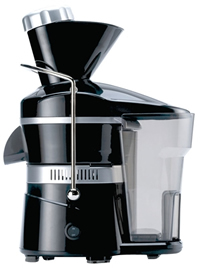 The PowerGrind Pro is a juicer put out by Jay Kordich, commonly known as the "father of juicing" by many in the raw food / living food world. In fact, our very first juicer was a "JuiceMan" model, purchased back in the early 1990s! But this is an entirely new machine, retooled from the ground up recently. At $289, it's a fairly high-end juicer (as compared with, say, department store models). However, it's certainly got the power and features to back up that level of investment. ?Head on over to the Jay Kordich web site for full details on the latest models.
The Hurom Slow Juicer
 A year or two ago, when we still lived in Pittsburgh, we hosted the Monarch's (Matt & Angela) during one of their speaking tours. I remember Angela firing up their juicer in the morning and I thought (or possibly even said), "Wow, your juicer is broken!" I swore that something was wrong because it didn't sound like anything I'd heard before. But they then told us about what was then the newest juicer on the market -- the Hurom Slow juicer. It's garnered a lot of positive testimonials over the past few years, from quite a lot of juicing enthusiasts. While many of the features are nice, we imagine the the most important potential benefit would be the slower speed, which theoretically means less oxidation, less processing, and thus healthier juice. If we were in the market today, I've no doubt we'd try one of these, too (even at $359)! These juicers are available through our good friends at Natural Zing!