Know Any Literary Animal Lovers?

Hi there PureJeevan readers! We wanted to let you know that Jim's new novel CHROO is available on Amazon. It's a crazy adventure involving a billionaire heiress, her Chihuahua BFF ("Chroo") and a host of human and animal characters. Find out more on Amazon! Here are some links:
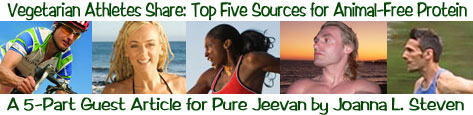
In this special five-part series, Joanna Steven uncovers where some top vegetarian athletes get their protein. Here's part two, focusing on Koya Webb's take on this issue.
ALMONDS
?The greater the percentage of raw food in the diet, the greater the health benefits? is Koya Webb, fitness model, personal trainer, triathlete and body builder's personal motto. Koya's sculpted physique won 1st place in the Ultimate Fitness Events "Fitness Model" and "Bikini Model" competitions and has modeled for Nike, Adidas, New Balance, Muscle and Fitness, Her Sports, Royal Caribbean and Triathlete magazine, to name a few. As a living-foodist (one who eats 60% or more uncooked veggies, nuts, seeds, and super foods) Koya believes eating all natural ?fruits of the earth? can help heal cancer, diabetes, and other diseases plaguing our society today.
Read more: Vegetarian Athletes Share: Top 5 Sources for Animal-free Protein (Part 2 of 5)

On this lovely Valentine's Day, I am focusing on how thankful I am for LOVE! I'm not into the whole this-is-the-day-you-are-supposed-to-show-love thing, though. I think love is something that should always be around, felt, and shared. Every day is a new day to express the love you have in so many varied ways, why hold it back for one special day a year?

I have enjoyed including information about new people, companies, and sites here in our blog for you to meet each Tuesday. Today, however, I want to do something a little bit different. Instead of someone or something being introduced to you, I'd love for YOU to introduce yourself to ME!
Take the time for ME to meet...
I like this "travelogue" format, so let's continue! Here's Wendi's comments from their adventures in San Luis Obispo, checking out the raw vibes along the CA Central Coast!
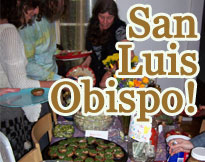 After a very active visit in the San Francisco / Berkeley area, we headed down the coast to San Luis Obispo, CA. There's a pretty active raw food meetup there and we were asked to stop in their town to give a talk to their group.
It was a nice drive south, but the sun is a bit brighter than we're used to (especially when driving long distances). When we arrived in the town, we were overcome by the beauty of the place. It's one of the most beautiful places we've seen in California, so far!
Read more: The Friendly, Mellow, Raw Groove of San Luis Obispo
Welcome to Episode 4 of Know Your Food. Wow, the PEAR episode is here at last! Aren't you thrilled to know that? Of ALL of the fruits, veggies, nuts, seeds, herbs, etc. in the knon world, we finally got to the wonderful pear. Well, it's no surprise, when you think about it. After all, sweet, mild pears are usually among the first fruits fed to babies. So, chances are, you were fed them, too, as a toddler. So, let's dig in, shall we?
Pears contain water-soluable fiber (pectin), Vitamin A, Vitamin B1, Vitamin B2, Vitamin C, Vitamin E, Copper, Potassium, Posphorous, Folic Acid, Niacin, Iron, Magnesium, Sodium, Sulphur, Calcium, and more! They lower your blood pressure, releive inflammation, lower cholesterol via pectin, calm the stomach, cool the body, prevent cancer via anti-oxidants, boost your energy via the fructose/glucose, reduce inflammation, help your bones/calcium levels, aid in pregnancies via the folate, and much more. Pears are GREAT for you, so eat them regularly!
A few days ago, we'd mentioned that Wendi had done a five-day water fast as part of her early dealings with Lyme disease. This was the first time I can recall in our household anyone fasting for more than a day or so, although there may have been the odd juice fast now and again for a few days.
Thinking back, I can tell you that, all while I kew Wendi (and especially during her cooked years), such an extended fasting would never have happened because she used to get wicked headaches any time she went without food for more than a normal time period between meals. This makes perfect sense, of course, as you really do have to be in fairly good health to successfully fast -- and, during those "cooked" years, we were both extremely unhealthy! (More on the reasons for all that later, as Wendi will likely do a write-up on fasting at some point.)
I've been back from the Raw Spirit Festival for about five days, now. The first few days I couldn't stop crying. I have a lot to share with all of you, maybe more than you'll want me to share. While away some pretty amazing healing took place. I found myself lifted out of the past and delivered to the future, in a way. I am here, whole, and aligned with who I am on all levels.
Pure Jeevan means Pure Life (or Total Life). Raw food is only part of my life, part of who I am, part of my journey. So, I'll be openly sharing who I am here in this blog; raw food isn't going to be the main focus---it's just part of my story and part of what I want to share.
Until I can sit down to begin sharing everything that transpired while I was away and over this past five days, I'll share some pictures with all of you!
On this Thankful Thursday I am feeling especially thankful for the Internet. Without the Internet I wouldn't be able to learn as much as I've learned about raw foods in such a short period of time. The Internet has connected me with people from all over the world who are also interested in natural health and raw food living. I am part of a larger community, one that would never exist without the Internet.
So, today I am especially thankful for the Internet. What are you thankful for today?
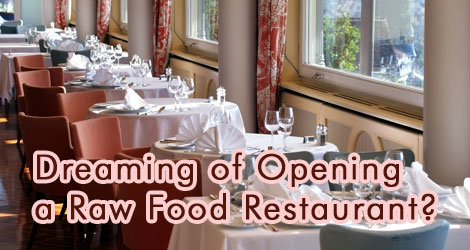
This is Part II of a two-parter on raw food restaurants. Yesterday, we listed a half-dozen challenges that one might face when opening a raw restaurant. Today, we're focusing in on the more enjoyable side -- the potential advantages that opening raw restaurants offer over their cooked-food counterparts.
Let's dive into it... Here are six things we believe are advantages!
Read more: Some Thoughts on Opening a Raw Foods Restaurant -- Part II of II!

Before we moved to Portland, Oregon, land of all things fresh and organic within walking distance, we had to drive quite a distance to reach the food co-op (the only place that had a good selection of organic produce and other raw food necessities). So, we only went shopping about once a week. It took a lot of trial and error to find ways to keep our weekly produce fresh for about a week.
We learned which fruits and vegetables stay fresh the longest, and which go bad the fastest. Based on this, we stocked the refrigerator accordingly (and used up the produce accordingly, as well). The fruits and veggies that stayed fresh the longest were stored in the backs of the shelves (things like carrots, beets, broccoli, cauliflower, apples, etc.). Next we stored the greens that lasted a pretty good amount of time (like kale and collards). And in the front of the shelves and in the door, we stored the more delicate greens (like lettuces and herbs).
in-tu-i-tion n. 1.a. The act or faculty of knowing or sensing without the use of rational processes; immediate cognition. b. Knowledge gained by the use of this faculty; a perceptive insight. 2. A sense of something not evident or deducible; an impression.
FASCINATING!? While out to dinner with our friend Debbie, she brought up the topic of intuitive food preparation. This is really amazing, groundbreaking stuff that probably few people have ever seriously attempted. Now, Wendi has discussed intuitive eating many times here on the blog in the past. Intuitive eating is basically when you get in touch with those "perceptive insights" mentioned above -- a kind of communication with your own body in which you just "know" that you should eat a certain food. Ever, say, walk past a large display of apples and simply know that eating one would make you feel good? That's intuition.