Know Any Literary Animal Lovers?

Hi there PureJeevan readers! We wanted to let you know that Jim's new novel CHROO is available on Amazon. It's a crazy adventure involving a billionaire heiress, her Chihuahua BFF ("Chroo") and a host of human and animal characters. Find out more on Amazon! Here are some links:

Jim here... Sorry for being away for so long. We've got SO much going on these days, it's mind-boggling! More on that later, as I have something in mind already for today...I should start by clarifying that I've been basically raw for almost 4 years now (high-raw, you might say). During the first nearly-two years, I still ate meat from time to time. Actually, I still ate (and drank) almost everything from time to time -- sugars, processed foods, alcohol, you name it -- only less than I did before, and within the context of a dietary intake consisting of a significantly higher percentage of living foods. In those early years, I'd estimate I was averaging 75-90% raw. Not bad ... I definitely experienced improvements in my health!
 The big change in consciousness didn't follow until two years ago. (This is an interesting point because, as you can see, I wasn't "ready" for a bigger change for two years into eating a lot of raw foods!) I suppose the difference was that, during the early years, I was pretty much raw by default rather than by conscious decision. As Jules said in Pulp Fiction, "... my girlfriend's a vegetarian. ?Which more or less makes me a vegetarian..." Yeah, that was my case back then, too, although I certainly grew into it (and am thankful that I did).
Read more: Reflecting on Two Years of an Exclusively Raw Die
I thought I'd share some recent pictures with all of you. Let me know what you think!?
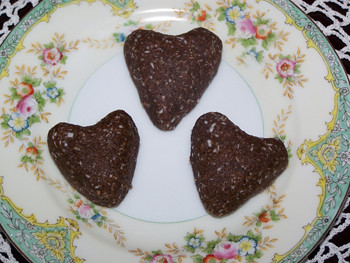
Carob Peppermint Hearts
This is a recipe I created to take the place of a packaged raw cacao dessert that Jim loves. I don't like to eat cacao, because it disturbs my heart, so I use carob. A new raw friend asked for a recipe for this dessert, because she loved it so much, but I don't have one. I dump walnuts, coconut, agave, and peppermint oil into the food processor and mix until it's a consistency that can stick together. For Valentine's Day I shaped the mixture into hearts. Sweet!?

Bunny Berry is back with a new 100-day Raw Fu challenge! If you've made a New Year's resolution to eat more raw in 2009, Bunny Berry's Raw Fu community may offer you the amazing support you'll need to meet your goal for the new year. Check it out!? Here's a snippet from Raw Fu:
And we re BACK! It s time to ring in the New Year with a New 100 Day Challenge. Take the plunge with 100 days of support, love, and lots of leafy greens. Bunny will be back with daily videos, vision boards, special Raw Fu celebrity guest stars, Breakfast with Bunny calls, and more Cutting Board Cam!
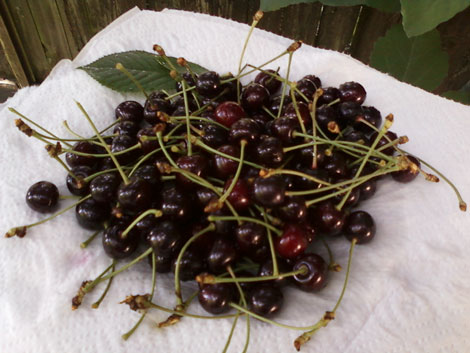
We're extremely busy this week with some home projects, so we figured we'd simply share a few interesting photos each day. Here's today's -- a big plate of freshly picked cherries from our yard! ?These are smaller cherries than you'll find in stores. We believe they're sour cherries, which is a very healthy variety, even though they're not as tasty as Bing's or Ranier's. ?They're reportedly good for pies, though. I've eaten tons of them so far; ?they're at their peak at the moment here.
I tell you... the dangerous thing about cherries is something you'll only discover when you're out there on a ladder, standing on that tip-top rung (which clearly states: "Do NOT stand on this rung!"), and you're reaching higher and higher for that next bunch of nature's goodness. Even in this situation, you find yourself thinking: "If I could just reach a *little bit* higher!" ?Sooner or later, you have to realize that some cherries are there for the birds, squirrels, and raccoons.

Every Tuesday we introduce an individual or business that may be of interest to our readers. Our introductions vary from those that will help support your body, mind, spirit, or emotions. This Tuesday we are pleased to introduce an individual who brings a holistic view to her work and nourishes your body, mind, spirit, and emotions on all levels.
Take the Time to Meet

We tried it in the past, this most unusual fruit. While in Chicago recently, we decided to give it one more try! You see, the first time we tried it we were ... let's just say "not big fans" of the infamous durian. (Here's an episode of Kevin Gianni's Renegade Health Show, shot in our home, documenting that day.) It's a stinky fruit to most, although some claim to enjoy the bizarre odor (which is sometimes described as dirty sock and propane gas smell). If you can get past the smell to give it a taste, you'll be greeted by a taste as strange as the odor. Wendi describes it as a sweet onion pierogie, but each person seems to have a different opinion about this odd fruit.
In this current video our raw friend Debbie Gedayloo-Bennett, whom we met in Chicago, jumped at the opportunity to hang out for a bit of a durian experience. Debbie is on the pro-durian side of the fence that divides those who love and those who hate the alien-like fruit. Wendi was still sitting on the fence, not making up her mind after the initial taste with Kevin and Annmarie. Jim was adamantly sitting far from the love side of the fence, refusing to even attempt approaching the pro side. Debbie was a pro in opening this spiny fruit, so she agreed to open it while on video so that we could share the experience and knowledge with all of you.
I've been back from the Raw Spirit Festival for about five days, now. The first few days I couldn't stop crying. I have a lot to share with all of you, maybe more than you'll want me to share. While away some pretty amazing healing took place. I found myself lifted out of the past and delivered to the future, in a way. I am here, whole, and aligned with who I am on all levels.
Pure Jeevan means Pure Life (or Total Life). Raw food is only part of my life, part of who I am, part of my journey. So, I'll be openly sharing who I am here in this blog; raw food isn't going to be the main focus---it's just part of my story and part of what I want to share.
Until I can sit down to begin sharing everything that transpired while I was away and over this past five days, I'll share some pictures with all of you!

How does the following menu* sound for your Thanksgiving meal
Nut Loaf, Apple un-stuffing, Mac Mushroom gravy,


Welcome to Day One of "Dressings Week" here on Pure Jeevan. After finding out that KDcat took it upon herself to film a segment of "Makin' It Monday, Guest Raw Chef Edition," I decided that we should probably spend an entire *week* focusing on salad dressings.
Read more: Makin' It Monday Guest Raw Chef Edition: KDcat Makes Orange Pepper Cilantro Dressing
You're in for a treat with this recipe. Our Guest Raw Chef this week is Shivie Kaur, half of "The Cook and Butler" duo of TeamRaw. Wendi shot this video a few weeks back in San Francisco during Pure Jeevan's recent cross-country tour! While there, Shivie and her partner Cemaaj created and served a delicious gourmet meal for Wendi and KDcat. The blog post from that visit was here. So, here's Shivie sharing with you how to make an easy and delicious raw salad dressing!
Read more: Makin' It Monday Guest Raw Chef Edition: Shivie Kaur Makes Salad Dressing

Thinking of Writing a "My Raw Story" Piece for Pure Jeevan's Blog
Fantastic! We d love to consider running your raw story to help inspire others. Please know that the "My Raw Story" series isn't only about success with weight loss on the raw food diet. It's about an overall life change that happens when a raw food diet is followed. We want to hear how your life was dramatically changed by adopting a raw food lifestyle. Below are some guidelines to help you submit your story: