Know Any Literary Animal Lovers?

Hi there PureJeevan readers! We wanted to let you know that Jim's new novel CHROO is available on Amazon. It's a crazy adventure involving a billionaire heiress, her Chihuahua BFF ("Chroo") and a host of human and animal characters. Find out more on Amazon! Here are some links:

The way your smile just beams
The way you sing off-key
 ?
?
Well, it's nearing the end of 2009, and I've been unwell for half of the year. (To make a positive statement out of that, I'll add that I've been well for the other half!) It's hard to believe so much time has gone by and about half a year of my life was spent in pain, tears, and sometimes fear (mostly in the beginning of the lyme disease). I'm definitely looking forward to the new year, to leaving this disease behind me while taking the lessons I've learned with me into 2010.
As many of you know, I was very proactive in finding a "cure" to the disease as soon as it was identified. I tried allopathic remedies (antibiotics for about three months), alternative remedies (herbal protocols, vitamin/mineral/supplemental protocols, aromatherapy techniques, healing massage, hands-on-healing, water fasting, prayer/meditation/positive visualization), and so much more. Nothing completely cured my body from the lyme bacteria that seems to have spread throughout my body and found favorite spots to multiply (particularly in my shoulders and arms).
Read more: Wendi's Health Update: Cooked Food Experiment and Great News!
For the most part, I've been eating intuitively from the very start of my raw food journey (which began over two years ago!). I noticed that I was drawn to different foods for blocks of time, and as my interest would wane I'd find myself drawn to another raw food. Anyone who has followed my story to health knows about my love for young Thai coconuts. My entire body would vibrate with physical excitement every time I picked up another case of those life-enhancing baby coconuts. I felt like a child receiving a much-desired gift---giddy with excitement and unable to stand still. I'm not just saying that, either---it was a very strange sensation, feeling such excitement over a food.
Well, my love for the coconuts faded and I found myself drawn to other foods over the past few years. However, none of them ever compared in intensity to my desire for the coconut. I can't recall all of the foods I cycled through, but there were plenty of food cycles I went through. Currently, I'm intuitively drawn to the pineapple. I want to eat it at least once a day, sometimes more. I haven't tired of it in the least bit.


In this special five-part series, Joanna Steven uncovers where some top vegetarian athletes get their protein. Here's part one, focusing on Tim VanOrden's take on this issue.
When alternatives to the Standard American Diet are discussed, protein is on everyone's mind. There are many reasons why someone might want to eat a plant based diet, whether for allergy concerns, health reasons, or more variety. But nagging doubts often come up;? Are plant proteins adequate for athletes and body builders ? Are they really the preferred protein source of the human body ? Are they better than animal based protein or are they just consumed for environmental reasons ? To answer these questions, why not ask the experts:? triathletes, professional dancers, bodybuilders and extreme sport racers ? Here are the answers from some of the most competitive athletes in their respective fields.
Read more: Vegetarian Athletes Share: Top 5 Sources for Animal-free Protein (Part 1 of 5)

 Six months ago, we devoted a week's worth of coverage here on Pure Jeevan to diabetes. You'll find diabetes statistics, raw food resources for diabetes, stories of people who have beaten diabetes using a raw foods diet, an audio interview Wendi and I did about diabetes, and more.
We also linked several times to the Movement to Reverse Diabetes Naturally, where people could pick up copies of two amazing DVD documentaries, "Simply Raw: Reversing Diabetes in 30 Days" and "Raw for Life." Through an enormous effort during those weeks back then, the RDN Movement spread the word about raw foods to literally thousands of people!
Read more: "Raw for Life" and "Simply Raw" on Special This Week

Here it is...the Queen of all Juices! It's cooling, cleansing, light, easy, delicious, pretty, promotes weight loss, energizing, vibrant, and FUN!
Can one simple juice really be so wonderful for your body? Yes!! Following is the recipe, as well as some highlights about the ingredients and why it's so great for your body.
Cooling and Cleansing Juice
(Serves 1)4 medium apples
Recently I've been to three potlucks in the span of four days. They've all been wonderful for different reasons -- one was a birthday party for a lovely young woman, Bethany, another was part of a women's circle that my friend, Melissa, invited me to attend, and the other was at my home as a meetup when Kevin and Annmarie Gianni were here visiting. Lots of fun, connecting with people, and raw foods to eat.
Sounds perfect, right? Well, something's been happening with me and raw foods over the past year. It became even more evident after eating at three different potlucks over four days. I've noticed more and more that when I don't eat something that I've created, I many times have reactions to the foods I've eaten. The reactions have ranged from flushed facial skin, slight headaches, hives, full-blown headaches, upset stomach, water retention, achy joints, etc. All signs of being sensitive to something I'm eating, right? I've narrowed it down to a few things, but it doesn't seem to be an exact science to knowing what's going to cause the reaction.
At home I know that I feel better if I don't consume garlic even though I love the taste and smell of it. When I eat too much of it I experience headaches and sometimes flushed cheeks. I gave up raw vinegar a long time ago because it makes my joints ache. Recently I noticed that whenever I eat Nama Shoyu I get a headache, flushed cheeks, and sometimes some hives. So, at home I can control my reactions to foods -- I simply avoid eating the things that sometimes trigger problems for me. I feel great most of the time because I eat more simply and my body doesn't experience any problems.
Read more: Something Has Been Happening With Me and Raw Foods

Yesterday, I posted a question on Facebook and was met with some wonderful responses. The question was essentially, "If you're a trying to run a health-conscious household, and if you truly believe that most sugary candy is actually damaging to people's health, then what should you give away to all of the little trick-or-treaters who visit on Halloween night "
I got some great responses! Raisins, fruit leathers, glow sticks, etc. Thanks to those responses, I went out and bought about 60 glow-stick bracelets (the kind that you snap and then they glow brightly for 6 horus or so). I think the kids will think these are neat, and will all want to wear them. I also picked up a bunch of small juice boxes with 100% juice in them. (They're pasteurized, of course, but at least it's not sugary junk.) So, between all of that, I think I'll make it through the night without getting egged.
You're in for a treat with this recipe. Our Guest Raw Chef this week is Shivie Kaur, half of "The Cook and Butler" duo of TeamRaw. Wendi shot this video a few weeks back in San Francisco during Pure Jeevan's recent cross-country tour! While there, Shivie and her partner Cemaaj created and served a delicious gourmet meal for Wendi and KDcat. The blog post from that visit was here. So, here's Shivie sharing with you how to make an easy and delicious raw salad dressing!
Read more: Makin' It Monday Guest Raw Chef Edition: Shivie Kaur Makes Salad Dressing
We've promised many of you that we'd share some ideas for the whole family (especially the children), so here's one idea that might prove particularly popular. In a household of two former English majors, it's only natural that we've always adored and admired alliteration. So, we may be biased to believe that these "Breathtakingly Bejeweled Blueberry Banana Breakfast Bowls" will be as beloved by your beauteous bellies as they are by ours. See what you think!
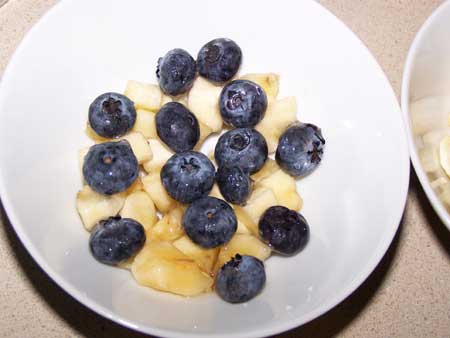
Read more: Breathtakingly Bejeweled Blueberry Banana Breakfast Bowls

I need fast & easy meal ideas (esp. breakfast & dinner) -- time is a luxury I don't have (taking 18 college credits, internship, PT job and I started a natural perfume business!). By the end of the day I am so exhausted that I'd rather not eat than go in the kitchen & try making somethin raw.
If you're dealing with exhaustion or fatigue, we'd like to direct you to a recent blog post discussing the subject. As for time being a luxury, we address that, as well, in the same post. You'll always hear the same thing from us about limited time in relation to your diet: Make the time! Your overall health is what's most important in life and it's imperative that you arrange your life so that you have plenty of time to not only prepare healthy meals, but to also eat them in peace without feeling rushed.
With that said, it's also important to realize that eating healthy doesn't need to take hours out of your life. There are plenty of raw food recipes that are not only quick and easy, but also packed with nutrition! We'll share, below, some links for some of our favorite recipes that are quick, easy, nutritious, and delicious! These recipes are located here on our blog.