Know Any Literary Animal Lovers?

Hi there PureJeevan readers! We wanted to let you know that Jim's new novel CHROO is available on Amazon. It's a crazy adventure involving a billionaire heiress, her Chihuahua BFF ("Chroo") and a host of human and animal characters. Find out more on Amazon! Here are some links:

As many of you know, I'm more of an intuitive eater than anything else. I eat what I intuitively feel my body needs most of the time. Well, for the past two weeks what my body has been asking for is cauliflower. I went through a cauliflower stage sometime last year, and it seems I'm back to eating that lovely white flower veggie again!
At first I was making mashed cauliflower (like? mashed potatoes) and keeping the recipe very simple. I've made complex versions of the mashed cauliflower before, but I was really drawn to a more simple taste so all I was adding was some olive oil, salt, and a tiny bit of macadamia nuts. Yesterday, however, as I was cleaning the cauliflower (since my body was telling me it wanted more of it), I had a sense that I wanted something more vibrant, more fun than simple mashed cauliflower. So, I followed my intuition (picking up whatever I felt my body wanted to eat with the cauliflower) and here's what I created...

Jim here... Just wanted to say quickly that I'm heading off to the Raw Spirit Festival (RSF) today! I'll be carpooling (or, vanpooling) with our friends Melissa and Dave Sokulski, their daughter Ella, and our friend Bethany. We're all volunteering at RSF, which should not only be a lot of fun, but should also be a great way to get to know many other fellow raw foodies.
So, we'll be arriving Friday to help set up, enjoying the festival over the weekend, and staying Monday to help them "break it down." Since we need to leave Monday, we'll likely miss a fun-sounding party at Rawbin's place Monday night. But, I'm sure it'll be a blast overall, and it'll also be fun to camp out again, as I haven't done that in a while. I especially hope I'm also able to light something on fire, as I always love the fire aspect of camping most. Maybe I'll run into some of those raw foodies who spin fire-poi and can learn a new skill!

Yesterday's post was a little "heavy," don't you think In it, we shared a bit of the stress we were experiencing related to our pending move. There was just so much data to pore through (and yes, we're still feeling that stress)!?
At times like these, it's often good to step back, breathe, and make sure you're not ...well, freaking out -- which makes today's "Take the Time Tuesday" installment absolutely fitting, for we would like you to meet a raw foodie who goes to great lengths to ensure that your "Vitamin L12" levels stay well into the superhero range. Without further adieu, then...

How does the following menu* sound for your Thanksgiving meal
Nut Loaf, Apple un-stuffing, Mac Mushroom gravy,
?
Jim here... A few months ago, I'd posted an article here on the topic of Cognitive Dissonance. This theme seems to crop up from time to time in questions people ask about the raw foods lifestyle. For example, one new raw fooder recently posted a question in a raw foods forum asking whether other raw foodies had reached a place in their lives at which things changed so much that they felt as though they were living a contradiction. Because this struck home for me, I'd like to reiterate my response, somewhat edited, below.

On special Mondays, you sometimes see a regular feature here on Pure Jeevan's blog called Makin' It Monday. We always have so much fun doing this series, and it's been a huge hit both here on our blog and on YouTube.
We thought of a way to make the special Mondays even more special! Guess how? By seeing YOU in our Makin' It Monday raw food recipe videos! So, here's an open casting call for anyone in the Pure Jeevan family (that's you!) adventurous enough to prepare a raw food recipe on video to be featured in our Makin' It Monday series!
We'd like to welcome the RawFoodRightNow blog readers to our Pure Jeevan blog! We are a new blog (started earlier this month), so we are thrilled that you have already found us and have taken the time to come and meet us!
Our blog is focused on a holistic look at living life as a raw food vegan (we have a holisitc raw-focused newsletter, too). We write posts that cover the body, mind, spirit, and emotions--as well as just random talk straight from our hearts to the blog page.
We update at least five times per week because we have daily blog features (Makin' It Monday, where we share raw recipes we are making; Take the Time Tuesday, where we introduce people or businesses we think may interest you; Weird Wednesay, where Jim shares observations about strange things; Thankful Thursday, where we share what we are thankful for and ask you to share, as well; and Fun-Filled Friday, where we tell you what fun things we have planned for our weekend).
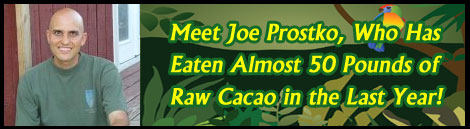
Hi everyone! Jim here with a really special treat for you today. I'm interviewing our friend Joe Prostko, who we've known for a good year or so through the Pittsburgh raw food meetup group. You may remember Joe from our cacao pod video a while back.
 We just had a big raw food potluck costume party here, and Joe showed up as an Oompa-Loompa. At first, I admittedly did not get the deeper part of this joke. I simply thought it was a novel costume because it was a character from the Willie Wonka book / movie. Later, however, it really sunk in, as I decided to flip through the Willie Wonka book to read up on Oompa-Loompas. Here's a quote from Willie Wonka author Roald Dahl:
Read more: Meet Joe Prostko, Who Has Eaten Almost 50 Pounds of Raw Cacao in the Last Year!
Here's a fun story, with a fun, inspirational, and at least partially dietary conclusion. As I mentioned yesterday, Wendi is in Portland this week. Can you guess what she's doing there? ... She's attending a very important event -- something that merited getting on an airplane with almost no notice (and, wow, are those last-minute airfares pricey!). Still not sure? That's okay; I'll let the cat out of the bag: We found a new home!!
We've been talking about moving to the west coast for literally years now, so it's about time, right? ?In recent times, we've really begun taking action on things in a much more profound and immediate way than ever, and it's been working out amazingly well. This home purchase was just the latest instance of it. We basically saw an opportunity and immediately went for it, without hesitation, and before we knew it we were sending paperwork back and forth across the internet to our realtor.

Jim's mother, JoAnn, LOVES pasta. I'm sure many of you can relate to that---pasta is a big part of the cooked diet and just about everyone loves it. When going raw, many individuals say they just can't do it because they miss pasta too much. Well, that's no longer a problem. There is a raw way to make pasta and you are going to love it if you haven't experienced it, yet!
As a gift for Mother's Day, we sent a pasta-making tool to JoAnn along with a pasta sauce recipe we created for her (see the Paradisio Pasta Pomodoro entry). To make it easier for her to learn how to create pasta, and to answer some of the emails we've been receiving about the device we used to make the pasta, we have put together a two-part video showing how to make delicious, beautiful raw pastas! You'll learn how to use two different pasta-making devices, as well as how to use a simple vegetable peeler to create delicious noodles!
I receive many questions from our readers, and I am very happy to respond. I truly love helping others, but I don't do it just for them.When I was younger, many times I thought I was performing selfless acts of kindness whenever I'd help others. However, now I realize I am experiencing pleasure by helping others. I find it very rewarding, as though I am fulfilling my purpose in life.
Do you know what your life's purpose is? Do you believe there is such a thing These aren't rhetorical questions; I'm really interested in hearing your response. Well, I've known my life's purpose (actually, I have more than one) from a very young age, but it wasn't until recently that I began living it more fully. My purpose in life is to love others---to connect with others through an immensely deep and genuine love.One way I've found for spreading my love and realizing my purpose is by helping others.
When I answer questions for our readers, I speak from my heart. I think it's important to realize, however, that the answers we receive from others are *their* answers to similar questions. Maybe their answers will work for us, but maybe they won't.I've stressed this many times, but it never hurts to repeat it: Listen to others, hear what they have to share, but mostly listen to your own inner voice. We all have the answers deep within ourselves, even if we can't always hear them very well.
Read more: Life's Purpose and Reader Questions: Emotional Eating