Know Any Literary Animal Lovers?

Hi there PureJeevan readers! We wanted to let you know that Jim's new novel CHROO is available on Amazon. It's a crazy adventure involving a billionaire heiress, her Chihuahua BFF ("Chroo") and a host of human and animal characters. Find out more on Amazon! Here are some links:
***** DISCLAIMER: As with all of our posts here at Pure Jeevan, and particularly those coming up over the next week and a half (which will all be tagged with a new term, "Nadi Balance,"), please refer to the disclaimer that runs at the bottom of all Pure Jeevan Pages. Wendi and Jim are health researchers, educators, and extreme self-experimenters. ******
With this post we launch what is perhaps the most important series of posts in the history of Pure Jeevan's blog, and indeed within the entire field of natural health. This series covers ground-breaking health science education that we've been immersed in, and which will form the basis for much of the direction in which Pure Jeevan will be heading in the coming years. You know we're all about helping others, about educating others about what we've learned, and about inspiring you to take your health into your own hands and blossom into your most vibrant selves. But, ?this time you're in for some never-before talked about, mind-blowing health science information. This has changed our lives, and continues to do so, and it will more than likely change yours (and others'), as well. [Jim says: The ultimate question is not "What is the matrix "; it is: "What is Nadi Balance "]
Nadi Balance: Part I
April 15, 2008
Every year my dear friend, Mamta, lets me know when Navratri is going to begin. ?It s the nine-day fast, but you don t have to change anything since you are already eating so healthy. Traditionally, Hindus used to abstain from eating during Navratri. In modern times, with everyone working and life being less relaxed, fasting isn t always something that can easily be accomplished. So, over the years Navratri has been modified by many to represent a time of eating more simply and abstaining from meat if you eat it.
This year, I had an email question from one of our readers who was asking about ways to eat simpler during the nine-days of fasting. After responding to him, it sparked in me a desire to do something this year for Navratri. I had read about eating mono meals and always thought it sounded like such a gentle way of cleansing the body, so I figured I d try it for the nine days of Navratri. To make it even easier on me, I decided to consume a different food every 24 yours, rather than eating the same thing for the full nine days. Maybe in the future I ll try that, but this time I wanted this to be as easily doable as possible.

For today's Makin' It Monday, we're not really making something, but rather sprouting something! We tend to go through periods of time when we are sprouting a lot, consuming sprouts on salads, sandwiches, and inside whatever dishes we can add them to at the time. It seems appropriate for this time of year to start sprouting, again.
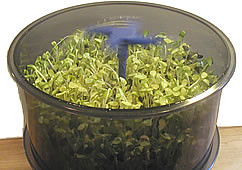
Have you ever sprouted seeds? The first time I ever sprouted, I used a nut milk bag that I kept dangling over the kitchen sink. I put some seeds into it, let them soak overnight in a bowl of water, and then rinsed them in the morning. Every time I was in the kitchen, I rinsed them again and let them drip into the sink until the next rinsing. It's important to keep the seeds moist and rinsed. It was thrilling to see the tiny little sprouts when they first began emerging from the seeds!
Here's Wendi in Portland interviewing Wes Hannah, one of the owners of Blossoming Lotus, a vegan restaurant that also serves a lot of delicious raw foods. Wendi said it's worth a trip to Portland just to eat there!
[Sorry about the video quality there. I was having some trouble editing this on an old machine. Wendi took the good one with her on the trip!]
Read more: Wendi Interviews Wes Hannah of Blossoming Lotus Restaurant

Jim here... Okay, the title and graphic, above, may be a bit silly, as are a few of the remarks I made in the video, below. But, within this rather odd piece a few hopefully noble and economical ideas exist -- especially the ridiculously simple and obvious notion about reusing glass beverage bottles. I'm embarrassed to have lived on this planet for so long and not to have adopted this fun and environmentally friendly practice much sooner.
 We really do take things like glass containers for granted, when we probably shouldn't. Their ubiquity aside, it still takes a fair amount of energy and resources to make a single glass bottle. On the mass scale that they're made, they're obviously super cheap. But, if you had to start from scratch, it would take ages to make a single one, so we should at least appreciate them more and do all we can to make their continued existence as sustainable as possible.
Read more: If Keith Richards Is Still Alive, Then Can I Have a Little Tea?
Hi all-? Jim here from Pure Jeevan with our next eipsode of "Know Your Food."? This is "Episode 2 (salvaged): Turnips."? As far as that "salvaged" parenthetical... This relates to the story I told in our first episode -- about how we're planning to upgrade our video equipment, audio equipment, video editing software, and more. I hope you like it, though. Still working on getting them down to 3-4 minutes. This one's just over 5 minutes. If you're wondering how Wendi became strong as Xena Warrior Princess, you'll have to watch this vid!
So, to summarize:? Turnips are great for the root portion (the turnips, proper) or the greens. (Here at Pure Jeevan, we like to use turnips as shells for rawvioli, or simply sliced and served with a little salt. The greens are great juiced!)? Turnips are starchy, but not as heavy as potatoes, and are a great Vitamin C source. They contain fiber, manganese, pantothenic acid, thiamine, potassium, folic acid, copper, niacin, B6, E, riboflavin, and more. The greens of course have calcium, and are a particularly great source of folate (esp. important for pregnant women) and many of the vitamins and minerals listed previously, along with Vitamin A.


Q. Do you know of any nutritional protocol that would be beneficial for reducing or *gasp* even healing fibromyalgia using a high raw diet regimen
Do you feel that something like live blood testing, or mineral level testing would be beneficial? Wendy, after following your long ordeal with Lyme disease **Gentle Hugs to you** I believe you might be able to understand the pain, fatigue and depression that is involved while dealing with a chronic illness. ?I am looking forward to hearing more about your healing journey!
Sending love,? C.
If you like raw cauliflower and fresh mint, I recommend you try this dish! Jim and KDcat don't like raw cauliflower much, so this dish wasn't a big hit with them. I, however, consumed the entire dish before the end of the day! I LOVED it!
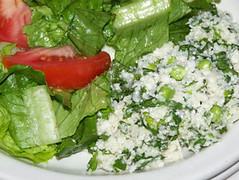
Read more: Makin' It Monday: Refreshing Cauliflower Mint Salad
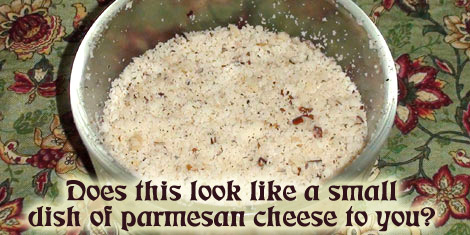
Back when we ate cooked foods (especially way back when our menu was not exclusively vegan), parmesan cheese seemed to be a staple of our existence (especially for Jim). We'd sprinkle it liberally on pasta dishes, salads, soups, and more.
As is typical for many raw foodies, you often realize after going raw that it was not always necessarily the food itself that you craved (no matter what it was); often it was simply the texture, the spices, the various flavors and tastes, etc. And that realization leads raw chefs to wonder whether the same experience can be recreated using only raw ingredients.
Read more: Quick Raw Tip: Making Your Own Raw Vegan Parmesan Cheese!

I'm not sure I'm getting enough carbs 'cuz I eat very little grains or beans and I am always worried of overdoing fruit.
Well, rest assured that if you are consuming enough calories with your diet, and not exclusively eating fats and proteins, you are most likely getting enough carbohydrates. Carbohydrates exist in just about anything you can eat. By simply eating enough food during the day, you can easily meet your body's carbohydrate requirements.
There are two classifications of carbohydrates: simple and complex. Grains and beans fall under the complex category, while fruits fall under the simple category.
Read more: Am I Getting Enough Carbs Without Beans and Grains?

Jim here... A few months ago, I was in our local food co-op's juice bar. I'd ordered an apple juice and had cringed when I saw the barista chop up four Granny Smiths and nonchalantly toss the whole lot, seeds and all, into the juicer. That juice was for someone else. So, when my order came up, I politely requested that he cut the seeds out -- a request he reluctantly granted, although not without showing considerable annoyance. My thinking was: Hey, those seeds contain cyanide! Why would I want to consume that, even in small amounts
 But then... Have you ever known anyone who died from eating apple seeds? ?I know I haven't. Also, after mentioning this to a few people I know, I found that a number of them regularly ingest apple seeds. And, well, they're still living. So, is there any truth to the rumors? And, should we be concerned at all about this?
Read more: Should You Juice the *Whole* Apple, Seeds and All?