Know Any Literary Animal Lovers?

Hi there PureJeevan readers! We wanted to let you know that Jim's new novel CHROO is available on Amazon. It's a crazy adventure involving a billionaire heiress, her Chihuahua BFF ("Chroo") and a host of human and animal characters. Find out more on Amazon! Here are some links:
Jim here... Whether you've had the pleasure of knowing Wendi for decades as I have, or have only recently met her, I think you'll be absolutely stunned by this inspirational video. It demonstrates, in undeniable pictures, the power of raw and living foods -- and not only the physical healing that takes place when you adopt this lifestyle, but also the height to which this lifestyle helps lift your spirit.
Read more: Wendi Dee's Raw Food Weight Loss Transformation Video
Is cacao dangerous or is it a super food? Anyone who's been learning about raw foods knows about raw cacao (check out a recent episode of Know Your Food: Cacao). It's raw chocolate without all the processing and additives normally included in the chocolate bars many buy from standard grocery stores. In its raw form, cacao has different nutritional components than typical processed chocolate. Many claim that raw chocolate is filled with mega doses of nutrients, making it a super food, and therefore extremely healthy for the human body. Others claim that even in its raw state, cacao is a stimulant that taxes the human body and cacao is more like a poison than a food. I've heard murmurs about negative effects of cacao for many years, but that was always subdued by the vociferous praise of cacao.
Recently, my friend Kevin Gianni (The Renegade Health Show) spoke out about cacao and his experiences with it. Kevin is well known in the raw food community, so his words came as a shock to many people. He explained in his video (below) that he developed a rash on his stomach. After much investigating and diet changes, he came to the conclusion that cacao was causing the rash (eliminating the cacao caused his skin to clear). He also stated that cacao had been stripping his body of vital minerals. Kevin pointed out that he was simply sharing his own experience with cacao, possibly shedding some light on a subject that may need to be further investigated. He advised others to take a look at their own reactions to the food, to see if they are experiencing any problems.
As we said yesterday, we have some fantastic videos to share from RSF East last weekend. To launch a series of interviews, we want to reiterate that Pure Jeevan has always been a holistic site, meaning that we like to focus on all aspects of a human being's optimal existence (mind, body, spirit, and emotions). While it's not always "all about the food" here, it's also fair to say that it all really does start with the food -- super-nourishing 100% raw living foods! So, it's only appropriate that we begin this series of interviews with a raw food chef.
RawDawg Rory was a huge pleasure to meet and hang out with. The man exudes happiness, and it's quite infectious! We had a great time talking, and of course talked a lot about tasty raw foods. In this video, RawDawg shares a delicious dessert recipe. Here it is:


In our Mnemonics for the ?Clean 15? ? Or, ?Conventional? Produce That Tests Lowest for Residual Pesticides blog post last week, we put an asterisk next to "sweet corn" and took it off our list of foods to eat. Even though sweet corn tests relatively low for pesticides, Pure Jeevan still feels the vegetable isn't a safe choice for a healthy diet. There are primarily two reasons for our decision to completely remove corn from our diets. First, of all the vegetables that have undergone genetic modification (GM), GM corn is one that has been proven to cross-pollinate with non-GM corn. Second, since corn is so plentiful and easy to grow, it has been modified to become all sorts of flavors, sweeteners, fillers, etc., in food products and many individuals have developed sensitivities to it.
Read more: Is Corn Safe to Eat? No, and Neither is Most Papaya!
I am very fair-skinned, with light eyes and medium-colored hair. For as long as I can remember, the sun made me feel ill. The older I got, the sicker I'd feel. I felt uncomfortable in the heat, my skin would feel all prickly, I got horrible headaches, and sometimes I even got sick to my stomach. I've always loved being out in nature, but on really sunny days, it bothered me and I'd try to stay in/near the woods and the shade.

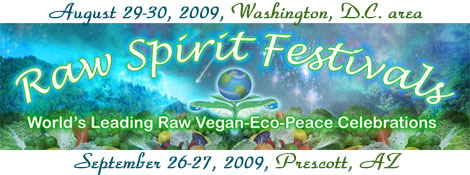
Many people have asked us about the Raw Spirit Festival (RSF): What is it? When is it? Where is it? Will we be going ? So, we wanted to take a moment to answer those questions.
-
What Is It ? Well, as any long-time reader of this blog is likely aware, RSF is a very special event! Not only does it have its own web site, which we encourage you ti visit in order to learn more, but we've also devoted an entire category of the All Raw Directory to "Raw Spirit Festival Memories," a place where people can post links to blog entries, photo sets, and videos from various RSF events.
?

A Pure Jeevan family member recently asked us how they can tell if they're consuming too much protein. They felt because they have been eating too many nuts and seeds, because of how quick and filling they are, that perhaps their intake of protein is too high in their diet.
We fully understand the convenience of the quick energy that eating nuts and seeds can bring to one's diet. We also have learned, through experience, that the more we rely on this type of nutrition (high in fat), the less energetic we feel long-term. There's nothing wrong with eating nuts and seeds as a pick-me-up between meals, as long as you're eating a small handful of them and your body does well with fats (not everyone can easily digest fats).
One of our readers, Julie, asked me to update her on what kind of diet I'm doing and why I'm doing it. The last time I publicly made changes with my diet, I received many similar questions. So, I figured maybe it would be a good idea to respond to her question here on the blog for anyone else wondering the same thing.
I did explain, in a long post, about experimenting with my diet being important to me.If you didn't read that entry, it will answer a lot of your questions. For many of you, I think I know what you are thinking: "Wendi was pretty much morbidly obese, her health was horrible, but she's now healthy. Why would she change anything with her diet when she has already found what works "?
Well, it's true. I am extremely healthy compared to how I was before I started consuming raw foods. Here are some pictures to show the changes, to motivate some of you currently struggling with eating more raw foods...

Over the next few months and the coming year, you'll be witnessing the continued growth of Wendi Dee and Pure Jeevan in ways you might not ever have imagined! So, stay connected and let us know your thoughts about the changes that are (and will be!) taking place. We're not here for ourselves, we're here for all of you and for those who don't know about us (yet!). We have a mission: to share our stories and inspire others to fully embrace their lives and be all that they could ever desire (including healthy, happy, and vibrant)!
This is a long post, even though I tried to keep it brief. It's mostly a personal entry, but I wanted to share things so that you know a bit about what's going on with me and Pure Jeevan, now and in the near future. I'll break it up a bit with some more photos from Raw Spirit, the most therapeutic and life-changing event of my life.
======Wendi Dee's Growth======