Know Any Literary Animal Lovers?

Hi there PureJeevan readers! We wanted to let you know that Jim's new novel CHROO is available on Amazon. It's a crazy adventure involving a billionaire heiress, her Chihuahua BFF ("Chroo") and a host of human and animal characters. Find out more on Amazon! Here are some links:
Continuing on, again, with Wendi s San Francisco travelogue:
After leaving Pete and Blessing, we had a little time before our next meeting. So, KDcat and I explored San Francisco a bit. We saw the largest rainbow flag we've ever seen, experienced the steep hills (much steeper than the ones in Pittsburgh), and checked out an overview spot called Twin Peaks. Our San Francisco host taught us later that evening about how to "curb" your car and always apply the parking brake (which is necessary in a place with such steep hills).
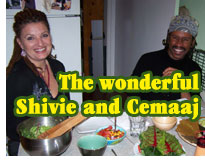 Later we met up with Shivie and Cemaaj, who heard we'd be in town and invited us to visit them for a raw meal? in their home. Wow, what a delicious and beautiful meal we were served! Shivie and Cemaaj are gentle, loving people with a true gift for preparing and serving gourmet raw foods. We were honored to be invited to visit with them and loved them both instantly. They were a lot of fun getting to know, and very generous (sending raw foods with us before we left to eat and share with our San Franciso host). Cemaaj is also a gifted musician and taught KDcat some rhythms on the djembe African drum, which she quickly learned and enjoyed very much! Cemaaj is a gifted teacher and great with kids. It was fun watching him ease her into the instrument, which she now says she'd love to own and practice on!
Read more: Part 3 of 4: Glowing Gypsy Gals Glimpse the Glorious Golden Gate's Gastronomical Goodness
Jim here... Since many people have asked me how she liked the surprise gift, here's a quick, unedited video taken last Saturday on Wendi's birthday. We had gone to the park that evening to hang out and catch some fresh air. I took a few minutes to ask her about her day, and thought I'd share this with you.If I showed you the video of her receiving the gift that morning, I'm afraid all you'd see would be tears all around the dining room table. (We were all rather emotional about it.) So, take a look at this video for now. Wendi said that she wanted to write something here as well. So, that will no doubt be coming soon.
By the way, at the end of this video, Wendi mentions another video of a man we interviewed earlier that day on Wendi's birthday. I was going to edit some of that in, but we decided to run that video here on its own this Thursday because it addresses a question Wendi gets quite often. You'll love that video, as it's a great testament to the power of raw foods. For now, I hope you like the above vid (even though there's a fair amount of dog posterior that I should have edited out - LOL).
Read more: Wendi Dee Interviewed About Her 25th Birthday Surprise!
Jim here... Wow, we haven't posted in a few days. That calls for some action! Hmmm... how about taking a look at some delicious mini pizzas Wendi whipped up the other day:
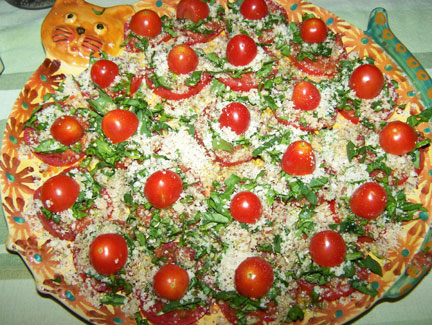
We went absolutely nuts for these little "pizzas." They were both tasty and fun. If memory serves, I believe she made them by taking slices of firm roma tomatoes, spooning on some improvised pesto sauce that she whipped up, sprinkling on some chopped basil leaves, sprinkling on some "cheese" that she made with ground Brazil nuts, garlic, and salt, and then topping each "pizza slice" off with a half cherry tomato. No recipes necessary here; just take a look at the picture & go try it!

I have enjoyed including information about new people, companies, and sites here in our blog for you to meet each Tuesday. Today, however, I want to do something a little bit different. Instead of someone or something being introduced to you, I'd love for YOU to introduce yourself to ME!
Take the time for ME to meet...

Jim here... A few months ago, I was in our local food co-op's juice bar. I'd ordered an apple juice and had cringed when I saw the barista chop up four Granny Smiths and nonchalantly toss the whole lot, seeds and all, into the juicer. That juice was for someone else. So, when my order came up, I politely requested that he cut the seeds out -- a request he reluctantly granted, although not without showing considerable annoyance. My thinking was: Hey, those seeds contain cyanide! Why would I want to consume that, even in small amounts
 But then... Have you ever known anyone who died from eating apple seeds? ?I know I haven't. Also, after mentioning this to a few people I know, I found that a number of them regularly ingest apple seeds. And, well, they're still living. So, is there any truth to the rumors? And, should we be concerned at all about this?
Read more: Should You Juice the *Whole* Apple, Seeds and All?
Jim here... Wow, it's Monday, April 27! Let's do something different today: Let's celebrate Monday instead of bemoaning this day that represents the taditional start of the dreaded work week. Why? Because it's our sincere hope that whatever you do in your work week is a labor of love. And, if you're not quite there yet, then celebrate the fact that you WILL be there sometime soon. For us, it means another week of working to inspire you to achieve optimal health -- and that's not "work" at all; it's actually FUN!
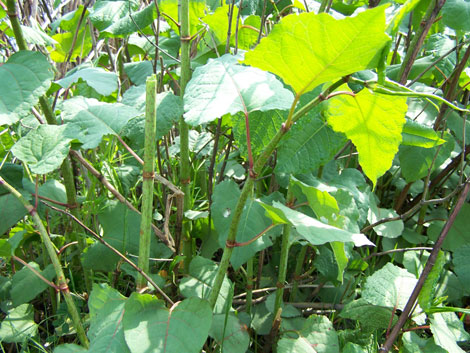
So, without further adieu, let's jump into this week's fun. Our good friends Melissa and Dave Sokulski have launched a site recently called FoodUnderFoot ("unleash the energy of wild edibles"). Even in it's young seedling state, I think it's already a fascinating site, and promises to become an encyclopedic web destination for anyone interested in foraging wild edibles. So, check them out for some informative info and valuable freebies, too!

Jim here with another exciting edition of Weird Wednesday. You know, each time I say "weird," I don't always mean the same thing. Sometimes "weird" means odd or strange. Other times it means funny or ironic. It might also mean unusual or out-of-the-ordinary. Come to think of it, the definition of weird is also weird.
Today, I was thinking about an old friend, Jim Banholzer. He lived next door to Wendi and me when we first moved to the D.C. area in 1991. We all lived in a small "garden apartment" complex in Falls Church, Virginia. Our roommate at the time worked as a leasing agent there, which qualified us for a decent rental discount. I think we paid $800 or so for the place, an upscale 2-bedroom townhome close to the community pool. Jim lived next door with one of the more unstable people I've ever met (and, trust me, that's saying something).
Today, for Take the Time Tuesday, I'd like to introduce you to an online social networking Web site for those with similar interests to get together, meet, and hang out in the physical world. If you haven't already heard about it, check it out!
Take the time to meet....

Today we wanted to do something fun and a bit unusual. We raw foodies are a creative bunch, so we? thought, "Why not profile a handful of raw musicians !" Sounded like an interesting project, as we've all heard of at least a few raw foodist musicians out there. So, here are a dozen raw musicians to get you started -- that's right, FOURTEEN wonderful raw musicians!? (Since when does a dozen equal fourteen? Well, we figure that cooked foodies have their "baker's dozen," which everyone knows is thirteen.We figure: Why be outdone by the cooked food world, eh? So, we're redefining things a bit!)
Anyway, some of these bands/musicians are internationally famous; others are names you may not have heard before. We asked some of our friends to suggest raw musicians for today's post and we were surprised with the number of musicians mentioned! All those listed below are reportedly raw (or, in the case of whole bands, at least one or more of the members are raw foodists).Please note that this is by no means a complete list.
Welcome to Day 2 of Pure Jeevan's "Salad Dressing Week"!? Today we take a trip across the Pacific to the land of the "Rawsing Sun." I've yet to meet any raw vegans from Japan, but would be highly interested in hearing about what it's like to be raw vegan there.
 Today's video not only shows a tasty salad dressing recipe, but it's really a testament to bold improvisation in your raw kitchen. In order to create something new, you really have to be willing to experiment. Sometimes you simply fail!? But, more often than not, a recipe that you have not quite perfected just needs some tweaking.

For the past twelve years I've been doing some monthly freelance work for a nonprofit company. I've done other work in addition to the work for this company, but for the past few years I've solely been working with them. The work is sweet---straight-forward desktop publishing for a legal advertising publication. I don't have to read, write, edit, research, or anything else---simply format the pages. The pay is great, too!
Well, I just received a call a few minutes ago notifying me that the publication will no longer be printed. I'm overjoyed for the trees---I wish all publications would go digital. However, since it's going digital, they won't be needing my services much longer.