Know Any Literary Animal Lovers?

Hi there PureJeevan readers! We wanted to let you know that Jim's new novel CHROO is available on Amazon. It's a crazy adventure involving a billionaire heiress, her Chihuahua BFF ("Chroo") and a host of human and animal characters. Find out more on Amazon! Here are some links:

A few years ago, my dear friend Melissa and I decided to split the cost and order a raw food home study course (then known as The Dr. Ann Wigmore Program).Let me tell you, this was not a cheap program that we purchased, but at that time there wasn't as much free information available on the Internet like we now have.
Was it worth the cost? Well, kind of. Since we had both been reading and learning so much about raw foods (she had actually been raw for a long time many years before), much of the information wasn't new to us. However, if someone was newly learning about raw foods, the program would probably have been fantastic. The quality of the materials we received wasn't great (photocopies of photocopies that were sometimes difficult to read, and some videos that were blurry or difficult to hear), but at least we had a lot of information at our fingertips.

Day 9: It's the final day of Navratri, often the largest day of celebration. On this day in India new businesses are started, children begin their formal education if they are at the right age, and past regrets (and many times debts) are left behind. It's a new beginning, fresh start, and is celebrated as such. Today, Pure Jeevan is celebrating in a big way, too!
 Yesterday, Jim handed in his resignation where he works. He was closing old books, imagining new ones, and today markes his first step of his new life. He gave the office one month's notice, after which he'll be here in Portland. Our new life has officially begun!
Short post today... We're currently dealing w with a pesky kitchen drain issue that's wreaking havoc in our household. Fortunately, a very talented and power-tool-weilding local plumber just fixed the problem. In the process, he seems to have applied those power tools to our bank account -- $175 for less than one hour's work!? (Ouch!) And the kicker is that the current state of our kitchen is "absolutely atrocious."? I'm serious... we're at like DefCon 5 in terms of the disastrous nature of that room -- and as you well know, for a raw household, that's probably 10 times more frustrating than it is for others. (I smell a whole post coming soon on this topic ...)
Today, we mainly just wanted to say that, at the end of our post yesterday, we briefly asked what you would like to see more of here at Pure Jeevan. We have received some great comments and emails in return, and have decided to devote tomorrow's post to responding to / addressing some of the suggestions we received. So, if you have any further thoughts to share about raw foods content you'd like to see more or less of, please let us know either by commenting below, or by email. Wendi is at WendiDee [at] Pure Jeevan.com. Jim is at Rawdiant [at] gmail.com.

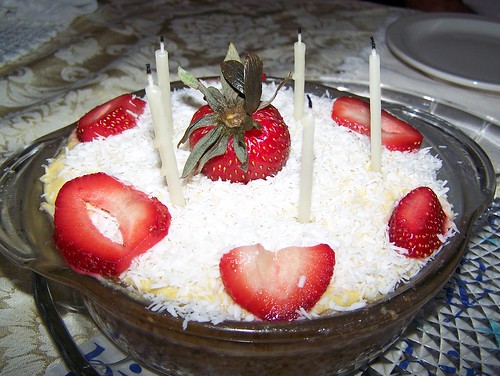
What better way to start our Fun-Filled Friday than by celebrating Jim's birthday ! He worked for half the day and now he's home for a long weekend. So far we've had a nice lunch (cashew/macadamia cheese with red peppers and celery) and birthday pie (mango and pineapple!) after singing "Happy Birthday" to him! This evening we'll have veggie stir-not-fry, since that's what Jim has requested. I prepared it earlier and it's in the dehydrator to marinade and get a bit warm.
It is with heartfelt gratitude that I reach out to say thank you for all of the lovely birthday wishes from all over the world.
As many of you know, I've been working on all aspects of myself---continuing to grow healthier in all ways (body, mind, spirit, and emotions). After a lifetime of feeling that I wasn't worthy of my own attention and affection, I learned to love myself. That was a huge thing for me and I am still overjoyed to acknowledge who I am and proudly proclaim that I love myself.
I'm not perfect, but I'm perfectly me---allowing myself to blossom more fully into who I am as the days go by. I've been openly sharing my journey because I know that I'm not the only person who has lived a life without self love.I receive emails from so many of you saying that you can relate to what I've been through, the pain I've suffered on all levels. You've shed tears and thanked me for my story because it has helped you see more clearly your own self. With open arms, and an open heart, I love all of you. It brings me great joy to know that through sharing I am able to help you grow and blossom more into your own beautiful selves. Imagine a world where we all know and love ourselves for the lovely individuals that we all are! What a beautiful and fragrant garden there would be!
Do you know the saying about freely giving out love because you never run out of it? Well, that's definitely true! There's something else that happens, however, the more you share love: it comes back multiplied more than you ever could have imagined! That's what happened to me on my birthday--I was overwhelmed with a flooding of love coming in from all over the world!
Many of our visitors go directly to our raw food recipes section of the blog. They must be terribly disappointed to find only a few recipes there. We ll continually add more, but for now there are only a handful. So, it is with extreme pleasure that we introduce you to someone you are going to love!
Take the time to meet...

A month has gone by since my last health update. At this point, I consider myself healed of lyme disease! In the past I asked the lyme specialist doctor if there's a way to test to see for certain the lyme is gone, but he said there isn't. So, I go on my inner wisdom, which tells me that it's gone and now I simply need to continue healing from all that the lyme brought with it.
We're still not comfortable sharing what we've been learning and doing to help move my body into an even healthier state, but it's obviously working. I've been able to go back to daily living, for the most part, without much assistance at all. I've organized the house again (Jim and KDcaT were busy caring for me and the house wasn't the top priority for the past half a year), caught up on all of the laundry, responded to all of my email that had been piling up, and I've been able to be more social again. The biggest improvements are that I can now prepare my own food without experiencing any pain, and I can dress myself with only minimal assistance at times! BIG improvements!
I received some very sad news about the holistic doctor I've been seeing during my raw journey. Dr. Amy Ruth Stine died Saturday after a rock climbing accident. This news breaks my heart. Dr. Stine was an amazing woman and doctor. She was extremely intelligent, acutely in tune with how we are all connected and one, compassionate, loving, thoughtful, and had a gift of really getting to know each patient as an individual and friend.
It was with Dr. Stine's care that I was able to track my progress with the raw food diet. She encouraged me to follow my instincts (which were telling me that raw is the way), cheered me on with the many changes that I was going through (physically, mentally, spiritually, and emotionally) over the years, and told me many times that I inspired her! Imagine how wonderful that made me feel---to be inspiring someone as wonderful as Dr. Stine.


I am extremely thankful for sleep. I can't imagine striving to sleep only four hours a night. Jim always says he wishes he didn't have to sleep, that he's wasting his life when he sleeps. For me, I've always loved sleeping. I feel so great after I wake up. Not only that, I thoroughly enjoy dreaming. I wouldn't want to miss out on the amazing dream life I've been able to enjoy while I sleep.
Today I am thankful for the small things in life that often go overlooked. I'm thankful Jim made some sweet dessert last night when I wanted it. I'm thankful KDcat is having a fun time with some of her friends right now. I'm thankful that: the trash collectors just picked up the garbage (we don't produce a whole lot since going raw); the older woman across the street has started smiling and being nice to KDcat; the sun is out and the snow is melting; I have another computer job to work on for some income.

I have enjoyed including information about new people, companies, and sites here in our blog for you to meet each Tuesday. Today, however, I want to do something a little bit different. Instead of someone or something being introduced to you, I'd love for YOU to introduce yourself to ME!
Take the time for ME to meet...