Know Any Literary Animal Lovers?

Hi there PureJeevan readers! We wanted to let you know that Jim's new novel CHROO is available on Amazon. It's a crazy adventure involving a billionaire heiress, her Chihuahua BFF ("Chroo") and a host of human and animal characters. Find out more on Amazon! Here are some links:

There are many things to be thankful for in this life, but for our very first Thankful Thursday entry we'd like to stress how thankful we are for the vibrant health we now have. Consuming only fresh, organic raw fruits, vegetables, nuts and seeds has allowed our bodies to heal from the inside out. For this we will forever be thankful. In fact, we are so thankful that we are here, as Pure Jeevan, to spread the word about how raw, life-filled foods can bring you renewed health!

To help keep all of you inspired, we ve asked some
remarkable individuals to share their raw food stories with you. Enjoy!
Here's a basic recipe that can be used to create any nut milk!
Nut Milk
1 cup of nuts or seeds?

Yesterday's smoothie was superlatively tasty, eh? It was clearly something out of Elvis' more energetic younger years, I think. You're probably wondering: "How does one follow an Elvis smoothie?!" I know ... it'll be tough to do.
Read more: Protein Powder Smoothies Part 3 of 3: The Donald Smoothie

Jim here with another intriguing installment of Weird Wednesday.Look, I'm a hugefan of gigantic, mondo salads. If you (well, not raw foodists but most SAD-diet Americans) were to visit our house at lunch time, you'd likely think that the individual salads on our table are as big as the salads bowls put out for entire families (for those few families, relatively speaking, that serve any salad at all these days, that is).
Seriously, when I have enough prep time, I like to pile 'em high with organic green leaf (though I'll take red leaf or romaine frequently), tomatoes, carrots, onions, peppers, apple slices, pepitos, sunflower seeds, raisins -- basically everything but the kitchen sink.
***** DISCLAIMER: As with all of our posts here at Pure Jeevan, and particularly those tagged with a new term, "Nadi Balance," please refer to the disclaimer that runs at the bottom of all Pure Jeevan pages. Wendi and Jim are health researchers, educators, and extreme self-experimenters, not doctors. ******

There are four parts to blood: red blood cells, white blood cells, platelets, and plasma. Using a specialized microscope, one can easily view these parts of the blood. Red blood cells deliver oxygen to, and carbon dioxide from, the body. White blood cells, also known as leukocytes, help defend the body against disease and anything that they see as unnatural or foreign. Platelets help form clots to prevent bleeding. Plasma, comprised of about 90% water, is the fluid that transports all of the above.
Aren't these videos wonderful? Today we have yet another special Raw Spirit interview for you -- the mega-talented Markus Rothkranz. What can I say about Markus? He's a true inspiration, a man who truly lives by his heart and inspires thousands of others on a daily basis. He's actually very tough to interview because he's so interesting and self-actualized, you really just want to hang and chat with him (but then you remember that you're on film and you should probably get back to asking questions that people will appreciate).

In this special five-part series, Joanna Steven uncovers where some top vegetarian athletes get their protein. Here's part one, focusing on Tim VanOrden's take on this issue.
When alternatives to the Standard American Diet are discussed, protein is on everyone's mind. There are many reasons why someone might want to eat a plant based diet, whether for allergy concerns, health reasons, or more variety. But nagging doubts often come up;? Are plant proteins adequate for athletes and body builders ? Are they really the preferred protein source of the human body ? Are they better than animal based protein or are they just consumed for environmental reasons ? To answer these questions, why not ask the experts:? triathletes, professional dancers, bodybuilders and extreme sport racers ? Here are the answers from some of the most competitive athletes in their respective fields.
Read more: Vegetarian Athletes Share: Top 5 Sources for Animal-free Protein (Part 1 of 5)

Quick note: Jim here... So strikingly pervasive is the "winter blues of 2010" that I suspect many of my friends will think this is about them. But, it's just some thoughts, really -- not in response to anything or anyone in particular. (In fact, if anything, it's in response to something related to our dog, which we'll no doubt write about at some point.)
I sense that there is a useful blog post on the topic of "raw during tough times." However, after pondering the topic at length, I'm just not exactly sure what to say about it. I do know that quite a lot of people come to feel disappointed in themselves for straying from the healthiest path. It's a story I've read over and over on raw web sites and blogs, perhaps more frequently in the winter. It starts out the same: Someone goes raw, gets all fired up about it, and soon starts feeling youthful and vibrant again. The high lasts for a while, but then ... something happens. They slip back to cooked foods -- or worse, to junk foods. Sometimes the process repeats itself for years.

Okay, it's question day once again -- and we've received some great ones lately. Before I begin, just let me reiterate once more that Wendi and I can't give medical advice here. We're motivational, inspirational raw food / natural health writers and educators (considerably knowledgeable and experienced ones, I might humbly add!); not doctors.So, whenever we give "advice" (or, whenever our writing appears as such), what we really mean is, "Well, if that were me, this is what I would do." And, the rest is in the disclaimer that runs on all of our pages.
 Not only do we not give medical advice because we're not doctors (as if that wasn't enough of a reason!), but we also know that each person is different and, as such, all symptoms and conditions are unique to each person's individual situation. If person A and person B are both experiencing high blood pressure, it could easily be two different things causing that -- and the treatments or approaches could differ tremendously. What might fix person A might kill person B! (Sorry person B. No hard feelings.)
Read more: Reader Question: Returning to "Healthy" Eating After Healing with Raw
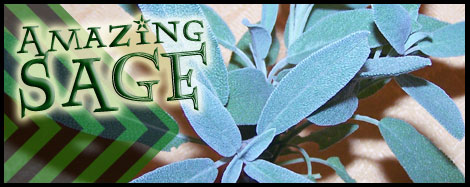
Well, we've always found the herb SAGE to be delightful in so many ways. That's why we've grown it here and elsewhere for years. Such a lovely, fragrant, sturdy, resilient herb, it's truly one of the easiest plants to communicate with -- and YES!, it truly IS a meaningful dialogue when you step out into the garden and sit among a patch of sage. All you need to do is listen carefully, and sage will speak its sage herbal wisdom to you.
I was wondering how sage came to be known as "sage" -- when all of the sources I had handy simply listed its technical name, salvia, along with its common name. Enter the great Wiki for an answer:
Read more: Please Tell Everyone: "I Read Some *Sage* Words at Pure Jeevan Today"