Know Any Literary Animal Lovers?

Hi there PureJeevan readers! We wanted to let you know that Jim's new novel CHROO is available on Amazon. It's a crazy adventure involving a billionaire heiress, her Chihuahua BFF ("Chroo") and a host of human and animal characters. Find out more on Amazon! Here are some links:
 Well, after three long days of train travel, Wendi and KDcat arrived in Portland. I knew they'd had a rough trip (as I'd posted, Wendi experienced some serious motion sickness!), so I booked them into an awesome Bed & Breakfast, literally across the street from the raw restaurant they were planning to visit. That B&B is called the Lion and the Rose Victorian Bed & Breakfast Inn. Wendi said everyone there was super-nice. (There was a neat synchronicity about it, too, which I'll post in the comments section.)
Thanks to everyone for the motion sickness tips! Wendi's feeling better, but after such a long train ride, she and KDcat still feel the effects on their balance (feeling like they're still moving, slightly dizzy, ears blocked a bit etc.). I suppose train travel takes a little getting used to. But, again, they're feeling much better.
Even though it was a short stay in Portland, they managed to squeeze in a meetup with two Pure Jeevan family members, Ann Chatterton and Tracy Partridge Johnson (as well as Ann's children, Zoe and Zack, and Tracy's son Brandon). They met up at the Blossoming Lotus, an organic/vegan venue that offers some gourmet raw dishes. Here's a slideshow!
Read more: Wendi and KDcat Wonderfully Welcomed to the West (See Slide Show!)
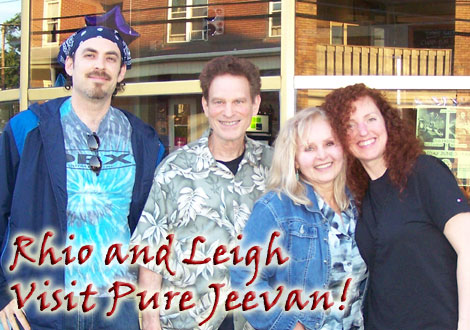
Jim here... We had a whirlwind weekend last weekend when the uber-talented couple Rhio and Leigh came to Pittsburgh for a three-day visit. As many of you probably know, Rhio is a well-known pioneer of the raw food movement, having written one of the definitive books on raw foods, Hooked on Raw. She's also the host of a popular Internet radio show of the same name, for which Leigh serves as primary engineer and co-host. Both have extensive backgrounds in music, as well, which is fitting for such a colorful, vibrant couple.
Saturday, Rhio gave a two-part presentation to a capacity crowd at a local coffee shop / art gallery.Part One was a demonstration on making raw dairy-free yogurt using almonds (a technique demonstrated, I believe, on her new DVD, "What's NOT Cookin' in Rhio's Kitchen " -- available soon on her web site at www.rawfoodinfo.com). According to the yogurt eaters in the crowd (of which I'm not one -- never went in for much dairy), the recipe mimics yogurt perfectly! So, if you're a raw foodie who misses dairy yogurt, you're definitely going to want to connect wth Rhio to learn the technique.

Welcome to Pure Jeevan's "Juice-a-Day Jamboree"! You're probably wondering, "What IS Pure Jeevan's Juice-a-Day Jamboree, anyway "? Well, it's simple:? It's an ongoing, informal, loosely organized "event" centered around juicing. Think of it as an interim step between (1) any kind of diet or lifestyle, from SAD to full-on raw, that does not include much regular juice, and (2) an all out juice feast where that's ALL you'd consume for a period of time. Basically, we're saying, "Let's just make this simple and accessible for everyone. Let's just make a goal to simply drink more fresh juice!"
Wendi and I have been thinking a lot about incorporating more juicing into our lives lately (which is something we've done off and on over the years but never stuck with long-term). One thing holding us back from doing it more often is the time requirement. When we juice, it usually takes a half hour or so from start to finish. I know it doesn't seem that complicated, but I suppose it's just the whole process of setting up the juicer, washing and peeling the produce, juicing it, setting the juice aside while we clean the juicer, doling out the juice into glasses, cleaning up the mini-mess that makes, and then sitting down to actually enjoy the juice.

Wow, we've been getting a lot of publicity lately.(We'll be writing more about that later.) We're thrilled to be recognized for the work we're doing for the raw food community!
For those newly acquainted with Pure Jeevan, you've already found our blog (this site), and likely our main site. But, we also wanted to highlight another offering we've put a lot of work into -- the All Raw Directory. Here's a screenshot:

I'm excited about something that one of my friends has been working on. Melissa is gifted in so many areas, one of which is wild edible identification. She recently told me she was working on something that would help a lot of people and I was excited about her new project. Well, now it's ready to be shared with everyone!
Take the time to meet...

We have two events scheduled for this weekend and we are looking forward to both of them! The first is a Raw Food Potluck Meetup. I haven't decided what I'm creating, yet. So far I'm thinking I'll make either an apple pie or some beet noodles with alfredo sauce, but I know how things usually go when it's time for me to prepare something special. I usually feel like I don't want to make what I had planned, and I search around in the fridge to see what pops out at me. I almost always go by what I'm inspired to create at that moment. So, who knows what I'll end up making. I'll try to take pictures of my creation as well as pictures of the other raw food dishes that others bring.
This will be our first raw food potluck. When I first went raw it was something I was doing special for myself, by myself, so I didn't join any of the raw food meetups and didn't want to make it a group activity with my friends.After two years of raw (a little over one at 100%), I've done (and continue to do) what I needed for myself.Now, I'm ready to share my experiences with everyone and to be an active member of the raw food community.So, I'm looking forward to the raw food potluck tomorrow!? You are welcome to join us at the potluck if you are in the area!

To help keep all of you inspired, we ve asked some remarkable individuals to share their raw food stories with you. Enjoy! (Today's "My Raw Story" is also a special installment for our Diabetes Awareness Week!)

In our Mnemonics for the ?Clean 15? ? Or, ?Conventional? Produce That Tests Lowest for Residual Pesticides blog post last week, we put an asterisk next to "sweet corn" and took it off our list of foods to eat. Even though sweet corn tests relatively low for pesticides, Pure Jeevan still feels the vegetable isn't a safe choice for a healthy diet. There are primarily two reasons for our decision to completely remove corn from our diets. First, of all the vegetables that have undergone genetic modification (GM), GM corn is one that has been proven to cross-pollinate with non-GM corn. Second, since corn is so plentiful and easy to grow, it has been modified to become all sorts of flavors, sweeteners, fillers, etc., in food products and many individuals have developed sensitivities to it.
Read more: Is Corn Safe to Eat? No, and Neither is Most Papaya!
In this video, Pure Jeevan heads to Washington, D.C., to visit some close friends. See what these raw foodists pack to eat for the weekend and hear proof that Wendi Dee is getting younger! A friend who has known Wendi for 20 years says she now looks as young as she did when they first met! *giggles* Raw foods are AMAZING at restoring youthfulness! Are you getting younger, too !
You'll see a picture of a raw apple pie that Wendi created (the recipe is included in our free raw food recipe ebook) and hear her friends rave about the raw cheesecake she prepared for them. It's always nice to make some extra special raw treats for your friends, so they can see that you're enjoying the food that's helping you regain your health (and youth!).

Yesterday we talked about attending raw food meetups / potlucks. Today we'll focus on...
*Hosting* Raw Foods Meetups
There are two main ways to host a raw foods meetup. The first would be through the meetup.com web site. If there is no raw foods meetup in your area, you're going to need to launch one. (See the Meetup web site for details.) If there is a group, you'll need to sign up and get to know the moderator, as you'll need to announce your meetup through that person.
Read more: Raw Meetups: What to Bring, How to Host Them (Part 2)
Here at Pure Jeevan we are preparing for our cross country tour to educate others about raw foods. This means we are paring down on a lot of things, donating a lot, selling some things, and pretty much not buying anything unless it's absolutely necessary. That's what we've been doing for almost two years now (we're waiting for the house to sell). Recently, however, I decided it was time to spend a little bit of money even if it wasn't absolutely necessary.
-
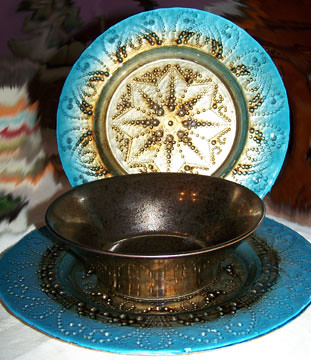
- Wendi's Dish Set
What did we buy? Dishes! Seems a bit strange to finally spend some money on something unnecessary and have it be dishes, right? Well, I had a few reasons for this purchase. The first is that when we are living in the RV, the space is going to be minimal. There won't be a lot of room for dishes, let alone much of anything else. Since there's not a lot of space to have dishes drying, we'll need to be washing, drying, and putting away immediately after use. That may not sound like a big deal, but when someone in the family decides to eat a few different things and leave the dirty dishes in the tiny RV sink, on the small counter, or somewhere else, it's going to really seem like a bigger mess than it is. So, to remedy this I thought it would be good for each of us to have our own dishes. That way we have a sense of responsibility for our own particular dishes--we know they are ours and we are responsible for taking care of them.