Know Any Literary Animal Lovers?

Hi there PureJeevan readers! We wanted to let you know that Jim's new novel CHROO is available on Amazon. It's a crazy adventure involving a billionaire heiress, her Chihuahua BFF ("Chroo") and a host of human and animal characters. Find out more on Amazon! Here are some links:

The way your smile just beams
The way you sing off-key

Jim here... Today Wendi is busy preparing for a multi-day activity that I'm sure she'll be writing about later this week. So, I thought I'd field a question we received recently (one directed specifically to me). We do receive a good deal of questions at our Raw Food Diet Question In-box (at Questions [at] PureJeevan.com), so feel free to send any in that you may have, and we'll definitely get to them all here in time. In any case, one reader writes:
As drawn as I am to a raw diet, being mostly cooked vegan right now, I can't help but come up against this each time: Since produce is, after all, mostly water, what did you eat while transitioning that didn't lead to shoving in lots of bread, potatoes, etc. Do you just eat lots and lots of, say, oranges, at one go? This has always been my raw downfall. I'm sure the answer is very simple.
Wow, this is a great question, and one with many possible answers! To begin, let's recognize that this isn't a question from a "SAD diet" eater. ?Being a vegan, alone, takes significant learning and (often) self-discipline to accomplish successfully. It's also, in my view, an excellent dietary and lifestyle choice for many people, regardless of whether they ever decide to try a raw foods diet. So, this question is rather advanced.
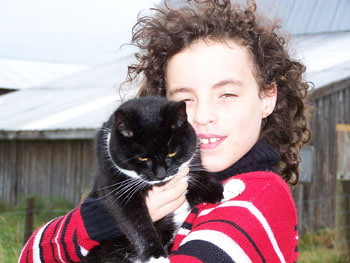
You rarely hear us talk about our daughter here on the blog. Some of you have noticed and asked questions about her through email. I'd like to tell you why we don't write about her very much, because there's something to be learned from it.
First, I usually don't like to write about people unless I get their permission. This is especially true when my daughter is concerned. I respect her privacy if she chooses for me to not share things about her life. Years ago when I knew I wanted to create the Pure Jeevan site, I talked with Jim and our daughter about it. I said it was something I felt drawn to do, that I felt it could help a lot of people, but I wanted it to be a family site if it's something they were interested in doing along with me. Jim agreed to help me at the time, but didn't fully embrace Pure Jeevan himself (now, however, he has become a very active part of this site and all of our projects). Our daughter, however, said from the very beginning that she didn't want any part of it.

I'm still doing my nine-day mono meals for Navratri. Since it's Makin' It Monday, instead of actually makin' a recipe, I'm dreamin' about it! After talking with my sweet friend Melissa, I thought I wanted to eat spinach pie when I end my mono meals. She was talking about it, shared how she was going to create it, and my mind was filling with the image of spinach pie, the smell and taste of it, and I wanted it right then.But, we don't have any spinach in the house right now. Since I end my mono meals after tomorrow's lunch, and don't have time to buy spinach at the food co-op, I decided to dream some more about what I'll be eating for tomorrow's dinner.
Then it came to me. I want beet pasta! Not just any beet pasta, but beet pasta topped with a creamy alfredo sauce! I picture it in my mind; I can imagine the taste of it, the texture, and it's so delicious. I think I want something green with it, too. Perhaps I'll start with a small salad. Ooh! Yes, that's what I'll do!
This pie is amazing and exactly like a traditionally cooked pumpkin pie! I took a few different pie recipes and altered them until I came up with this recipe.
Pumpkin Pie
Filling:

As promised, here is the picture again of the Mexican meal I created the other day. It will be served at the upcoming 3-Day Raw Food Spiritual Ashram Retreat (only a few spaces left!). Since many of our readers can't make it to the retreat, I said I'd post some of the recipes here in the blog. I hope some of you will try to create the recipes and let me know what you think!

We've spent some time on this blog talking about how much fun you can have via the meetup.com web site. If you search that site, you can probably find raw food meetups near you!? But, a few readers have asked us some follow-ups, such as What should I bring and What should I do if I'd like to host a raw foods meetup
*Attending* Raw Foods Meetups
Okay, so you signed up for a raw foods meetup group, waited patiently for the next event to come round, and now it's time!? But, wait... this is your first such outing. What should you bring
Read more: Raw Meetups: What to Bring, How to Host Them (Part 1)

Jim here... Anyone else like a good funky beat ? Who's familiar with Kool & the Gang's 1973 classic, "Jungle Boogie"? Surely a lot of people know that awesome tune. If you do, recall some of the main lyrics: "Get Down Get Down, Get Down Get Down!" That's the tune I want you to keep in mind as you read this post. Hear the drums, the bassline, the electric guitar, the horn section, the voices, the phrasing, the overall dynamics of that distinctive groove. Consider how magically it all comes together.
So, Wendi called me this morning and said, "Why don't you put a blog post up about your new challenge "

Who's been making small changes and feeling a bit brighter lately, since we've been talking about brain health? Today, let's continue focusing on some things we can actively do to minimize our chances of developing memory problems like Dementia or Alzheimer's in the future.
Yesterday we focused on heart-healthy tips to increase brain function (since heart disease seems to be linked with Alzheimer's) and I shared a heart-healthy recipe with you. Today, we'll focus on inflammation.
Read more: Extinguish Inflammation: Anti-Inflammatory Recipe

Welcome to the very first Take the Time Tuesday entry! What's Take the Time Tuesday, you may ask? Well, it's a time to meet someone special. Each Tuesday we'll introduce you to an individual or business we think might be of interest to you. So, who's in the spotlight for this very first Take the Time Tuesday entry? Pure Jeevan, of course!
Take the Time to Meet...
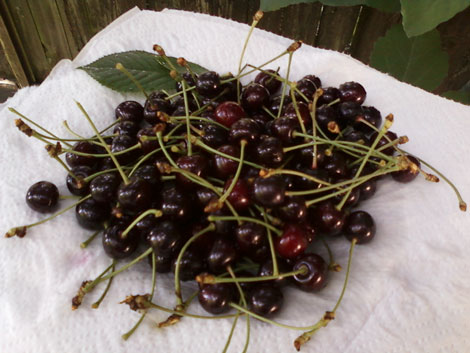
We're extremely busy this week with some home projects, so we figured we'd simply share a few interesting photos each day. Here's today's -- a big plate of freshly picked cherries from our yard! ?These are smaller cherries than you'll find in stores. We believe they're sour cherries, which is a very healthy variety, even though they're not as tasty as Bing's or Ranier's. ?They're reportedly good for pies, though. I've eaten tons of them so far; ?they're at their peak at the moment here.
I tell you... the dangerous thing about cherries is something you'll only discover when you're out there on a ladder, standing on that tip-top rung (which clearly states: "Do NOT stand on this rung!"), and you're reaching higher and higher for that next bunch of nature's goodness. Even in this situation, you find yourself thinking: "If I could just reach a *little bit* higher!" ?Sooner or later, you have to realize that some cherries are there for the birds, squirrels, and raccoons.