Know Any Literary Animal Lovers?

Hi there PureJeevan readers! We wanted to let you know that Jim's new novel CHROO is available on Amazon. It's a crazy adventure involving a billionaire heiress, her Chihuahua BFF ("Chroo") and a host of human and animal characters. Find out more on Amazon! Here are some links:
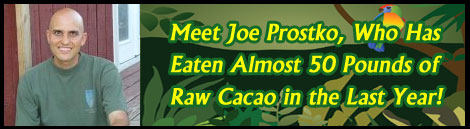
Hi everyone! Jim here with a really special treat for you today. I'm interviewing our friend Joe Prostko, who we've known for a good year or so through the Pittsburgh raw food meetup group. You may remember Joe from our cacao pod video a while back.
 We just had a big raw food potluck costume party here, and Joe showed up as an Oompa-Loompa. At first, I admittedly did not get the deeper part of this joke. I simply thought it was a novel costume because it was a character from the Willie Wonka book / movie. Later, however, it really sunk in, as I decided to flip through the Willie Wonka book to read up on Oompa-Loompas. Here's a quote from Willie Wonka author Roald Dahl:
Read more: Meet Joe Prostko, Who Has Eaten Almost 50 Pounds of Raw Cacao in the Last Year!

I'm not sure I'm getting enough carbs 'cuz I eat very little grains or beans and I am always worried of overdoing fruit.
Well, rest assured that if you are consuming enough calories with your diet, and not exclusively eating fats and proteins, you are most likely getting enough carbohydrates. Carbohydrates exist in just about anything you can eat. By simply eating enough food during the day, you can easily meet your body's carbohydrate requirements.
There are two classifications of carbohydrates: simple and complex. Grains and beans fall under the complex category, while fruits fall under the simple category.
Read more: Am I Getting Enough Carbs Without Beans and Grains?
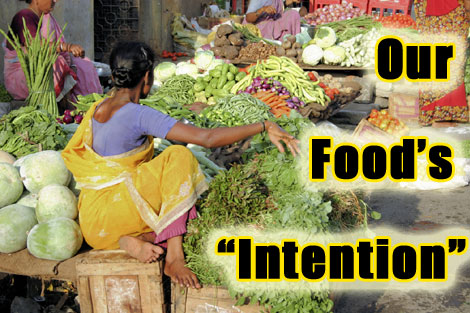
Jim here... During one of our marathon sessions at a Border's book store, I recall reading somewhere about the notion of a fruit's "intention" to be eaten. It's been a few years since I've read that, but I immediately resonated with the notion that many fruits, nuts, vegetables, and seeds are actually evolved to be eaten by other living beings and, therefore, to consume them (or their fruits and seeds) is to participate in a wonderfully nonviolent act that is in perfect harmony with a kind of primordial Earthen symbiosis. Whether these plants, vines, trees, etc. feel a conscious intention to have their fruit eaten by others is a matter of metaphysical conjecture. But, within the context of discussing vegetarianism, the argument is certainly relevant and fairly strong.
 If you walk up to a farm animal, it may be impossible to estimate what's going through its mind, but I feel intuitively that it isn't, "Please kill me and eat my flesh." In other words, there's no "intention" present in that scenario. On the other hand, it's very easy to imagine that a tree produces fruit, knowingly or not, in order to produce offspring. Throughout the entire evolution of that tree, part of that reproductive process has involved animals (including humans) eating the fruit and then "redistributing" (which is a nice way of putting it, I suppose) the seeds naturally.

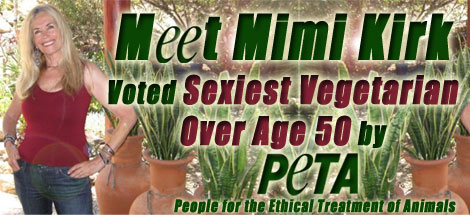
Today for "Take the Time Tuesday," we'd like you to take the time to meet Mimi Kirk, whom many of you may know as the winner of PETA's "Sexiest Vegetarian Over 50" contest last fall. If you're interested in longevity, and how diet influences the way we look, act, think, and exist, then you'll definitely want to listen closely to what this vibrant woman, who is 71 years young, has to say. We spoke with Mimi for nearly an hour this weekend, and are happy to share her inspiring interview with all of you. Below, you can listen right here, or download a podcast MP3 version.

Wow, are you in for a treat! I came up with the most delicious soup recipe today! I wanted to make something that didn't require use of the food processor, blender, or dehydrator because I've gotten quite a few emails saying that it's too hard to be raw if you don't have the money for the appliances.
I disagree that it's too hard to be raw without the appliances. It's definitely easier to do it *with* the appliances, but it's not overly hard to do it without. So, from time-to-time I'll try to create recipes that don't use anything more than a knife and a chopping board to show you that it's not too difficult to eat raw. :-)
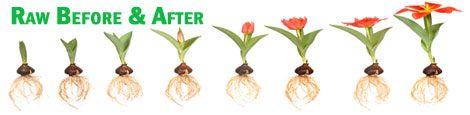
Yesterday, we covered the concept of "unsubscribing" from unhealthy practices. This was of course based on the common Internet practice of subscribing and unsubscribing to various things like newsletters and email lists. I receive quite a few of these each day, many raw foods ones and many non-raw ones. Among the non-raw, one that has been interesting to me lately is called the Art of Non-Conformity, penned by Chris Guillebeau. Basically, Chris' site chronicles his adventures in reaching his personal goal -- to travel to every country in the world! Along the way, he writes about all sorts of out-of-the-box things, as the blog name implies.
Today, he posted something that is remarkably insightful and applicable to our subject matter here, even though his context was completely different. The entry, entitled simply "Before and After," discusses the drinking water problems in much of Africa, focusing for the moment on Liberia. Atop the piece (the "before" picture) is a muddy water hole, the only source of drinking water for one village. The next picture (the "after" shot) shows a different, very happy village obtaining fresh, clean water from a newly installed well. Chris closes his article with the following quote:
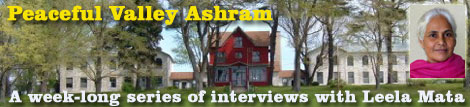
In August of 2007, I was on the verge of an emotional breakdown. My entire world had changed since I adopted the raw food lifestlyle. My body had released nearly 100 pounds of unhealthy weight, my health had dramatcially improved, I ended unhealthy friendships, I released a lot of stored emotional memories from childhood abuse, I realized that I wasn't living in a location that met my needs anymore, and so much more. I can't think of any aspect of my life that hadn't changed, in one way or another, over the year and a half that led up to my urgent need for a retreat.
Read more: Take Time for Yourself: Peaceful Valley Ashram (video)

What a fun weekend we'll be having! We leave later today to visit some friends in Virginia. Sweet little Rhia (a niece's daughter) will be turning one year old and there will be a huge party for her. I'll be wearing a sari, there will be lots of Indian food to tempt me back to the cooked side of life (but, never fear, I am strong!), and we'll be staying up very late enjoying the party Saturday evening.
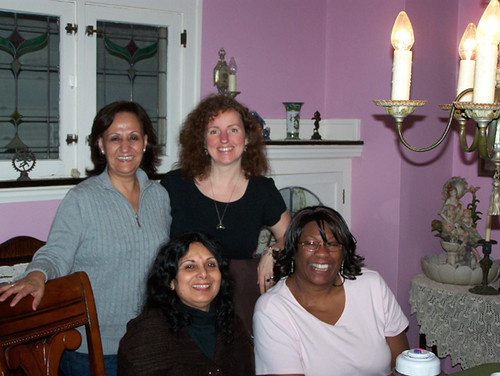
Mohtarama, Wendi, Mamta, Deborah

Every day I receive countless emails filled with questions about the raw food diet, my own success with reducing nearly 100 pounds and regaining health, and pleas for help by many who feel like they've hit bottom and there's no way up. Some emails have me in tears, because I can completely relate to what many of you are going through. I feel your pain, frustration, desperation.
One thing I've always been good at is listening, truly listening to what others are saying (and being an empath allows me to know what some are saying, even when they many times aren't verbalizing it). Another thing I've always been good at is intuitively knowing how to help others who are asking for advice. Jim used to joke that he wanted me to go into business running an advice column because ever since he's known me, I've been the person everyone comes to for help and advice. So, when I receive so many emails asking for help, it feels natural for me to reach out and connect with those needing help. It's what I do best well, that and spreading love!

Announcing: Pure Jeevan's Halloween Raw Pot Luck - A Costume Party for All Ages!!
When:? October 31, 2009, 6:00 p.m. - ? ?
Read more: Pure Jeevan's Raw Halloween Bash -- You're Invited!

As this is a holistic web site, it's important that we take time every so often to feature pieces on other aspects of human health besides diet. So, today's subject is unrelated to raw foods, but is directly related to your health. (Don't worry: We'll get back to raw foods on Monday!)
Today I want to share a super-valuable lesson I learned when I was just 21 years old. Back then, Wendi worked within the advertising department of a large newspaper. She helped me meet the paper's photography editor who, in turn, approved an internship for me during my senior year of college. So, several days per week for one semester, I hung out with professional newspaper photographers. It was a lot of fun -- and with real darkrooms, too (as this was way before the age of digital cameras).