Know Any Literary Animal Lovers?

Hi there PureJeevan readers! We wanted to let you know that Jim's new novel CHROO is available on Amazon. It's a crazy adventure involving a billionaire heiress, her Chihuahua BFF ("Chroo") and a host of human and animal characters. Find out more on Amazon! Here are some links:

Just a quick post on what may or may not be considered "weird" for our inaugural "Weird Wednesday" post. According to a few web sites I checked, around 3% of the population (and I'm assuming this means U.S. population) is vegetarian. It looks like maybe 1% (possibly a little more) is vegan. Of every 100 vegans, how many do you suppose are raw foodists? (Actually, I'm asking; I didn't find any solid answer to that.) Maybe 1 of every 100 vegans? What do you think?
Here's a painfully unscientific, yet still slightly educated guess:

There's a peculiar yet recurring kind of argument I get from a number of people from time to time when the subject of diet or health arises. Basically, it goes like this: "Yeah, all of those vegetables and exercise might be good for you, and all of that meat and fried food I eat might be bad for me, but what if you get hit by a truck tomorrow "
This sort of perspective is interesting to me for at least two major reasons.
I like this "travelogue" format, so let's continue! Here's Wendi's comments from their adventures in San Luis Obispo, checking out the raw vibes along the CA Central Coast!
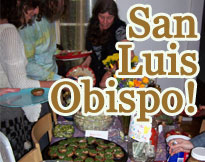 After a very active visit in the San Francisco / Berkeley area, we headed down the coast to San Luis Obispo, CA. There's a pretty active raw food meetup there and we were asked to stop in their town to give a talk to their group.
It was a nice drive south, but the sun is a bit brighter than we're used to (especially when driving long distances). When we arrived in the town, we were overcome by the beauty of the place. It's one of the most beautiful places we've seen in California, so far!
Read more: The Friendly, Mellow, Raw Groove of San Luis Obispo
This has been floating around the web for a day or two, but for those who haven't seen it, here's former President Bill Clinton talking about his plant-based diet, and what he hopes to gain through it. How amazing to see an *American president* discussing this sort of thing!! Who'd have ever imagined this (considering the strength of the beef and dairy lobbies in this country)?
Stories like this give me hope that the world will become more health conscious -- and will begin to understand that things like irradiation, GMO technology, pesticides, and all of the scary discussion floating around about the "Codex" are all unnatural, unsustainable, and unhealthy for us and for the planet. All you need is love -- and delicious organic foods! Glad to see Bill Clinton advocating this.
Read more: Bill Clinton Shares Details of His Plant-Based Diet, Cites the China Study!
Jim here... Thought I'd cross-post a discussion I put up on Give It To Me Raw yesterday.

Recently, I saw an article advocating a ban on banana consumption based on the premise that, if you don't live in the tropics, you have no business eating tropical fruit. Pointing to transportation costs and the related environmental impact of such transportation, the article argues that, by eating bananas, you're contributing to the destruction of the environment.
 Today's post isn't specifically about raw foods. But, we wanted to post a few videos highlighting some interesting research by an Italian doctor named Tullio Simoncini, who just might be onto something HUGE! Dr. Simoncini treats certain cancer patients with ordinary sodium bicarbonate (baking soda), based on his premise that cancer is a fungal problem and that a solution of baking soda is anti-fungal. Naturally, he's been vilified by the medical establishment for making such a seemingly simplistic claim. But, what if he's right?
Here at Pure Jeevan, we're very much into health research -- not so much with an aim to cure any specific disease or ailment, but rather to understand ways in which our bodies can become what we like to call unbalanced, as well as the ways in which we might return our bodies to proper balance, when necessary. In this way, I suppose that we, like many in the natural health world, feel that the body is amazingly capable of healing itself (in many circumstances) as long as the body is able to find a favorable state from which it can properly do what it naturally wants to -- which is to return the body to an optimal state of health.
Medical doctors don't buy into this theory very much. ?However, it's certainly ironic how, where certain areas of standard medical practice are concerned, what I described above is exactly what doctors do. Take something like a broken bone, for example. A doctor does not normally attempt to surgically repair the bone itself. Rather, the standard and time-honored practice is to set the bone (say, with a cast), and then to let your body heal the break naturally, on its own, making those skeletal connections as only the imponderably complex, ever-evolving wisdom of the human body can facilitate. (True, doctors do often intervene these days with surgery for broken bones. But, their aim there is mainly to position the bones for proper healing, and/or to do things like insert pins in an attempt to improve functionality after healing. Either way, the procedure here still relies on the body's ability to eventually heal the problem.) Standard medical knowledge in this area is without question outstanding -- and this is why most people in the natural health world have little problem with going to see a medical doctor for emergency treatment.
Read more: Is Cancer a Fungus? Considering the Work of Italian Dr. Tullio Simoncini

Jim here... Of the many lessons 2008 brought to our household, one standout was certainly the importance of having patience. That s because we set some lofty goals, and lofty goals are often vital teachers.
For example, imagine sitting in your living room one day and deciding: "I'm going to scale Mt. Everest."? (For the purposes of this example, imagine also that no political, administrative, or financial restrictions exist to prevent you from doing this immediately if you really wanted to -- things like passports, entry visas, transportation costs, etc.)
Read more: Acknowledging Changes and Growth: 2008 / 2009, Part 2

So it's time to continue that discussion on the aforementioned fringe one percent -- those people who will not accept your conscious intention to pursue your own health via this path. Please keep in mind during this discussion that we're only discussing just that one percent, not people in general. So, this is, I hope, relatively rare.
To begin, I'd like to stress a few points:
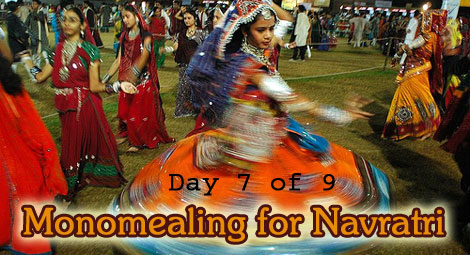
Day 7: Happy Navratri! It's the final three days, and today begins the special day of focusing on the attributes of Goddess Saraswati, recognizing those same feminine qualities within ourselves, and drawing inspiration to continue growing and changing in the most wonderful ways.
 Saraswati has always held a place of honor in our home. When we traveled to India a very long time ago(*), we purchased a batik wall hanging of Goddess Saraswati and framed it. It's quite large and we've always hung it in places where we wanted to focus on the energy that she represents to Hindus: creativity (particularly in the areas of music and art) and knowledge/intelligence (usually linked with education and literature).

Welcome to Pure Jeevan's "Juice-a-Day Jamboree"! You're probably wondering, "What IS Pure Jeevan's Juice-a-Day Jamboree, anyway " Well, it's simple: It's an ongoing, informal, loosely organized "event" centered around juicing. Think of it as an interim step between (1) any kind of diet or lifestyle, from SAD to full-on raw, that does not include much regular juice, and (2) an all out juice feast where that's ALL you'd consume for a period of time. Basically, we're saying, "Let's just make this simple and accessible for everyone. Let's just make a goal to simply drink more fresh juice!"
Wendi and I have been thinking a lot about incorporating more juicing into our lives lately (which is something we've done off and on over the years but never stuck with long-term). One thing holding us back from doing it more often is the time requirement. When we juice, it usually takes a half hour or so from start to finish. I know it doesn't seem that complicated, but I suppose it's just the whole process of setting up the juicer, washing and peeling the produce, juicing it, setting the juice aside while we clean the juicer, doling out the juice into glasses, cleaning up the mini-mess that makes, and then sitting down to actually enjoy the juice.

Jim here... Many people write to us asking whether we own pets and, if so, whether they are raw, too. Well, I wish I had a straight answer for you, but I think the answer is better told via a dedicated blog post.
As I'm writing this, part of me is tempted to include this post in our "My Raw Story" series. You see, Julia (pictured above) had some serious health issues just after we adopted her from a local rescue shelter, and we're still relatively early-on in our attempt to understand and reverse these issues.