Know Any Literary Animal Lovers?

Hi there PureJeevan readers! We wanted to let you know that Jim's new novel CHROO is available on Amazon. It's a crazy adventure involving a billionaire heiress, her Chihuahua BFF ("Chroo") and a host of human and animal characters. Find out more on Amazon! Here are some links:

Recently, the wife of a friend of ours decided that she wanted to lose 20-25 pounds. As far as we know, she follows pretty much a "Standard American Diet." We've heard that she doesn't care for red meat, but she does eat other meats, plus a good deal of dairy (which, we believe, she regards as a healthy food choice). She's apparently tried a number of exercise regimens, and a few fad diets, with no luck on losing these 20-25 pounds. (Frankly, we haven't seen her many times, but would not have guessed that she had 25 pounds to lose. But, we'll save "self image" as a topic for for further posts.) In any case... Frustrated, she decided to see a hypnotist!
Our friend accompanied his wife to the initial consultation. He said it was actually interesting. The hypnotist basically sits you down and walks you through some fundamental psychology, demonstrates a few of the primary principles of suggestion (e.g., showing you how easy it is to, say, imagine the sourness you would experience when biting into a slice of lemon), and then lays out how the program works.

So, did you think we'd forget about Makin' It Monday during Wendi & KDcat's big cross-country tour? Absolutely not! ?While in Salem, Wendi filmed Kerry Matson demonstrating one of her favorite raw recipes -- heck, one of our favorites, too! I'd have to say that raw apple pie is one of the classic raw dessert recipes. Everyone interested in raw should know how to make this! (And anyone who tastes it will soon be interested in raw!)
Read more: Makin' It Monday Guest Raw Chef Edition: Kerry Matson Makes Raw Apple Pie
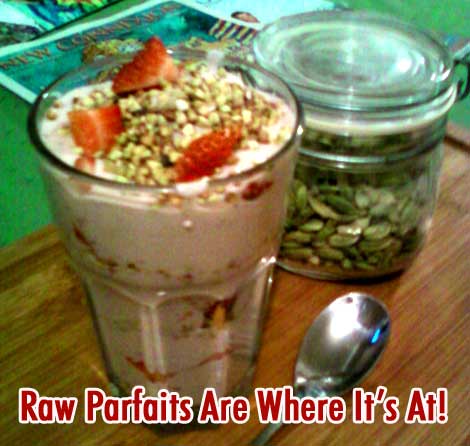
Above is a quick camera-phone pic I posted to our Facebook group lately. I did talk about making raw parfaits on that page, but want to talk a little more about them today, as it's just the perfect time to be talking about delicious raw parfaits (at least here in America, in any case, where many of the fresh berries you'll probably want are cheap and in season). I'll share a brief story about them, and then share my own basic recipe, and then we'll make some plans for MORE parfait talk really soon, okay?
I'm almost hesitant to talk about raw food parfaits here because, well, if the government found out how unbelievably healthy and ENJOYABLE parfaits are, I'm sure they'd make them illegal. But, I'll take a chance...
"... a warrior's life is not about imagined perfection or victory; it is about love. Love is a warrior's sword; wherever it cuts, it gives life, not death."
~ Dan Millman, The Way of the Peaceful Warrior
During some "highway philosophization" (my term for pondering everything and anything while driving) this afternoon, I eventually began to think rather deeply about human aggression, and specifically about how people hurt other people. Mainly, I was thinking about individual aggreession, although, as a group, humans are unfortunately rather prone to it.Wikipedia maintains a list of ongoing conflicts (i.e., wars), in fact. According to that page, there are seven major wars happenning right now and 15 additional significant ones. Of course, there are scores of unlisted ones ongoing as well, most of which the average person has never heard about.
Rawbin Rescues Turtle
I had a fantastic time at the 2008 Green Festival in Washington, DC. My wonderful friend, Rawbin, picked me up last Thursday and we had a nice drive back to her place in Maryland. She lives in an almost magical setting with wooded areas, horses, a goat, chickens, dogs, and cats! KDcat will not want to leave when she visits Rawbin someday. Above is a video of Rawbin rescuing a turtle that was in the middle of the road near her home.

Today, we thought we'd share another non-diet-oriented explanation of obesity. It's from Rhonda Byrne, author of the international multi-media phenomenon known as "The Secret," which provides readers with in-depth philosophical explanation and instruction with respect to the Law of Attraction.
Wendi and I have The Secret on CD, and often enjoy listening to it. I think, in fairness, we both have a few legitimate criticisms about certain aspects of it (and I'll share one or two, below). However, on the whole, many of the ideas within resonate deeply for us and we find much of the underlying message profoundly uplifting and empowering -- especially (for me) much of the discussion regarding maintaining a healthy, positive, optimistic attitude and practicing gratitude.
All this week we're continuing to feature a variety of answers to the question "Are Raw Foodists Crazy " from various friends of Pure Jeevan. If you're just now tuning in, please read the back story and introduction to this, as posted on Monday.But, for now, let's continue with posting the rest of the excellent responses sent in! Enjoy!! :-)
Thanks to everyone who has offered, so far, to help us out with our project (mentioned in yesterday's post). If anyone else thinks they'd like to help, we're looking for as many people as possible! We'll fill you in soon, just be sure to send us your email addresses if you haven't already done so. Thanks!
Here are more pictures of some of the foods we've been eating. Over the past year, we've pretty much been eating simple foods (except for the time I was preparing meals for the Raw Food Retreat). However, recently KDcat has been doing some extreme yo-yo eating between raw foods and packaged/unhealthy cooked foods. The back and forth has been causing her to experience a bit of a tummy upset. So, I've decided to make our meals a bit more exciting for her---so she'll possibly not feel so tempted by all of the colors and artificial flavors of the packaged "foods" she's been eating.
Talk about color...check out this salad I made earlier today:

Man must cease attributing his problems to his environment, and learn again to exercise his will - his personal responsibility. ~Albert Einstein.
Jim here with another wonderful edition of Weird Wednesday. Here's something I find a little weird about food (and, I apologize in advance if this comes off a little preachy).
See, I work in an office and sit rather close to the corporate kitchenette. Routinely, people bring in junk food to set out for everyone -- cookies, donuts, cakes, pastries, pies, candy bars, nut rolls, cheesecakes, summer sausages, cheese cubes, fondues, etc. The thought seems to be that, in putting these things out for everyone, you're showing you care for them.Offering large servings of concentrated fats and refined sugar is viewed as a favor, as an altruistic service for your fellow coworkers. But this odd fact isn't even the weird aspect of my post (although, now that I think of it, that is pretty weird).
?
As we'll show over the course of this week, the Raw Spirit Festival is about much more than just delicious, nutritious raw food. In fact, there's usually so many fun things taking place simultaneously while you're there that it's easy to forget about the foods completely!
I'd been there an entire day before realizing that there was a raw food court on site. (Mostly, I'd been dining on fruit I'd brought along and had stored in a cooler in my tent!). Thankfully, I did eventually discover the food court, and it was really something special. To call it a "food court" is almost demeaning, as that phrase brings to mind bland "mall food" restaurants that serve up mostly fast food fare. At the RSF, you're treated with many delicious options, which can make choosing a place to dine rather difficult!
And here's the conclusion of Wendi's San Francisco travelogue:
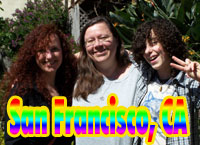 That evening we met up with Carolyn, a long-time friend since college, who was our lovely host for a few days. Carolyn has a gift with cats, which was a real treat for KDcat to see. Do you know how you can teach dogs to sit and give kisses? Well, Carolyn has taught one of her rescued cats to do the same thing! He *really* sits and *really* gives kisses on command! WOW!
Carolyn showed us all around the San Franciso and Berkeley areas, bringing KDcat to a thrift shop (she's been having fun popping into random thrift shops to see what she can find) and a fun shop called Ancient Ways, stopping by some Indian shops so I could pick up some more bindis and some ground coriander for a dish I made while visiting, checking out the Berkeley campus area, and taking us shopping for organic foods.
Read more: Part 4 of 4: Glowing Gypsy Gals Glimpse the Glorious Golden Gate's Gastronomical Goodness