Know Any Literary Animal Lovers?

Hi there PureJeevan readers! We wanted to let you know that Jim's new novel CHROO is available on Amazon. It's a crazy adventure involving a billionaire heiress, her Chihuahua BFF ("Chroo") and a host of human and animal characters. Find out more on Amazon! Here are some links:

Day 9: It's the final day of Navratri, often the largest day of celebration. On this day in India new businesses are started, children begin their formal education if they are at the right age, and past regrets (and many times debts) are left behind. It's a new beginning, fresh start, and is celebrated as such. Today, Pure Jeevan is celebrating in a big way, too!
 Yesterday, Jim handed in his resignation where he works. He was closing old books, imagining new ones, and today markes his first step of his new life. He gave the office one month's notice, after which he'll be here in Portland. Our new life has officially begun!

I knew right away that I would be filing this under our "Fun-filled Friday" bannner. Finding pawpaws is a huge treat! They're surprisingly little-known, and also very surprisingly tropical in nature. Who would think that something this delicious and exotic-tasting would thrive in so much of the non-trpoical world!? In this video, you'll learn where to look for pawpaw groves, how to identify a pawpaw tree, and what pawpaws look and taste like.
Read more: Learn How to Identify Pawpaws: Join Us on a Pawpaw Hunting Expedition!
April 12, 2008
Today we are doing some Spring cleaning and getting rid of stuff that has been collecting that we don t really need or use. I just finished the bananas (eight of them) and later I ll start eating the oranges that we have. I have plenty of oranges to get me through the day and into tomorrow until we go shopping. I m hopeful that there will be cantaloupes at the food co-op tomorrow. It would be fun to have a cantaloupe day!
How many days do I have left? I guess three? Overall, it hasn t really been all that difficult.
Here's an update from Wendi. I think this can be considered, with 99% confidence, the big announcement:
Of course, there's that 1% chance that something unexpected will happen. But, Portland feels right. It always has for us; we nearly moved there in the late 1990s. We had books on Portland back then, and I was buying their newspaper each week to hunt for jobs. It just never panned out, though. I suppose we were meant to live in Pittsburgh for a spell. It would be easy for me to list many reasons why Pittsburgh served a purpose for us. But, yeah, I think we're Portlanders at heart. So much about that city resonates with us. It'll be a homecoming, for sure! I want to reiterate a few things that I'd written in comments recently, slightly clarified in places.
Read more: Pure Jeevan Perceives Peace, Purpose, and Prosperity in Populous Portland!
April 13, 2008
I noticed that since I ve been eating only mono meals, I seem to be consistently sleeping eight hours a night, as opposed to nine, or more. It s a dreary day today, yet I don t feel like I m tired or down, which is how I normally feel when there s not enough sunshine.

There is a certain irony that takes place when you launch a raw foods web site because, no matter how much you love and believe in what you do, no matter how solid the proof may be that the information you're providing is true and accurate, no matter how clearly it can be demonstrated by analyses of blood tests or tons of "before and after" photos that this lifestyle heals the human body, you're still pretty much bound by legal best practices to include a full disclaimer on your site. And, as much as you just write it once and kind of forget about it, it's always there. For practical reasons, of course we understand all of that. But beyond all of that, there's an implied message that "only a medical doctor" really knows what's best for you.
Well, in fact, we DO recommend working with a competent health professional. But what we do not endorse here is simply accepting whatever that professional has to say without question. So, the operative word would be "competent" in that recommendation.

I was reminded about a video I saw some time ago, after seeing a similar video on my dear friend Bunny's blog. What you are about to see is AMAZING!!
Take the time to meet...
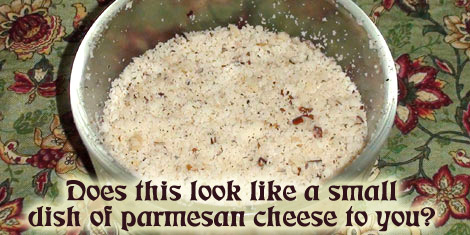
Back when we ate cooked foods (especially way back when our menu was not exclusively vegan), parmesan cheese seemed to be a staple of our existence (especially for Jim). We'd sprinkle it liberally on pasta dishes, salads, soups, and more.
As is typical for many raw foodies, you often realize after going raw that it was not always necessarily the food itself that you craved (no matter what it was); often it was simply the texture, the spices, the various flavors and tastes, etc. And that realization leads raw chefs to wonder whether the same experience can be recreated using only raw ingredients.
Read more: Quick Raw Tip: Making Your Own Raw Vegan Parmesan Cheese!
Have you ever heard about mono meals? When I first did, it sounded like such a great idea. When you eat a mono meal, you eat one item (and only one item) for the entire meal. Eating that way is supposed to be very cleansing and it gives your digestive system a rest from processing different types of foods at the same time. Supposedly there is a boost in energy, as well, since your digestion isn't taking up so much energy.
I recently received an email asking for advice from one of our Hindu readers, asking what I could recommend as far as light eating during the nine-day Indian festival of Navratri. Navratri is traditionally a time of fasting for nine days, however in modern society most Hindus no longer fast. Many do, however, pay more attention to their diets, and they try to eat lighter meals that do not contain animal products. Since our reader is just starting his exploration into raw foods, I didn't want to offer him advice that would make his nine days of Navratri difficult.He recently purchased a Vitamix, so I suggested that he make a lot of smoothies, since he has been enjoying them so much.

Jim here... Until our home sells (SOON!!!) and Wendi and I launch ourselves into the world as full-time raw food teachers / lecturers / inspiration providers, I'm more or less stuck in the corporate world during the day. While much of what happens in this Dilbert-esque environment is, as many of you likely know, absolutely meaningless, there is nonetheless the occasional pearl of wisdom to be pried from the clammy jaws of the 9-to-5 world. I was, for example, just reminded of a story I heard at a seminar once. Not surprisingly, the seminar pertained to the art of money making. However, there's another more fulfilling message to it as well.
A large modern newspaper company still uses these ancient printing presses from the 1950s -- huge old monstrosities with enough belts, pulleys, and greasy gearboxes to make any modern-day steampunk enthusiast squeal with delight. One day, not long after the old press manager finally leaves the company, the main press breaks down. Manuals are consulted, technicians brought in, engineers asked to take a peek. No one can bring the beast back to life. But there's a woman on the Internet who specializes in these babies -- and, guess what, she's local! So, they call her in. She listens to their problem and says she can fix it, but it's going to run them $5,000.

Today we welcome Devaki, the yoga instructor at Peaceful Valley Ashram, for another episode of Pure Jeevan s Makin? It Monday ?Guest Raw Chef? edition. In this episode, Devaki demonstrates how to make raw Cabbage-Mango salad. We ate the salad shown just after shooting the video. It was quite tasty and refreshing! Here s the recipe:
Read more: Devaki Makes Cabbage-Mango Salad on Makin' It Monday "Guest Raw Chef" Edition