Know Any Literary Animal Lovers?

Hi there PureJeevan readers! We wanted to let you know that Jim's new novel CHROO is available on Amazon. It's a crazy adventure involving a billionaire heiress, her Chihuahua BFF ("Chroo") and a host of human and animal characters. Find out more on Amazon! Here are some links:
All this week we're continuing to feature a variety of answers to the question "Are Raw Foodists Crazy " from various friends of Pure Jeevan. If you're just now tuning in, please read the back story and introduction to this, as posted on Monday.But, for now, let's continue with posting more of the excellent responses sent in! Enjoy!! :-)
In this video, Wendi talks with Leela Mata, spiritual leader of the Peaceful Valley Ashram, about her experiences with the raw food diet and a bit about a cob oven structure that was built on the ashram property. This is part 2 of a 5-part series featuring Peaceful Valley Ashram.
Read more: Leela Mata Discusses Her Experiences with Raw Foods
I've been back from the Raw Spirit Festival for about five days, now. The first few days I couldn't stop crying. I have a lot to share with all of you, maybe more than you'll want me to share. While away some pretty amazing healing took place. I found myself lifted out of the past and delivered to the future, in a way. I am here, whole, and aligned with who I am on all levels.
Pure Jeevan means Pure Life (or Total Life). Raw food is only part of my life, part of who I am, part of my journey. So, I'll be openly sharing who I am here in this blog; raw food isn't going to be the main focus---it's just part of my story and part of what I want to share.
Until I can sit down to begin sharing everything that transpired while I was away and over this past five days, I'll share some pictures with all of you!

So, did you think we'd forget about Makin' It Monday during Wendi & KDcat's big cross-country tour? Absolutely not! ?While in Salem, Wendi filmed Kerry Matson demonstrating one of her favorite raw recipes -- heck, one of our favorites, too! I'd have to say that raw apple pie is one of the classic raw dessert recipes. Everyone interested in raw should know how to make this! (And anyone who tastes it will soon be interested in raw!)
Read more: Makin' It Monday Guest Raw Chef Edition: Kerry Matson Makes Raw Apple Pie
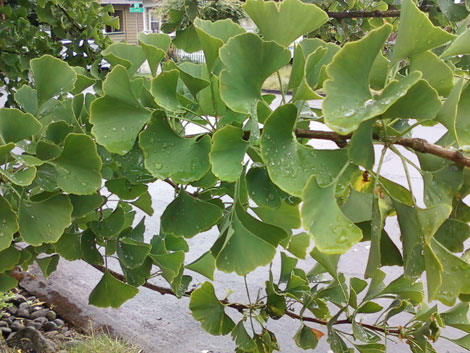
Ahh, yes... Ginkgo Biloba. What a distinctive tree, don't you think? So easy to identify, and so many reported health benefits. This one belongs to a neighbor that seems to have an affinity with Asian landscaping motifs. They also have gorgeous bamboo growing in their yard, and other Asian elements. I would have liked to have harvested some leaves to dry for some Ginkgo tea, but the owner wasn't around to ask. Perhaps some other time.

I want to admit something to all of you: Sometimes I still cry because of how people treated me when I was obese. Because I stuffed all of my "negative" emotions deep inside my entire life, it's going to take some time to fully release them. I'm working on it, however, and making tremendous progress with healing myself on all levels. I'm not telling you these things so you'll feel sorry for me, however. I'm telling you because I am thankful for all the pain I endured. It shaped me (in more ways than just my physical appearance) into the person I am today.
Even though it sounds strange, and somehow wrong to feel this way, I'm thankful that I was obese. I'm thankful for all of the experiences during my life, even the extremely painful, traumatic ones. Maybe if I was a different kind of person I would wish that those things didn't happen to me. However, I am using those experiences in positive ways. They've helped me understand people even better, and to understand myself on a deeper level, as well. When people reach out to me it's not only because I'm an approachable person, it's because they sense that I understand them--and they're right. I DO understand them. I understand you. My experiences, coupled with my gift of empathy, help me relate to you in a way that maybe not everyone else is able to do.
Today we bring you the last of our personal video interviews conducted while at the Raw Spirit Festival (RSF East 2009). I'll have one other highlight reel to run next week, just to round out this series by showing some of the additional ambience there.
So, we've finally come to the "infamous Viktoras video"! I smiled as I wrote that because it was quite the topic of discussion around our camp site. You see, one of my fellow campers, BH, was with me as we interviewed Viktoras (she filmed the interview, in fact) -- and, well... let's just say he strayed a bit from the expected raw food subject matter. I was worried that poor BH would be scarred for life after witnessing the discussion, but she did seem to get a good laugh out of it, and I suppose she's fully old enough to attend an R-rated movie.

Brutal Honesty. 100% Transparency. Unedited Feedback. Absolute Truth. ... How often are we treated to these things by those we know? How likely are we do conduct ourselves with these ideals in mind?
Propriety. Politeness. Decorum. Political Correctness. ... How often do these conventions in others prevent us from knowing what others think of us? How often do these conventions in ourselves restrict our own words when directed at others?
Read more: The Gift of Honesty: The "Crazy" Life of Raw Foodists

To keep all of you inspired while we are away, we've asked some
remarkable individuals to share their raw food stories with you. Enjoy!
Wow, is it really Episode 3 already? How time flies! Remember way back when we started this informative, informational, nutrition-oriented "Know Your Food" series? Seems like ages ago, doesn't it? (Oh, wait... It WAS ages ago. It's just taken us a while to get up to speed with this video stuff!) Anyway, here's the video, followed by some camera/video editing news -- oh, and of course some highly urgent celery information. (Okay, it isn't really urgent at all; we just needed to add a dash of drama.) So, see what you think. You might even learn a thing or two about our stalky green friend.
Not TOO bad, right? We're getting to our goal of roughly 3-minute episodes. Of course, this is still one of our first attempts, shot last Sunday. We thought it was decent enough to not entitle it "salvaged" as we did the previous installment.
Jim here... Wow, how awesome is it that today's Makin' It Monday falls just one day after Mother's Day -- and that we had ?a very special guest edition ready to post featuring ... ?my awesome mom! ??!!! ?I love my mom so much ... she's the best mom ever! And you'll love watching her demonstrate how to make 100% raw hummus. Mom might be 100% Italian, but she makes a pretty mean 100% Lebanese raw hummus, which is a pretty popular dish in my family. Here's the vid!
Read more: Makin' It Monday Guest Raw Chef Edition: Jim's Mom Makes Raw Hummus!