Know Any Literary Animal Lovers?

Hi there PureJeevan readers! We wanted to let you know that Jim's new novel CHROO is available on Amazon. It's a crazy adventure involving a billionaire heiress, her Chihuahua BFF ("Chroo") and a host of human and animal characters. Find out more on Amazon! Here are some links:

Jim here... Conventional wisdom says we shouldn't judge a book by its cover, right? Well, what about recipes? Should we judge them by their names?
When KDcat was young -- well before we followed a raw diet -- her friends sometimes scoffed at our typical vegan fare. After all, few kids would voluntarily eat "Pasta with Spinach Sauce."? But, we discovered, change the name and suddenly they're lining up for seconds. Instead of "Spinach Sauce," Wendi came up with "Jungle Sauce"! How exciting, right?

As some of you already know, along with regaining my physical health I've also been working on every other aspect of my overall health and being. I don't just want a healthy body---I want the whole package (vibrancy and bliss inside and out, in every way possible).
One area of my mental health that has been slow to heal is my self confidence. I continue to work on it in many ways and have made some tremendous progress over the past year, or so. I feel worthy of so much more than I ever did before.Many people never doubt their self worth---they have a good sense of who they are and assume that others see them as they are, as well.
Read more: Thankful Thursday: We Like It Raw and Dhrumil Purohit
One of our readers, Julie, asked me to update her on what kind of diet I'm doing and why I'm doing it. The last time I publicly made changes with my diet, I received many similar questions. So, I figured maybe it would be a good idea to respond to her question here on the blog for anyone else wondering the same thing.
I did explain, in a long post, about experimenting with my diet being important to me.If you didn't read that entry, it will answer a lot of your questions. For many of you, I think I know what you are thinking: "Wendi was pretty much morbidly obese, her health was horrible, but she's now healthy. Why would she change anything with her diet when she has already found what works "?
Well, it's true. I am extremely healthy compared to how I was before I started consuming raw foods. Here are some pictures to show the changes, to motivate some of you currently struggling with eating more raw foods...
April 15, 2008
Every year my dear friend, Mamta, lets me know when Navratri is going to begin. ?It s the nine-day fast, but you don t have to change anything since you are already eating so healthy. Traditionally, Hindus used to abstain from eating during Navratri. In modern times, with everyone working and life being less relaxed, fasting isn t always something that can easily be accomplished. So, over the years Navratri has been modified by many to represent a time of eating more simply and abstaining from meat if you eat it.
This year, I had an email question from one of our readers who was asking about ways to eat simpler during the nine-days of fasting. After responding to him, it sparked in me a desire to do something this year for Navratri. I had read about eating mono meals and always thought it sounded like such a gentle way of cleansing the body, so I figured I d try it for the nine days of Navratri. To make it even easier on me, I decided to consume a different food every 24 yours, rather than eating the same thing for the full nine days. Maybe in the future I ll try that, but this time I wanted this to be as easily doable as possible.
Well, here's my latest update on my nine days of mono meal eating. I have a headache this evening and I'm headed to bed early. I'm hoping the headache is a detox symptom and that it will be gone when I wake up.
April 9, 2008
I was standing in line at the grocery store the other day and plopped a package of chicken wings up onto the conveyor belt. The cashier made some sort of smalltalk -- I think she asked whether I liked wings -- which prompted me to say, "Oh, the chicken is for my dog, Julia."
She looked at me, eyebrows raised. "For your dog "
Rawbin Rescues Turtle
I had a fantastic time at the 2008 Green Festival in Washington, DC. My wonderful friend, Rawbin, picked me up last Thursday and we had a nice drive back to her place in Maryland. She lives in an almost magical setting with wooded areas, horses, a goat, chickens, dogs, and cats! KDcat will not want to leave when she visits Rawbin someday. Above is a video of Rawbin rescuing a turtle that was in the middle of the road near her home.
With love in my heart, I present this gift to the entire raw and living foods community:
Original Comments
Below, we have included the original comments from this blog post. Additional comments may be made via Facebook, below.

In all of our discussion of immune-building lately, we remembered today that we left out one enormously important item that should be present in anyone's "healing toolbox." That item is, of course, laughter. What better time than a "Fun-Filled Friday" to celebrate the healing power of humor!
 Years ago, we'd heard a remarkable story about a man who had cured himself of a terrible disease using laughter as his "medicine." According to the story we heard, the man checked himself into a hotel and just watched Marx Brothers comedies for hours on end, and was eventually cured.
Here at Pure Jeevan we are preparing for our cross country tour to educate others about raw foods. This means we are paring down on a lot of things, donating a lot, selling some things, and pretty much not buying anything unless it's absolutely necessary. That's what we've been doing for almost two years now (we're waiting for the house to sell). Recently, however, I decided it was time to spend a little bit of money even if it wasn't absolutely necessary.
-
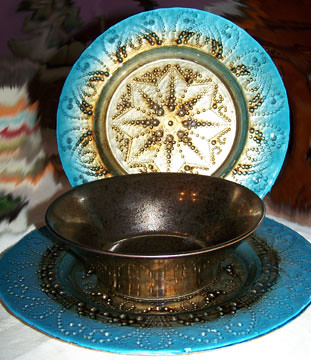
- Wendi's Dish Set
What did we buy? Dishes! Seems a bit strange to finally spend some money on something unnecessary and have it be dishes, right? Well, I had a few reasons for this purchase. The first is that when we are living in the RV, the space is going to be minimal. There won't be a lot of room for dishes, let alone much of anything else. Since there's not a lot of space to have dishes drying, we'll need to be washing, drying, and putting away immediately after use. That may not sound like a big deal, but when someone in the family decides to eat a few different things and leave the dirty dishes in the tiny RV sink, on the small counter, or somewhere else, it's going to really seem like a bigger mess than it is. So, to remedy this I thought it would be good for each of us to have our own dishes. That way we have a sense of responsibility for our own particular dishes--we know they are ours and we are responsible for taking care of them.

"An ounce of action is worth a ton of theory." ~ Friedrich Engels
When people talk about goals and planning, two distinct camps tend to emerge, in my experience:? (1) the "aim then fire" types, and (2) the "fire then aim" types.? I've used those specific terms for a reason, and will return to them in a bit. But, let's look at the two types, and relate them to the way in which one might approach raw foods.