Know Any Literary Animal Lovers?

Hi there PureJeevan readers! We wanted to let you know that Jim's new novel CHROO is available on Amazon. It's a crazy adventure involving a billionaire heiress, her Chihuahua BFF ("Chroo") and a host of human and animal characters. Find out more on Amazon! Here are some links:

Today I answer the second part of a letter Jim received from a Pure Jeevan member who was seeking advice about her daughter who has decided to become a vegetarian. Rather than quote parts of her letter, I'll summarize the questions (because they are general questions that we hear a lot and our answers are given for everyone, not just the individual who sent the most recent letter).
1) I don't have a lot of money for all the produce and kitchen appliances, so how can I eat a healthy diet2) I live with others who don't eat the same diet, so how can I possibly make this work
Read more: Financial Stress and Group Living Concerns (Part 2 of 2)

I was reminded about a video I saw some time ago, after seeing a similar video on my dear friend Bunny's blog. What you are about to see is AMAZING!!
Take the time to meet...
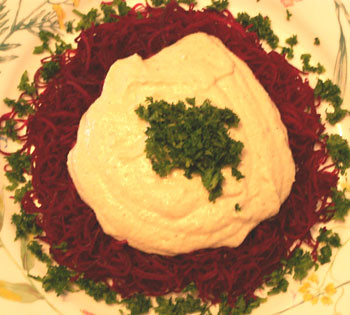
The mono meals ended and I did create that beet pasta with alfredo sauce that I was dreaming about. So, here's the recipe:
BEET PASTA
All this month, Jim has been experimenting with a low-fat, raw vegan diet. He discusses his reasons for trying a low fat diet, and how he s been feeling with the changes, in his first and second posts so far this month.
Many of you have heard us mention the famous low-fat, raw vegan 80/10/10 diet here on our blog. Well, today I d like to highlight the individual behind that diet. So?
 After leaving Salem, Oregon, Wendi and KDcat drove less than an hour to the city of Corvallis where they met up with their hosts the Zander's -- Joni, Steve, Bekka, and Stephanie -- a fellow unschooling family Wendi had come to know in an online forum. It was great to be in their company and we loved them right away,? Wendi wrote. ?Their home is absolutely beautiful on a really cute lot with plenty of plants and trees around ? including the most delightful flowers that smelled divine (I think they were called Daphne).
Corvallis is the city we ve mentioned multiple times -- the city that feels like it s the right fit for us. Well, it lived up to our dreams in just about every way. It s a progressive, hip town with a lot going on. The people are friendly, the weather is beautiful, the land is gorgeous, and there are lots of unschoolers. Access to fresh, ogranic, raw foods doesn't seem to be an issue anywhere in Oregon, according to reports from the road so far. While they've been away, we've talked quite a bit each night about what they're finding -- and fresh organic produce seems pretty much everywhere out west. "The west," wrote Jim Morrison, "is the best." (Surely he was a raw foodie.)
Jon Gold, owner of the Sunny Side Up Cafe (a vegan and vegetarian restaurant there) and an unschool father, put together a little gathering of unschoolers for KDcat and Wendi. They were able to meet some local unschoolers and ask questions. There was also a gathering one day at the cafe where KDcat was able to do some art at a table with some other unschool teens. It's definitely a creative, easy-going town with some fantastic people in it!

Here's a fun story, with a fun, inspirational, and at least partially dietary conclusion. As I mentioned yesterday, Wendi is in Portland this week. Can you guess what she's doing there? ... She's attending a very important event -- something that merited getting on an airplane with almost no notice (and, wow, are those last-minute airfares pricey!). Still not sure? That's okay; I'll let the cat out of the bag: We found a new home!!
We've been talking about moving to the west coast for literally years now, so it's about time, right? ?In recent times, we've really begun taking action on things in a much more profound and immediate way than ever, and it's been working out amazingly well. This home purchase was just the latest instance of it. We basically saw an opportunity and immediately went for it, without hesitation, and before we knew it we were sending paperwork back and forth across the internet to our realtor.

On this Thankful Thursday I am feeling especially thankful for the Internet. Without the Internet I wouldn't be able to learn as much as I've learned about raw foods in such a short period of time. The Internet has connected me with people from all over the world who are also interested in natural health and raw food living. I am part of a larger community, one that would never exist without the Internet.
So, today I am especially thankful for the Internet. What are you thankful for today?
Continuing on, today, with Wendi's San Francisco travelogue:
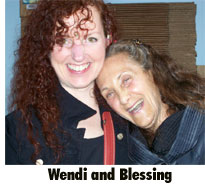 While on our walk, Pete pointed out that in the building on our right there are some amazing kale chips being produced. Kale chips ! I asked if he was referring to raw food kale chips and he nodded. Of course, I had to investigate and find out who was producing them and possibly meet the person. Well, what a treat we were in for!
One of the workers directed us to an office nearby where we met a lovely woman named Blessing. It turns out, Blessing is the producer of the kale chips we received from our Official Snack Sponsor during our tour, Natural Zing. Not only does Blessing produce some of the most popular kale chips in the raw community, her company is also the manufacturer of the famously delicious "Raweo" cookies (which you can find on Natural Zing's site)!
Read more: Part 2 of 4: Glowing Gypsy Gals Glimpse the Glorious Golden Gate's Gastronomical Goodness
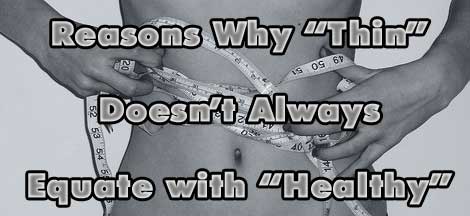
Thanks to Bitt, yesterday, for pointing out that one possible misinterpretation of yesterday's post (on celebrity weight loss) could be that "thin = healthy." I'm sure that, while there are countless wonderful benefits to being a famous actor, one of the less wonderful aspects of that life must be the pressure to remain young, thin, attractive, etc. It would seem realistic to me to assert that, additionally, women are held to even more objectified standards than are the men out there (although, in fairness, note that 6 of the 11 stars profiled in the Yahoo feature linked to yesterday were in fact men).
In any case, the post's intention was never to imply that one's weight is necessarily the best indication of one's overall health. After all, we all know thin people afflicted with serious health challenges.
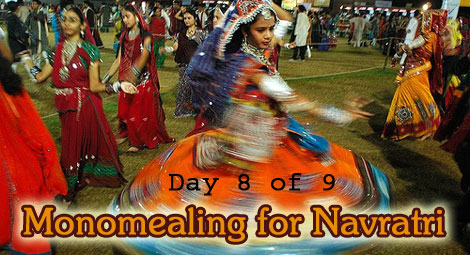
 Day 8:
Let's focus on creativity for a bit. This is an area where many men have been comfortable expressing a feminine quality, especially when done through art and music. I say many, because we all know at least a few men who were raised to believe that a strong, powerful man doesn't spend his time with such frivolous things. Instead, he works hard to earn an income to support his family. In the past, and still sometimes today, creative men were viewed as weaker and less masculine, not practical and in control. The feminine quality of creativity was, however, encouraged in women who were afforded more time for such "frivolity."
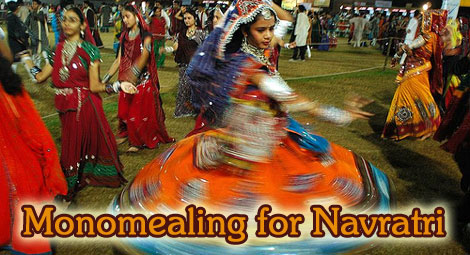
Happy Navratri!
You haven't been hearing much from me (Wendi) lately, for a variety of reasons. Over the next few days, I'll be celebrating Navratri and posting here on the blog at the end of each day. In my posts, I'll be sharing some of what has been going on with me and why you haven't seen much of me around, as well as comments on my celebration of Navratri.