Know Any Literary Animal Lovers?

Hi there PureJeevan readers! We wanted to let you know that Jim's new novel CHROO is available on Amazon. It's a crazy adventure involving a billionaire heiress, her Chihuahua BFF ("Chroo") and a host of human and animal characters. Find out more on Amazon! Here are some links:

We all know what "greens" are in general. For example, no one questions whether lettuce, kale, spinach, or chard are greens. But on the other hand, all of those items *are* also clearly green in color. With that in mind, what would you make of the following two questions I (Jim) recently pondered -- tagged as "reader questions" so they're easily found in the future by other equally inquisitive people ;-) -- that seem bizarre, but are really quite interesting?
1. Are non-green greens (e.g., purple kale) still considered greens2. Are vegetables with green skins (e.g., cukes, zucchini) considered greens? (After all, they're green!)
Jim here... Today Wendi is busy preparing for a multi-day activity that I'm sure she'll be writing about later this week. So, I thought I'd field a question we received recently (one directed specifically to me). We do receive a good deal of questions at our Raw Food Diet Question In-box (at Questions [at] PureJeevan.com), so feel free to send any in that you may have, and we'll definitely get to them all here in time. In any case, one reader writes:
As drawn as I am to a raw diet, being mostly cooked vegan right now, I can't help but come up against this each time: Since produce is, after all, mostly water, what did you eat while transitioning that didn't lead to shoving in lots of bread, potatoes, etc. Do you just eat lots and lots of, say, oranges, at one go? This has always been my raw downfall. I'm sure the answer is very simple.
Wow, this is a great question, and one with many possible answers! To begin, let's recognize that this isn't a question from a "SAD diet" eater. ?Being a vegan, alone, takes significant learning and (often) self-discipline to accomplish successfully. It's also, in my view, an excellent dietary and lifestyle choice for many people, regardless of whether they ever decide to try a raw foods diet. So, this question is rather advanced.
Short post today... We're currently dealing w with a pesky kitchen drain issue that's wreaking havoc in our household. Fortunately, a very talented and power-tool-weilding local plumber just fixed the problem. In the process, he seems to have applied those power tools to our bank account -- $175 for less than one hour's work!? (Ouch!) And the kicker is that the current state of our kitchen is "absolutely atrocious."? I'm serious... we're at like DefCon 5 in terms of the disastrous nature of that room -- and as you well know, for a raw household, that's probably 10 times more frustrating than it is for others. (I smell a whole post coming soon on this topic ...)
Today, we mainly just wanted to say that, at the end of our post yesterday, we briefly asked what you would like to see more of here at Pure Jeevan. We have received some great comments and emails in return, and have decided to devote tomorrow's post to responding to / addressing some of the suggestions we received. So, if you have any further thoughts to share about raw foods content you'd like to see more or less of, please let us know either by commenting below, or by email. Wendi is at WendiDee [at] Pure Jeevan.com. Jim is at Rawdiant [at] gmail.com.

Wow, is it Friday already !? Time flies when you're powered by 100% raw organic goodness! Today, we wanted to share an audio interview with you. Last night, Alex Ortner from the Movement to Reverse Diabetes Naturally interviewed us about our recent work helping them spread their message. We were honored to hear him introduce us as "two people that hold a special place in my heart right now, and I'll tell you why that is: They are probably the two most active people that we've had in the movement to reverse diabetes naturally."
Well, Alex, it was our pleasure! We met scores of new people during our work for RDN, generated major awareness about the movement, and spread the word about the raw food lifestyle as well. To listen to or download the interview, just visit their site, here. Topics covered include:

A few days ago, we'd mentioned that Wendi had done a five-day water fast as part of her early dealings with Lyme disease. This was the first time I can recall in our household anyone fasting for more than a day or so, although there may have been the odd juice fast now and again for a few days.
Thinking back, I can tell you that, all while I kew Wendi (and especially during her cooked years), such an extended fasting would never have happened because she used to get wicked headaches any time she went without food for more than a normal time period between meals. This makes perfect sense, of course, as you really do have to be in fairly good health to successfully fast -- and, during those "cooked" years, we were both extremely unhealthy! (More on the reasons for all that later, as Wendi will likely do a write-up on fasting at some point.)

Jim here... This post is for anyone who has turned to raw foods in an attempt to become healthy -- to lose weight, lower cholesterol, to lower blood pressure, to beat diabetes, or perhaps to overcome something even more serious. Let me ask you something (rhetorically): Have you ever, in your journey toward optimal health, looked at someone else -- someone else who eats "worse" than you do, yet who appears outwardly more healthy -- and thought, "Why is it so hard for ME and yet so effortless for that person "
Have questions run through your mind such as: ?How can that other person eat all of the wrong things, and yet look healthy? ?Why is it that I eat better than most people, and yet I'm the one facing a health problem Why is it that some people go raw and their issues clear up so quickly, and yet here I am still not feeling and looking 100% healthy? Why is it that physical health is not always bestowed on those who really deserve it?
[Sorry, we lost the pic in a web update... will repost if we find it!]
Last night, Jim ate the first warm food he's had in over a year! I created a dinner that was placed in the dehydrator for about an hour before it was served. This dish is delicious at room temperature, also, but I thought it might be more special if I served it a bit warm. Jim thought it was a nice change to the colder temperatures of the smoothies he's been practically living on!
Here's the recipe, if you think you'd like to try it.

Pure Jeevan hosts the Pittsburgh Raw Food Meetup this Sunday, November 2, at 3:00 p.m.! Click here for details and a map link. We hope you can make it. We'd love to spend time with you!
Original Comments
Below, we have included the original comments from this blog post. Additional comments may be made via Facebook, below.
I have a need for hot food in winter to feel warm.
We hear this comment a lot from those trying to lose weight. Some joke that they thought their excess body fat would be keeping them warm, but they're still feeling cold and needing hot food in the winter months.
In the past, we've talked about reasons what's going on in the body when hot foods are consumed. Understanding this will help you realize that hot foods are actually not very good for our bodies. When we consume very hot foods, that heat is then inside our bodies, next to vital organs, while the body needs to maintain a temperature around 98.6 degrees. When we have temperatures higher than that right next to our vital organs, it must quickly work to remove that excess heat. It's the removal of this excess heat that causes us to feel warm. It's our bodies trying to stay in a healthy state. We are actually putting our bodies under stress when we do this (the same holds true for eating overly cold foods, like frozen desserts and icy drinks).
***** DISCLAIMER: As with all of our posts here at Pure Jeevan, and particularly those tagged with a new term, "Nadi Balance," please refer to the disclaimer that runs at the bottom of all Pure Jeevan pages. Wendi and Jim are health researchers, educators, and extreme self-experimenters, not doctors. ******
There are four parts to blood: red blood cells, white blood cells, platelets, and plasma. Using a specialized microscope, one can easily view these parts of the blood. Red blood cells deliver oxygen to, and carbon dioxide from, the body. White blood cells, also known as leukocytes, help defend the body against disease and anything that they see as unnatural or foreign. Platelets help form clots to prevent bleeding. Plasma, comprised of about 90% water, is the fluid that transports all of the above.
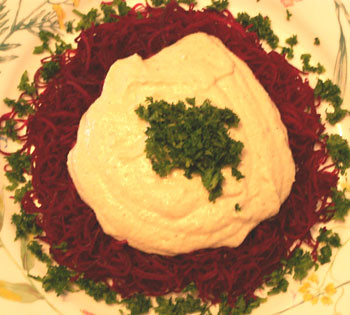
The mono meals ended and I did create that beet pasta with alfredo sauce that I was dreaming about. So, here's the recipe:
BEET PASTA