Know Any Literary Animal Lovers?

Hi there PureJeevan readers! We wanted to let you know that Jim's new novel CHROO is available on Amazon. It's a crazy adventure involving a billionaire heiress, her Chihuahua BFF ("Chroo") and a host of human and animal characters. Find out more on Amazon! Here are some links:

I'm pretty sure I've said this before, but I'm thankful for so many things that it could take me a very long time to list them all. Today, however, I'm focusing on how thankful I am to have loving, supportive friends in my life.
When I was a child we moved a lot (every two years, on average). I continued to move a lot even after college, when it was no longer my mother making the decisions about moving.Why am I telling you this on a Thankful Thursday ?Because all of that moving around when I was a young child partly shaped the way I made friends.

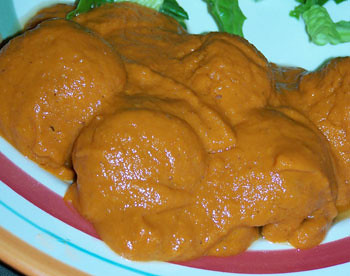
The other day I made a recipe from "Rainbow Green, Live-Food Cuisine" by Dr. Gabriel Cousens. I modified his recipe a bit and what resulted was amazing. Perhaps the original recipe tasted even better, but this is what I did with it.

An online friend of mine, Kevin Gianni (see previous blog entry introducing him), has been producing a terrific series of videos and blog posts. At the end of each post, he asks questions of his readers. In his recent post, he asked his readers:
What struggles have you been through

Jim here... I was listening to a radio commercial the other day that promised to reveal the "secrets that credit card companies DON'T want you to know." You hear that kind of rather manipulative marketing all the time, right? It's a psychological thing, I suppose -- filling your mind with intrigue almost instantly. My credit is pretty decent, but I was thinking, "Wow, I wonder what those secrets are?!" We humans are curious creatures, aren't we?
But then I started to laugh to myself, imagining a raw foods radio spot adopting that technique. "Buy our special report and learn all of the Secrets that Raw Foodists do NOT Want YOU to Know!!!" And then I laughed some more. Know why? Because, when you think about it, there are absolutely, positively NO secrets raw foodists don't want you to know! Isn't that stunningly cool? In fact, the entire message of the movement is conveniently included right there in the words "raw foods." It couldn't be simpler -- the cure for what ails so much of the planet, neatly summed up in two words.
Jim here... Here's part two of a video of Wendi showing how to make raw pasta. (If you did not view part one yet, click here to go there now.) She, with the help of her friend Melissa (of Food Under Foot), prepared a beautiful platter of pastas and some sauces that we all enjoyed when I returned home yesterday for lunch.
We hope this video shows you even more how fun and delicious eating raw foods can be!

Quick note: Jim here... So strikingly pervasive is the "winter blues of 2010" that I suspect many of my friends will think this is about them. But, it's just some thoughts, really -- not in response to anything or anyone in particular. (In fact, if anything, it's in response to something related to our dog, which we'll no doubt write about at some point.)
I sense that there is a useful blog post on the topic of "raw during tough times." However, after pondering the topic at length, I'm just not exactly sure what to say about it. I do know that quite a lot of people come to feel disappointed in themselves for straying from the healthiest path. It's a story I've read over and over on raw web sites and blogs, perhaps more frequently in the winter. It starts out the same: Someone goes raw, gets all fired up about it, and soon starts feeling youthful and vibrant again. The high lasts for a while, but then ... something happens. They slip back to cooked foods -- or worse, to junk foods. Sometimes the process repeats itself for years.

Pure Jeevan hosts the Pittsburgh Raw Food Meetup this Sunday, November 2, at 3:00 p.m.! Click here for details and a map link. We hope you can make it. We'd love to spend time with you!
Original Comments
Below, we have included the original comments from this blog post. Additional comments may be made via Facebook, below.
On this page, we'd like to share some information about vegetable juicers. There are a number of different kinds, and we'll try to offer some background on many of the leading ones. We're affiliates for some, so if you're in the market for one of the ones we discuss, please follow the links we provide (or click the juicer pics) and you'll help support Pure Jeevan. But, either way, we certainly encourage you to consume fresh, delicious, nourishing veggie juices regularly!
The Jay Kordich Juicer -- The PowerGrind
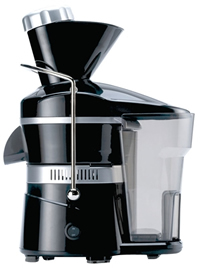 The PowerGrind Pro is a juicer put out by Jay Kordich, commonly known as the "father of juicing" by many in the raw food / living food world. In fact, our very first juicer was a "JuiceMan" model, purchased back in the early 1990s! But this is an entirely new machine, retooled from the ground up recently. At $289, it's a fairly high-end juicer (as compared with, say, department store models). However, it's certainly got the power and features to back up that level of investment. ?Head on over to the Jay Kordich web site for full details on the latest models.
The Hurom Slow Juicer
 A year or two ago, when we still lived in Pittsburgh, we hosted the Monarch's (Matt & Angela) during one of their speaking tours. I remember Angela firing up their juicer in the morning and I thought (or possibly even said), "Wow, your juicer is broken!" I swore that something was wrong because it didn't sound like anything I'd heard before. But they then told us about what was then the newest juicer on the market -- the Hurom Slow juicer. It's garnered a lot of positive testimonials over the past few years, from quite a lot of juicing enthusiasts. While many of the features are nice, we imagine the the most important potential benefit would be the slower speed, which theoretically means less oxidation, less processing, and thus healthier juice. If we were in the market today, I've no doubt we'd try one of these, too (even at $359)! These juicers are available through our good friends at Natural Zing!
In some wonderfully literary sense, there must be some kind of unique metaphor that could be constructed around the process by which cabbage turns to kimchi. Personal growth is not always easy, as any success technologist will surely tell you; ?there's a lot of doubt and oozing and off-gassing involved -- and yet, the final product is surprisingly pleasing to the palate.
Yes, it's time for us to update you on our first-ever kimchi experiment. If you want the short version:? I believe we have been successful! For those of you with a few more minutes, I'll share some of the lurid details. Highlights of our experiment included:

I realize we keep teasing everyone with vague yet bold talk of some new rawsome health frontier we're pursuing. We'll definitely get to discussing all of that later this year sometime. ?In the mean time, though, we may occasionally run an article or two that reflects a bit of our experimentation.
Lately, Wendi and I have been drawn to a similar style of eating -- although for different reasons. ?You see, we've both been on a real kick to simplify lately. For Wendi, this reflects more of an intuitive response to her diet. For me, it's more of a response to all of the experimentation I spoke of.
There's an old saying that "What Happens in Vegas, Stays in Vegas." But we're not ones for keeping secrets. So, here's the low-down on Wendi and KDcat's time in Sin City -- straight from Wendi's travelogue, once again!
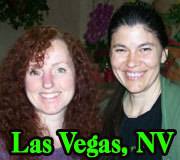 We drove to Las Vegas from California, and loved seeing the change as our surroundings became a desert. The snow-capped mountains are such a beautiful contrast in CA, but especially here in Nevada where it's so dry and hot!
This stop was longer than expected, since we decided to change our schedule a bit in order to get some more relaxing time in--and also to allow KDcat to have some fun that didn't involve raw foods or Pure Jeevan activity. ?We decided to hold off on visiting a date farm and the grand canyon (two activities we'd had planned for this leg of the trip) until Jim could do those things with us as a family. We especially missed him during this part of the trip, because he's always wanted to see what Vegas is like in person.
Read more: Las Vegas, Nevada: Relaxing Times and the Raw Scene at Go Raw Cafe