Know Any Literary Animal Lovers?

Hi there PureJeevan readers! We wanted to let you know that Jim's new novel CHROO is available on Amazon. It's a crazy adventure involving a billionaire heiress, her Chihuahua BFF ("Chroo") and a host of human and animal characters. Find out more on Amazon! Here are some links:

To keep all of you inspired while we are away, we've asked some
remarkable individuals to share their raw food stories with you. Enjoy!
And here's the conclusion of Wendi's San Francisco travelogue:
 That evening we met up with Carolyn, a long-time friend since college, who was our lovely host for a few days. Carolyn has a gift with cats, which was a real treat for KDcat to see. Do you know how you can teach dogs to sit and give kisses? Well, Carolyn has taught one of her rescued cats to do the same thing! He *really* sits and *really* gives kisses on command! WOW!
Carolyn showed us all around the San Franciso and Berkeley areas, bringing KDcat to a thrift shop (she's been having fun popping into random thrift shops to see what she can find) and a fun shop called Ancient Ways, stopping by some Indian shops so I could pick up some more bindis and some ground coriander for a dish I made while visiting, checking out the Berkeley campus area, and taking us shopping for organic foods.
Read more: Part 4 of 4: Glowing Gypsy Gals Glimpse the Glorious Golden Gate's Gastronomical Goodness

Jim here with another Weird Wednesday.
Recently, at the store, I came across a little plastic tool, priced at $1.49. It was an orange peeler. I'd never heard of such a thing. As someone who eats about 20 oranges/week, I was intrigued. Do you mean to tell me, I thought, that my days of laboriously de-skinning oranges would disappear (those trips to the company bathroom to remove the orange pulp from my fingernails!)?

Next weekend I'll be at the Green Festival in Washington, DC. helping Natural Zing at their vendor booth (I'm completely in love with Natural Zing because of their honest business ethics and commitment to having the highest quality products available---and the president is a truly beautiful individual). My dear friend RawBin will be picking me up next Thursday for a RAWsome weekend and I'll fly back on Monday!
Here's a list of some Green Festival facts from their Web site:

What a fun weekend we'll be having! We leave later today to visit some friends in Virginia. Sweet little Rhia (a niece's daughter) will be turning one year old and there will be a huge party for her. I'll be wearing a sari, there will be lots of Indian food to tempt me back to the cooked side of life (but, never fear, I am strong!), and we'll be staying up very late enjoying the party Saturday evening.
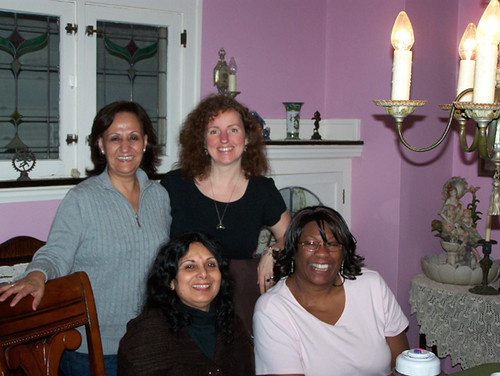
Mohtarama, Wendi, Mamta, Deborah

Wow, is it Friday already !? Time flies when you're powered by 100% raw organic goodness! Today, we wanted to share an audio interview with you. Last night, Alex Ortner from the Movement to Reverse Diabetes Naturally interviewed us about our recent work helping them spread their message. We were honored to hear him introduce us as "two people that hold a special place in my heart right now, and I'll tell you why that is: They are probably the two most active people that we've had in the movement to reverse diabetes naturally."
Well, Alex, it was our pleasure! We met scores of new people during our work for RDN, generated major awareness about the movement, and spread the word about the raw food lifestyle as well. To listen to or download the interview, just visit their site, here. Topics covered include:

Yesterday's smoothie was superlatively tasty, eh? It was clearly something out of Elvis' more energetic younger years, I think. You're probably wondering: "How does one follow an Elvis smoothie?!" I know ... it'll be tough to do.
Read more: Protein Powder Smoothies Part 3 of 3: The Donald Smoothie
Jim here... Back in November of 2010, my friends Joe Prostko, Heather Harris, and I decided to replicate an unusual experiment we'd heard about. Reportedly, some people with health issues had found improvement in their live blood samples after simply grounding themselves for a period of time. We all thought it was interesting enough to try on ourselves, so the above video is the result. ?Since it's 8+ minutes long, I'll spare you any suspense: The results were absolutely inconclusive. (However, we did have fun with it, as you'll see.)
NOTE: The site I'd posted the video on, BlipTV, seems to have gone out of business. Will have to see if I can find the video again and post on youtube.
Read more: Strange Grounding / Blood Experiment -- Inconclusive
 What fun it is to share a fun day with like-minded people at a special location, sharing good times, laughter, and delicious, nutritious raw food wonderment. Here are some pics from our outing -- hopefully the first of many such unique outings blending the Pittsburgh raw group with the D.C. one.
We hope this also provides some inspiration for other meetup groups to consider holding joint meetups in some geographically central location.
If you're new to raw foods, you're probably aware that eating this way isn't exactly mainstream. And, while we've talked here before about the importance of connecting with others for inspiration and support, it's true that a lot of that lends itself to participation in virtual worlds such as Twitter, Facebook, Give It to Me Raw, and other communities, blogs, and sites where raw foodies hang out.

"Hey there... I know you have a daughter about the same age as mine. Recently a friend at school told [my daughter] about the things animals go through to become our food and it has sickened her to the point where she wants nothing to do with meat except 'maybe' fish sticks.I'm so not against this in any way but my concerns are her eating enough other foods to balance out the vitamins and nutrients she got from meat so that it doesn't affect her health or learning development."
Above is part of a letter Jim received from a Pure Jeevan member. The letter was really three separate questions about the raw food diet in regards to (1) nutrition and development, (2) financial stress, and (3) group living. Since my response was getting quite long, Ive split up the questions and answers. Below is my response to the nutrition and development concern. Tomorrow, Ill address financial stress and group living when eating a raw food diet.
Read more: Teen Going Vegetarian: Nutrition and Development Concerns (Part 1 of 2)
Some of you have noticed that we've seemed a bit silent, or asleep, here at Pure Jeevan. We haven't abandoned our blog or our readers, though! For the next two weeks, it may continue to look like we are sleeping, but in reality we are doing anything but that! :-)
Here are some pictures of some recent meals we've been testing in our kitchen...