Know Any Literary Animal Lovers?

Hi there PureJeevan readers! We wanted to let you know that Jim's new novel CHROO is available on Amazon. It's a crazy adventure involving a billionaire heiress, her Chihuahua BFF ("Chroo") and a host of human and animal characters. Find out more on Amazon! Here are some links:
(Note: This is a closely-related piece to an earlier post ?entitled "Practice Is Your Key to Going Raw." I'll include a link to that article, below.* This one focuses more on recognizing your current level of progress.)
These days, I spend most of my free time cleaning up our fixer-upper home in Portland, so I haven't been going to the gym or regularly running as I had in the past. ?Hopefully, the house work is sufficient physical activity for me -- it sure does generate an appetite most days!
Welcome to Day 3 of Raw Salad Dressing Week here on Pure Jeevan. As you'll see, I "got a little creative" once again -- and again got lucky! I'll let you watch the video for the backstory on this one, but I'm happy to report that a nice, hearty, sweet, holiday-appropriate salad dressing was created. So, check out the video, and then I'll make a few closing comments.
Okay, so here's a recipe that may make you raise an eyebrow. "Baked " "Rice " Well, it's not really baked and there isn't really rice in it, but it tastes like a baked rice and veggies dish! I created this one day by mistake and we all loved it.
Baked Rice and Veggies
2 cups pureed sunflower seeds
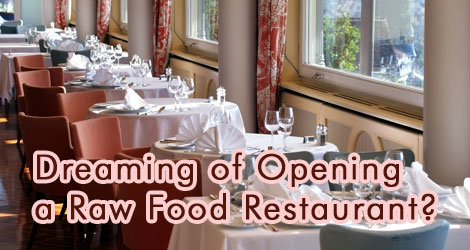
As raw foods enthusiasts for many years, Wendi and I have had the pleasure of patronizing raw food restaurants literally from coast to coast. Between us, we've been blessed to have sampled a more diverse spread of raw gourmet foods than have most people. (We hope that many others get to do this as well!)
From time to time in anyone's raw journey, it seems inevitable that thoughts crop up about opening a raw restaurant. For some, it's likely no more than a passing fantasy; for others, it may well become a firm business goal. We believe this is a fine and noble goal -- one that we'd like to see more people accomplish!
Read more: Some Thoughts on Opening a Raw Foods Restaurant -- Part I of II!
Just a quick notice that we've posted our December 2009 newsletter. Each month, we email a link to our newsletter to all Pure Jeevan family members. (If you're not receiving that, you're mising out on a ton of awesome raw inspiration and information. You can click here to sign up -- it's free!)
We'll be back tomorrow to continue our coverage of the Chicago raw food scene. As I've been saying for a few days now, you won't want to miss these great interviews!?

A few years ago, my dear friend Melissa and I decided to split the cost and order a raw food home study course (then known as The Dr. Ann Wigmore Program).Let me tell you, this was not a cheap program that we purchased, but at that time there wasn't as much free information available on the Internet like we now have.
Was it worth the cost? Well, kind of. Since we had both been reading and learning so much about raw foods (she had actually been raw for a long time many years before), much of the information wasn't new to us. However, if someone was newly learning about raw foods, the program would probably have been fantastic. The quality of the materials we received wasn't great (photocopies of photocopies that were sometimes difficult to read, and some videos that were blurry or difficult to hear), but at least we had a lot of information at our fingertips.

We tried it in the past, this most unusual fruit. While in Chicago recently, we decided to give it one more try! You see, the first time we tried it we were ... let's just say "not big fans" of the infamous durian. (Here's an episode of Kevin Gianni's Renegade Health Show, shot in our home, documenting that day.) It's a stinky fruit to most, although some claim to enjoy the bizarre odor (which is sometimes described as dirty sock and propane gas smell). If you can get past the smell to give it a taste, you'll be greeted by a taste as strange as the odor. Wendi describes it as a sweet onion pierogie, but each person seems to have a different opinion about this odd fruit.
In this current video our raw friend Debbie Gedayloo-Bennett, whom we met in Chicago, jumped at the opportunity to hang out for a bit of a durian experience. Debbie is on the pro-durian side of the fence that divides those who love and those who hate the alien-like fruit. Wendi was still sitting on the fence, not making up her mind after the initial taste with Kevin and Annmarie. Jim was adamantly sitting far from the love side of the fence, refusing to even attempt approaching the pro side. Debbie was a pro in opening this spiny fruit, so she agreed to open it while on video so that we could share the experience and knowledge with all of you.

I was grocery shopping in Giant Eagle with a friend the other day; I was just there to keep her company. When we left the Nature's Basket area (where they sell organics and more natural items), I felt a strange feeling. I hadn't realized it, but over the past two years I stopped shopping in the other areas of the store! I told her that by the time we hit the packaged shelves of the Nature's Basket area, I'd already be done shopping and my cart would be filled. We had a good giggle and went on shopping.
Anyway, that has since brought my attention to the shopping carts of those around me. We do about 5% of our shopping in Giant Eagle (last minute things that we've run out of, that don't merit a trip to our Food Co Op), so lately I've found myself in Giant Eagle looking into the carts of those around me. I'm not judging anyone, I'm just curious. On average, just about everyone has a small bunch of bananas in their cart. There are the occasional carts with something like a cantaloupe, a bag of apples, and once I saw a single tomato and a bag of lettuce. The rest of the carts have been filled with packaged foods. There is next to no living food in the carts.
Today, for Take the Time Tuesday, I'd like to introduce you to an online social networking Web site for those with similar interests to get together, meet, and hang out in the physical world. If you haven't already heard about it, check it out!
Take the time to meet....

It turns out that planning a 40-day/40-night cross-country trip is a LOT of work! (Who knew ??!) Wendi and I seem to be spending every waking moment planning this thing, which may explain why we've missed a day or two's posts here on Pure Jeevan. But, we're gearing up for something absolutely amazing -- and it all starts next week!? So, if there is a quiet day or two this week, just keep in mind that the rawsome content is going to be absolutely insane here starting late next week and continuing through March into early April!
Today, we wanted to extend a huge thanks to Jeff and Helen Rose, owners of Natural Zing, for offering to sponsor the snack portion of Wendi and KDcat's trip. Jeff and Helen understand that, being a raw foodie, it can be a little tough to be on the road for such a long time. Sure, Wendi and KDcat will probably be snacking on a lot of fresh fruit, but it's also nice to have some packaged raw goodies as well while you're traveling. So, Wendi and KDcat will be loading up on some of their favorites -- botija olives, Love Force breads, Gopal's power wraps, some nut butters, some raw chocolates, and more. So, in thanking Natural Zing, we'll be running banners and so forth along with our content during Pure Jeevan's trip.

The other day, before grocery shopping, I didn't have a lot of food in the house. When that happens, I usually take a look at what I have and then try to come up with something tasty. It's kind of an art form, to create something out of next to nothing. I think I learned the art from my mother, who had to make things stretch on a very minimal budget.
Here's what I created, and it turned out great!