Know Any Literary Animal Lovers?

Hi there PureJeevan readers! We wanted to let you know that Jim's new novel CHROO is available on Amazon. It's a crazy adventure involving a billionaire heiress, her Chihuahua BFF ("Chroo") and a host of human and animal characters. Find out more on Amazon! Here are some links:

So, we've been building up to something exciting all week long -- and here it is! As it turns out, Kevin Gianni is not only a "renegade health" expert, motivational speaker, and all-around great guy; he's also a singer/songwriter!? And he even has his own CD called "God Loves Guinea Pigs" (original songs and artwork by Kevin).
During the past few days, we shared some great interviews with Kevin. In addition to all of the material covered so far, both Jim and Wendi had asked Kevin some musical questions. So, we saved those parts of the interviews for today. Here are the bonus sections from those interviews, including the funny story about Kevin dropping his pants in public!
?
Jim here... A few months ago, I'd posted an article here on the topic of Cognitive Dissonance. This theme seems to crop up from time to time in questions people ask about the raw foods lifestyle. For example, one new raw fooder recently posted a question in a raw foods forum asking whether other raw foodies had reached a place in their lives at which things changed so much that they felt as though they were living a contradiction. Because this struck home for me, I'd like to reiterate my response, somewhat edited, below.

April 13, 2008
I noticed that since I ve been eating only mono meals, I seem to be consistently sleeping eight hours a night, as opposed to nine, or more. It s a dreary day today, yet I don t feel like I m tired or down, which is how I normally feel when there s not enough sunshine.
This recipe is an adaptation of one from "Rawvolution", by Matt Amsden. As of this point in time, "Rawvolution" is my favorite recipe book. Most of the recipes are high in sodium and fat, but very satisfying for those who are used to eating cooked foods.
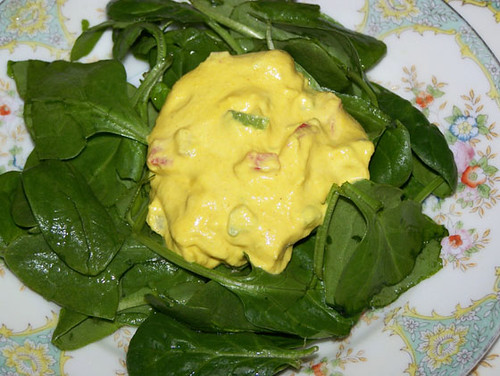
Egg-less Egg Salad
Here's an update from Wendi. I think this can be considered, with 99% confidence, the big announcement:
Of course, there's that 1% chance that something unexpected will happen. But, Portland feels right. It always has for us; we nearly moved there in the late 1990s. We had books on Portland back then, and I was buying their newspaper each week to hunt for jobs. It just never panned out, though. I suppose we were meant to live in Pittsburgh for a spell. It would be easy for me to list many reasons why Pittsburgh served a purpose for us. But, yeah, I think we're Portlanders at heart. So much about that city resonates with us. It'll be a homecoming, for sure! I want to reiterate a few things that I'd written in comments recently, slightly clarified in places.
Read more: Pure Jeevan Perceives Peace, Purpose, and Prosperity in Populous Portland!
If you've been following us for some time, you'll know that we are continually working on projects that will either serve our raw food community or educate others about the health benefits of a raw food lifestyle. If you are new here, or just getting to know us, you can read a summary of what we accomplished last year and a summary of the projects we're currently working on. We're serious about our goal to inspire others to learn about and embrace the raw food lifestyle and community. I've always been someone who helps others, who senses in what direction they are headed and then offers inspiration to keep them moving. I love the work we do as Pure Jeevan and it is extremely rewarding to receive so much gratitude from many of you. But, guess what? Sometimes I get tired!
Sure, some of you may be saying, "But, wait! People who eat raw foods are supposed to be power houses of energy -- able to continually keep active and never run out of steam." Well, that is very true. So, I take it back. I'm not really "tired" like I said -- my body is able to wake up in the morning, easily fall asleep in the evening, and go about its daily work without feeling like it's run down.However, I am feeling like I need a rest from all that I've been doing. Maybe I don't need to sleep hours and hours, because my body isn't truly tired. None of my being is truly tired -- my body, mind, spirit, and emotions are feeling great, actually.
However, I still feel like I need a break from my routine. On top of that, I've been feeling uncomfortable in the cold weather even more this year than I did last year. It hurts all the way down, deep inside my bones. I feel like it will take a lifetime to thaw from the cold I've been feeling here in Pittsburgh. The sun rarely shines, and the snow and ice are brutal on someone eating only raw foods. My instincts told me two years ago that it was time to move to a warmer, sunnier climate, but that hasn't happened yet (even though we are patiently working on it, as Jim pointed out in an earlier post).

I was just thinking about a particular phenomenon, but don't know what to call it. This is something I used to notice mostly after watching movies, although it's something that happens all the time in life -- and I think it does in fact relate to diet, so I'll share. Here it is:
Ever leave a theater after viewing a particularly uplifting film Recall what it's like for a moment. You walk outside, maybe with friends or family, still filled with that magical feeling of having visited another world, or having been moved beyond words, or being filled with inspiration. There's a glow about you, and the air seems sweeter as you stroll out to your car, absolutely care-free. You spin around as you walk, laughing with your friends, joking and hugging each other, engaging in imaginative conversation all the way home -- and the spell lasts for a good long time thereafter. Oh, I love, love, love great movies!!!
Read more: Pure Jeevan Adds Depth to the Phrase "Watch What You Eat"
Today I answer the second part of a letter Jim received from a Pure Jeevan member who was seeking advice about her daughter who has decided to become a vegetarian. Rather than quote parts of her letter, I'll summarize the questions (because they are general questions that we hear a lot and our answers are given for everyone, not just the individual who sent the most recent letter).
1) I don't have a lot of money for all the produce and kitchen appliances, so how can I eat a healthy diet2) I live with others who don't eat the same diet, so how can I possibly make this work
Read more: Financial Stress and Group Living Concerns (Part 2 of 2)

Here at Pure Jeevan we are preparing for our cross country tour to educate others about raw foods. This means we are paring down on a lot of things, donating a lot, selling some things, and pretty much not buying anything unless it's absolutely necessary. That's what we've been doing for almost two years now (we're waiting for the house to sell). Recently, however, I decided it was time to spend a little bit of money even if it wasn't absolutely necessary.
-

- Wendi's Dish Set
What did we buy? Dishes! Seems a bit strange to finally spend some money on something unnecessary and have it be dishes, right? Well, I had a few reasons for this purchase. The first is that when we are living in the RV, the space is going to be minimal. There won't be a lot of room for dishes, let alone much of anything else. Since there's not a lot of space to have dishes drying, we'll need to be washing, drying, and putting away immediately after use. That may not sound like a big deal, but when someone in the family decides to eat a few different things and leave the dirty dishes in the tiny RV sink, on the small counter, or somewhere else, it's going to really seem like a bigger mess than it is. So, to remedy this I thought it would be good for each of us to have our own dishes. That way we have a sense of responsibility for our own particular dishes--we know they are ours and we are responsible for taking care of them.

 Day 8:
Let's focus on creativity for a bit. This is an area where many men have been comfortable expressing a feminine quality, especially when done through art and music. I say many, because we all know at least a few men who were raised to believe that a strong, powerful man doesn't spend his time with such frivolous things. Instead, he works hard to earn an income to support his family. In the past, and still sometimes today, creative men were viewed as weaker and less masculine, not practical and in control. The feminine quality of creativity was, however, encouraged in women who were afforded more time for such "frivolity."
Mnemonics for the "Clean 15" -- Or, "Conventional" Produce That Tests Lowest for Residual Pesticides
Following up on yesterday's post, today we're going to take a look at the "Clean 15." These are the 15 produce items that, according to research done by the Environmental Working Group, contain the least amount of residual pesticides (even though they're still grown using pesticides).
What this boils down to is: IF you're going to eat conventionally grown produce, these items will harm you much less than those we covered yesterday. So, here's the list, and then we'll try to come up with a sentence to help you (and us) remember everything: