Know Any Literary Animal Lovers?

Hi there PureJeevan readers! We wanted to let you know that Jim's new novel CHROO is available on Amazon. It's a crazy adventure involving a billionaire heiress, her Chihuahua BFF ("Chroo") and a host of human and animal characters. Find out more on Amazon! Here are some links:

Jim here... Of the many lessons 2008 brought to our household, one standout was certainly the importance of having patience. That s because we set some lofty goals, and lofty goals are often vital teachers.
For example, imagine sitting in your living room one day and deciding: "I'm going to scale Mt. Everest."? (For the purposes of this example, imagine also that no political, administrative, or financial restrictions exist to prevent you from doing this immediately if you really wanted to -- things like passports, entry visas, transportation costs, etc.)
Read more: Acknowledging Changes and Growth: 2008 / 2009, Part 2

A Pure Jeevan family member recently asked us how they can tell if they're consuming too much protein. They felt because they have been eating too many nuts and seeds, because of how quick and filling they are, that perhaps their intake of protein is too high in their diet.
We fully understand the convenience of the quick energy that eating nuts and seeds can bring to one's diet. We also have learned, through experience, that the more we rely on this type of nutrition (high in fat), the less energetic we feel long-term. There's nothing wrong with eating nuts and seeds as a pick-me-up between meals, as long as you're eating a small handful of them and your body does well with fats (not everyone can easily digest fats).
Short post today... We're currently dealing w with a pesky kitchen drain issue that's wreaking havoc in our household. Fortunately, a very talented and power-tool-weilding local plumber just fixed the problem. In the process, he seems to have applied those power tools to our bank account -- $175 for less than one hour's work!? (Ouch!) And the kicker is that the current state of our kitchen is "absolutely atrocious."? I'm serious... we're at like DefCon 5 in terms of the disastrous nature of that room -- and as you well know, for a raw household, that's probably 10 times more frustrating than it is for others. (I smell a whole post coming soon on this topic ...)
Today, we mainly just wanted to say that, at the end of our post yesterday, we briefly asked what you would like to see more of here at Pure Jeevan. We have received some great comments and emails in return, and have decided to devote tomorrow's post to responding to / addressing some of the suggestions we received. So, if you have any further thoughts to share about raw foods content you'd like to see more or less of, please let us know either by commenting below, or by email. Wendi is at WendiDee [at] Pure Jeevan.com. Jim is at Rawdiant [at] gmail.com.

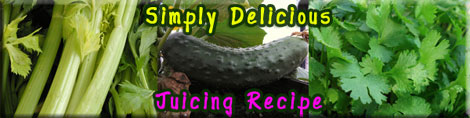
For today's installment of Makin' It Monday, we wanted to share something that we've been making a lot of lately. It's so simple, yet so delicious and refreshing. Here's the recipe:
- 2 cucumbers
- 3 large stalks of celery
- 1 handful of cilantro
That's all!? You might finish with a pinch of your favorite salt (optional).? Also, since the cucumber is an extremely water-heavy veggie, I would advise you to run it through the juicer several times. Here's what I do:
Read more: Makin' It Monday: A Simply Delicious Juice Recipe
Mnemonics for the "Clean 15" -- Or, "Conventional" Produce That Tests Lowest for Residual Pesticides
Following up on yesterday's post, today we're going to take a look at the "Clean 15." These are the 15 produce items that, according to research done by the Environmental Working Group, contain the least amount of residual pesticides (even though they're still grown using pesticides).
What this boils down to is: IF you're going to eat conventionally grown produce, these items will harm you much less than those we covered yesterday. So, here's the list, and then we'll try to come up with a sentence to help you (and us) remember everything:

For this Take the Time Tuesday, I'm going to do something different. I'd like to share with you some of my friends and family, people I'd be pleased for you to meet in person some day. They are all beautiful people, filled with love.
Take the time to meet...
Some of Pure Jeevan's Friends and Family!?

The birthday girl, Rhia, asleep on her beautiful Nani?

When I first decided to try a raw food diet again (I had sampled it for about three months a few years before going completely raw), I wanted to do it in a way to prove that it either does or doesn t work. The best way to do that, I figured, was through consistent blood tests. So, that s what I did. I have continued to document my path to health with regular blood tests. Many of you know that the results have been remarkable. My dramatic shift in weight is the most obvious to others, but there were equally impressive changes going on inside my body, as well.
It has been about a year since my last blood work was done, so I knew I should schedule an appointment to get the testing done soon (since I want to keep the tests somewhat yearly). I tend to always put the testing off, however. As much as I m curious about the results, the truth is that I m terrified of needles. Over the past few months, I was continuing to put this yearly testing off, but something has spurred me to get it done sooner than later.
Read more: Raw Food and Measurable Health: Does Wendi Have Lyme Disease?
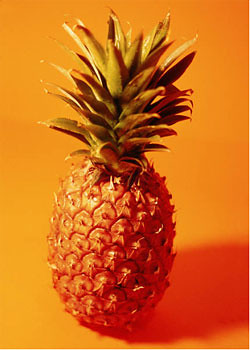
Eating only mono meals is going pretty well. I'm on my third food, so far, and have ended day two. This evening I've started my third fruit: Pineapples!

Here at Pure Jeevan we are preparing for our cross country tour to educate others about raw foods. This means we are paring down on a lot of things, donating a lot, selling some things, and pretty much not buying anything unless it's absolutely necessary. That's what we've been doing for almost two years now (we're waiting for the house to sell). Recently, however, I decided it was time to spend a little bit of money even if it wasn't absolutely necessary.
-
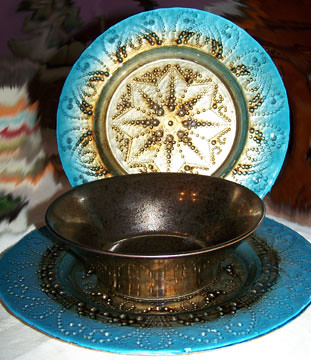
- Wendi's Dish Set
What did we buy? Dishes! Seems a bit strange to finally spend some money on something unnecessary and have it be dishes, right? Well, I had a few reasons for this purchase. The first is that when we are living in the RV, the space is going to be minimal. There won't be a lot of room for dishes, let alone much of anything else. Since there's not a lot of space to have dishes drying, we'll need to be washing, drying, and putting away immediately after use. That may not sound like a big deal, but when someone in the family decides to eat a few different things and leave the dirty dishes in the tiny RV sink, on the small counter, or somewhere else, it's going to really seem like a bigger mess than it is. So, to remedy this I thought it would be good for each of us to have our own dishes. That way we have a sense of responsibility for our own particular dishes--we know they are ours and we are responsible for taking care of them.
This pie is amazing and exactly like a traditionally cooked pumpkin pie! I took a few different pie recipes and altered them until I came up with this recipe.
Pumpkin Pie
Filling:
?
Jim here... A few months ago, I'd posted an article here on the topic of Cognitive Dissonance. This theme seems to crop up from time to time in questions people ask about the raw foods lifestyle. For example, one new raw fooder recently posted a question in a raw foods forum asking whether other raw foodies had reached a place in their lives at which things changed so much that they felt as though they were living a contradiction. Because this struck home for me, I'd like to reiterate my response, somewhat edited, below.
