Know Any Literary Animal Lovers?

Hi there PureJeevan readers! We wanted to let you know that Jim's new novel CHROO is available on Amazon. It's a crazy adventure involving a billionaire heiress, her Chihuahua BFF ("Chroo") and a host of human and animal characters. Find out more on Amazon! Here are some links:

Below are two variations of the same issue: I'm too tired and don't have enough time to be healthy. The irony, of course, is that the more raw foods you eat, the more energy (and therefore time) you have!
By the end of the day I am so exhausted I'd rather not eat than go in the kitchen & try making something raw.How do I stay raw with all the food prep and my lack of time and life's pressures
Here's a letter from Wendi to the Pure Jeevan family. I prettied it up a little with some color and graphics. -Jim

Hi there, lovely Pure Jeevan family! I'll be away from the computer for a month, working on some deep healing. It's time to go within and really hear what my body and spirit are saying.
Read more: Wendi's Taking a Break... A Peek Into How She's Been

I was grocery shopping in Giant Eagle with a friend the other day; I was just there to keep her company. When we left the Nature's Basket area (where they sell organics and more natural items), I felt a strange feeling. I hadn't realized it, but over the past two years I stopped shopping in the other areas of the store! I told her that by the time we hit the packaged shelves of the Nature's Basket area, I'd already be done shopping and my cart would be filled. We had a good giggle and went on shopping.
Anyway, that has since brought my attention to the shopping carts of those around me. We do about 5% of our shopping in Giant Eagle (last minute things that we've run out of, that don't merit a trip to our Food Co Op), so lately I've found myself in Giant Eagle looking into the carts of those around me. I'm not judging anyone, I'm just curious. On average, just about everyone has a small bunch of bananas in their cart. There are the occasional carts with something like a cantaloupe, a bag of apples, and once I saw a single tomato and a bag of lettuce. The rest of the carts have been filled with packaged foods. There is next to no living food in the carts.

Continuing with our week of ways to keep a sharp mind, let's focus on the one widely accepted indicator for dementia or alzheimer's: heart disease. If one wants to dramatically reduce the chances of brain degredation, the first step to take is keeping the heart healthy.
The key advice most health specialists agree on when it comes to a healthy heart is the reduction (ideally eliminatain) of unhealthy fats in the diet. The unhealthy fats are usually seen as solid fats, like butter, margerine, and shortening. However, it's important to not overlook the fats that are also found in meats. By substituting unhealthy fats with something healthier for your heart (like extra virgin, cold-pressed olive oil), as well as transitioning to leaner meats if you are a meat eater, you will be taking some important steps in keeping your heart healthy, as well as your mind.

Welcome to Day One of "Dressings Week" here on Pure Jeevan. After finding out that KDcat took it upon herself to film a segment of "Makin' It Monday, Guest Raw Chef Edition," I decided that we should probably spend an entire *week* focusing on salad dressings.
Read more: Makin' It Monday Guest Raw Chef Edition: KDcat Makes Orange Pepper Cilantro Dressing
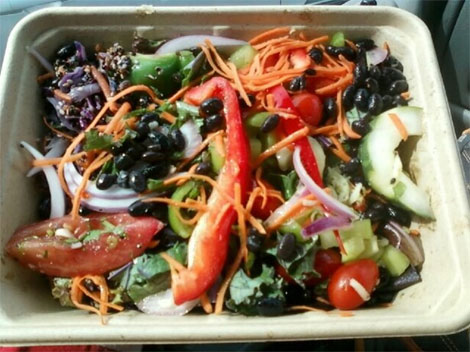
Jim here... As I hinted at last week, I decided to try changing things up a bit and seeing what I thought of it. The salad you see above included the first cooked food I've had in more than two years. If you look closely, you can see that I sprinkled on a few spoonfuls of black beans. Also, in the upper left corner, there's a small spoonful of quinoa. I don't want to give the wrong impression here: ?This blog will certainly remain a major go-to source for raw food nutrition information. It's just that, today, I want to talk about experimentation a little bit.
First, I think it's generally healthy to experiment with your diet -- especially when you get the sense that something isn't working in your current diet. The fact is, diet is a dynamic thing, not a static aspect of your life. It has to be this way because so many factors affect our physiology on a day-to-day basis. Off the top of my head, these include the facts that:
Read more: Experimentation: The 95% Raw Salad... A Good Idea or Not?
I've been holding on to some things to share here on the blog, and today feels like a good day to share this particular inspirational gem, below. I hope it speaks to some of you in a way that brings about a deeper love for yourself. Many times I have a feeling, based on emails I receive, that I love some of you more than you love yourselves (and I deeply love all of you). That's okay, though. Your time will come to blossom into the self-loving individual that you know you are at your core. Perhaps today what I share will trigger a deeper sense of self-love for you, as it did for another friend.
Back in October, a friend in an online raw community sent me a message about how she was having a tough time with cravings. I responded to her, as follows:
... You CAN do it, too! For me, it took finally loving myself to make the change. I had to KNOW that NOTHING was going to stop me from loving myself. And loving myself meant never putting harmful things into my body EVER AGAIN! So, once I made that decision, I moved forward. I'm not saying I didn't have cravings, but I loved myself through them! ...
Many times in the online communities, the messages you share with others will also be read by individuals stopping by the pages of your friends. That was the case with what I wrote, above. I received a lovely message from another friend in that community, who had read the message I left for someone else. Here's what she wrote to me:

Greetings, everyone! ?We've been away from regular blogging for what seems an *eternity*. When we left the airwaves, the raw food world was at total peace with itself -- bliss, harmony, sister- and brotherhood. Aside from rare, gentle disagreements among raw vegans on issues such as whether raw chocolate was mineral-rich or potentially taxing to your body's store of minerals, things were pretty much business as usual.
And then we moved away and took a little time off to regroup .. ?and NOW look at the state of the raw food zeitgeist: (1) long-term raw foodists just about everyhwere are now "eating a little bit of cooked food," (2) an enormous schism has emerged after the seemingly improbable development of many long-term vegans returning to meat eating, (3) informational summits and online meetings have been replaced by debates, and (4) let's face it, the supplements being discussed and sold are getting, well, much *weirder* than ever!

As we mentioned in one of our first blog posts, Pure Jeevan met with Leela Mata at her Peaceful Valley Ashram to discuss the details for some 3-day Raw Food Spiritual Retreats for you during 2008! The details are finalized and we are proud to announce our first 3-Day Raw Food Spiritual Retreat, that will be held at the ashram from May 23-25, 2008. We've set this retreat up so that it's as affordable as possible. There's a significant savings if you sign up early, so be sure to check it out!
Some very special companies have delicious treats for those attending the retreat.



"An ounce of action is worth a ton of theory." ~ Friedrich Engels
When people talk about goals and planning, two distinct camps tend to emerge, in my experience:? (1) the "aim then fire" types, and (2) the "fire then aim" types.? I've used those specific terms for a reason, and will return to them in a bit. But, let's look at the two types, and relate them to the way in which one might approach raw foods.