Know Any Literary Animal Lovers?

Hi there PureJeevan readers! We wanted to let you know that Jim's new novel CHROO is available on Amazon. It's a crazy adventure involving a billionaire heiress, her Chihuahua BFF ("Chroo") and a host of human and animal characters. Find out more on Amazon! Here are some links:
I love this video, in which Wendi interviews our new Portland-based realtor, Bill Futrell. It's a nice interview, but I love the way Wendi's enthusiasm for raw foods rubbed off on Bill almost immediately. There's even a moment in here in which Bill starts talking about Natural Zing. We thought for sure everyone would think we put him up to that, but he did it absolutely spontaneously! So, thanks Bill for helping to support our Snack Sponsor. Anyway, here's what he had to say about Portland, about where we'll fit in, and about his first exposure to raw foods:
One thing I can tell you for sure: Portland is WAY more expensive than Pittsburgh. A year ago, I invested a ton of time reading about low-cost cob houses, straw-bale construction, Earth-ship homes, homes fashioned from "obtanium," thatch roofs, off-the-grid systems, igloos, you name it -- anything DIY-oriented. (Okay, well not igloos; that was a joke. Even though igloos are probably pretty neat-o.) I'm sure we'll get to many of those types of projects one day still. But for now, as you can see, we're going to put down roots in a really great city out West. We're doing it with intention, though, and in harmony with our mission to help ourselves and others obtain the highest levels of health and happiness.

Many of our visitors go directly to our raw food recipes section of the blog. They must be terribly disappointed to find only a few recipes there. We ll continually add more, but for now there are only a handful. So, it is with extreme pleasure that we introduce you to someone you are going to love!
Take the time to meet...

Let's stay sharp by learning about brain power! Did you know that the less exercise your brain receives through reading, learning new things (like you do here on our blog!), playing games, and contemplating puzzles the more it is likely to become weak and not serve you well into your centenarian years? Scientists have been trying to figure out ways to improve the brain's function and have learned a lot, but are still uncertain what causes Alzheimer's Disease, or any other form of Dementia.
If you ve ever known someone who suffers with a loss of mental capabilities, you know how sad and sometimes scary that can be. Last week, Jim posted a blog that touched a bit on the subject of Alzheimer s Disease. He wrote in that article, ?I want better than just a small chance that I ll live healthfully for a full lifespan. I want to stack the aging deck in my favor. ?Eating a healthy, raw food diet is something Jim was hoping to use in order to stack the deck in his favor of a life free of memory loss and full of vibrant health.


It's not much longer before I'll be serving all kinds of delicious foods to those attending the 3-Day Raw Food Spiritual Ashram Retreat! I've been working on the recipes and taking pictures to include with the bound materials going home with everyone attending the retreat.
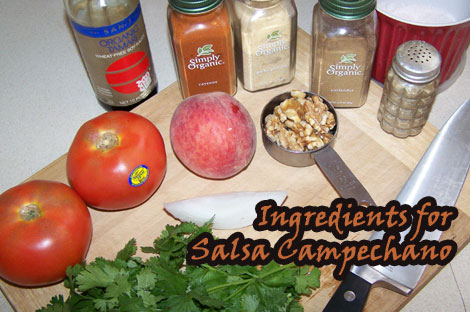
For today's Makin' It Monday feature, we'd like to present "Salsa Campechano." We'll have to admit, though, that we do not speak Spanish. So, we have to give some credit to Google's online language translator. When we went to name this recipe, Wendi suggested that this is a "manly" dish (since I created it). However, we didn't find the perfect Spanish word to fit the recipe.Then, considering the walnuts in the recipe, Wendi suggested that perhaps "hearty" was a better adjective. Google returned the Spanish word campechano for this, and we immediately thought: Yes!, that sounds just perfect!? So, here's an amazing recipe for you. It's a hearty salsa recipe, but I actually like to eat it as a soup.
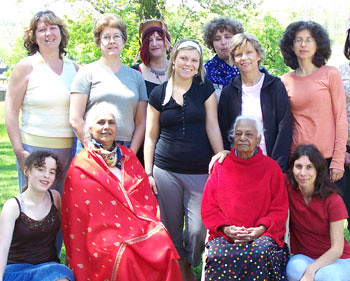
A partial group picture from the retreat.
The 3-Day Raw Food Spiritual Ashram Retreat was a success! All my time and effort that went into creating the event was well worth the experience. When Leela Mata and I discussed a possible raw food retreat about a year ago, I had no idea how to go about creating such an event. I have never done anything like this, so I approached it by asking myself: "What would I want if I was attending a raw food spiritual retreat " From there, I created a retreat that I would love to attend, myself. In fact, when it was completely organized and guests began signing up, I wished that an identical event existed that I really could take part in, as well!

Is low fat more expensive? When I was eating a lot of nuts and seeds, in the back of my mind I kept saying, "Someday you'll eat less of these nuts and seeds, and you'll save a lot of money." I really believed that to be true because organic, raw nuts and seeds are outrageously expensive.
For one hundred days, I'm transitioning to a lower fat raw diet. I'm down to fats only in the evening, and for the next ten days those fats will only come from avocados, young coconuts, and possibly some hemp seeds. If I'm not hungry for the fat, however, I'll go without it. That hasn't been the case yet, though. By dinner time I'm ravenous and wanting to eat heavy, dense foods to calm the hungry beast in my belly. Even though I've been including some fats in the evening, I'm eating significantly less than I normally would if not doing this challenge. So, I've been eating more fruits and vegetables to get the calories I normally received from nuts and seeds.

Q. I recently read the following on Dr. Micahel Eades' (dr. protein power) blog & would appreciate your opinion:
Have you any comments on the RAW FOOD movement and particularly Dr. Cousens claim of a ?cure ?Dr. Eades' response:
I don t know anything about Dr. Cousens. I do know that people in the raw food movement seem to believe the raw foods deliver ?natural? enzymes unaltered by cooking to the GI tract to help it do its work. Problem is these ?natural? enzymes are made of protein and are denatured (the same alteration process as cooking does with heat) as soon as they hit the stomach acid. The fact that proteins can t make it through the stomach without being completely altered is why diabetics can t take insulin pills and have to get their insulin via injection. Insulin is a protein, just as enzymes are, and it can t make it through the stomach without being denatured.

As I write this, Wendi and KDcat have been en route to Portland for 39+ hours so far (including a long layover in Chicago)! Looks like they still have another 22 or so hours to go. What a monumental trip, eh ! Cross-country travel by rail really gives you a better appreciation for the distance, as compared with air travel or even highway travel. Imagine what it must have been like in the covered-wagon days!
 So far, reports from the train have been not so wonderful. KDcat seems to be having a good time roaming around socializing. But, Wendi's experiencing some major motion sickness. Oddly, we never anticipated this problem -- which is incredible, as we spent more than a month planning this trip! But, it just goes to show you that you cannot anticipate everything in life!
Today we welcome Devaki, the yoga instructor at Peaceful Valley Ashram, for another episode of Pure Jeevan s Makin? It Monday ?Guest Raw Chef? edition. In this episode, Devaki demonstrates how to make raw Cabbage-Mango salad. We ate the salad shown just after shooting the video. It was quite tasty and refreshing! Here s the recipe:
Read more: Devaki Makes Cabbage-Mango Salad on Makin' It Monday "Guest Raw Chef" Edition
Jim here... Today Wendi is busy preparing for a multi-day activity that I'm sure she'll be writing about later this week. So, I thought I'd field a question we received recently (one directed specifically to me). We do receive a good deal of questions at our Raw Food Diet Question In-box (at Questions [at] PureJeevan.com), so feel free to send any in that you may have, and we'll definitely get to them all here in time. In any case, one reader writes:
As drawn as I am to a raw diet, being mostly cooked vegan right now, I can't help but come up against this each time: Since produce is, after all, mostly water, what did you eat while transitioning that didn't lead to shoving in lots of bread, potatoes, etc. Do you just eat lots and lots of, say, oranges, at one go? This has always been my raw downfall. I'm sure the answer is very simple.
Wow, this is a great question, and one with many possible answers! To begin, let's recognize that this isn't a question from a "SAD diet" eater. ?Being a vegan, alone, takes significant learning and (often) self-discipline to accomplish successfully. It's also, in my view, an excellent dietary and lifestyle choice for many people, regardless of whether they ever decide to try a raw foods diet. So, this question is rather advanced.