Know Any Literary Animal Lovers?

Hi there PureJeevan readers! We wanted to let you know that Jim's new novel CHROO is available on Amazon. It's a crazy adventure involving a billionaire heiress, her Chihuahua BFF ("Chroo") and a host of human and animal characters. Find out more on Amazon! Here are some links:

Jim here with another installment of Weird Wednesday...
Throughout the year, I go through various phases of fruit preferences. Right now, it's citrus. I eat probably four large grapefruits per day (dark reds). The darker the red the better, IMHO. I can get quite disappointed when the grapefruits are listed as "ruby red" but turn out to be just regular pink ones. I've noticed that the ones I like the most have an orangish tint to them, as though they've been left to ripen on the bush a little too long. Also, the best ones I've had this year have been from Texas. So, find yourself some burnt-looking Texan grapefruits & enjoy the blood-red bitter-sweetness!
Read more: If Oranges Smell So Darned Good to You... Buy Some!

Jim here... Here's an interesting way to finish out the week: Today just happens to be my one-year "rawniversary." That's right, for the past full year, I've existed as a 100% raw food vegan.
Sure, I'd been "high-raw" for a couple of years prior to September 18, 2008 -- and it was during those high-raw years when the bulk of my weight came off and when I kissed prescription meds goodbye (I'd been on powerful beta-blockers for my heart and blood pressure).

In this special five-part series, Joanna Steven uncovers where some top vegetarian athletes get their protein. Here's part three, focusing on Robert Cheeke's take on this issue.
YELLOW PEA POWDER
In the spring of 2005 this natural body builder became a champion bodybuilder - all on a strict? vegan diet. Robert Cheeke, an activist/athlete raised on an Oregon farm, went vegan when he was 15 years old and transitioned to full on vegan only two months later. Winning titles in Portland, OR and competing at the Natural Bodybuilding World Championships held in California, Robert maintains his intense mass building workout regime on a 100% animal-free diet.
Read more: Vegetarian Athletes Share: Top 5 Sources for Animal-free Protein (Part 3 of 5)

The Environmental Working Group publishes something really useful called the Shoppers Guide to Pesticides. In it, they offer two handy lists: (1) The Dirty Dozen -- conventionally grown produce items that contain the most residual pesticides, and (2) The Clean 15 -- conventionally grown produce items that contain the least residual pesticides.
While we believe that organic is always best, there nonetheless are times when most of us (for whatever reason) consider purchasing or consuming conventionally grown (meaning "sprayed with pesticides") produce.
Read more: Mnemonic for the "Dirty Dozen" Foods that You Should Only Buy if Organic!

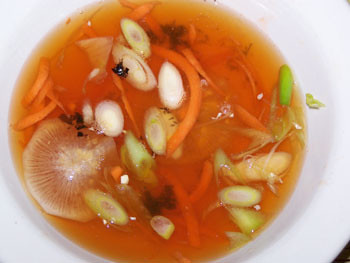
KDcat and I returned from the ashram last night filled with peace and motivation to move forward with our current goals (more about this in the upcoming newsletter). However, we also returned to a home with next to no produce in it (well, compared to what we normally have available). What to do? There's no way to run to the co op today (only one car in our home) or this evening, so it's time to be creative. Let's take a look at what Pure Jeevan has in the fridge and on the counter, and we'll see what we can create!

Jim here again... What do you think of that montage of vintage cigarette advertisements ! Knowing what we now know about cigarettes, it's tough to believe that such ads could have existed only 50 years ago, but the campaigns were real. Did doctors actually see no harm in cigarettes? Were there no pulmonary specialists back then who thought that habitually inhaling smoke might not be such a healthy idea Who knows... ?As I like to believe when it comes to doctors, even though they're quite oblivious to the harmful effects that chemicals have on our bodies, they do seem to mean well (in their own deluded ways). So, I don't hold it against them so much as I now hold it against individuals to think for themselves and challenge healthcare practitioners.
In any case, whether or not there is an advertising campaign attached to a new consumer product, it stands to reason that when a product is introduced into the marketplace, manufacturers should have a responsibility to ensure that the product is safe, and consumers should likewise have a reasonable expectation that the product is safe. Only, it doesn't always work that way, does it?
Jim here...As vegans and vegetarians, we're familiar with what we believe is quite a lot of misinformation regarding our lifestyle. However, we've done the research and, for example, know how we get our protein (always a concern received from others), know the stats on B12 deficiency (another concern often cited by mainstreamers), and know our answers to other issues such as where we get our minerals from and whether we consume processed foods and sugars. Bucking the mainstream conventional wisdom emergent from within a world dominated by the Standard American Diet, we live defiantly as healthy examples of our chosen path. But, is there any wiggle room as far as what is and isn't healthy (for us, and for everyone)? What about some of the things that everyone "knows" is bad for you? With questions like those in mind, here's something unusual -- a full post developed from a simple Facebook update. (You are friends with Wendi and me on Facebook, right ) Yesterday, I posted the following:
Think of something that you think is bad for you, and then go to Google & type in "benefits of [that thing]" and see if there is a web site that is promoting that thing. I just did this for "caffeine" and read some thought-provoking ideas (that might all be utter BS, but are interesting nonetheless).
Read more: If Science Can Prove Both Sides of an Issue, Then Which Is Correct?

Pure Jeevan hosts the Pittsburgh Raw Food Meetup this Sunday, November 2, at 3:00 p.m.! Click here for details and a map link. We hope you can make it. We'd love to spend time with you!
Original Comments
Below, we have included the original comments from this blog post. Additional comments may be made via Facebook, below.
Welcome to Episode 4 of Know Your Food. Wow, the PEAR episode is here at last! Aren't you thrilled to know that? Of ALL of the fruits, veggies, nuts, seeds, herbs, etc. in the knon world, we finally got to the wonderful pear. Well, it's no surprise, when you think about it. After all, sweet, mild pears are usually among the first fruits fed to babies. So, chances are, you were fed them, too, as a toddler. So, let's dig in, shall we?
Pears contain water-soluable fiber (pectin), Vitamin A, Vitamin B1, Vitamin B2, Vitamin C, Vitamin E, Copper, Potassium, Posphorous, Folic Acid, Niacin, Iron, Magnesium, Sodium, Sulphur, Calcium, and more! They lower your blood pressure, releive inflammation, lower cholesterol via pectin, calm the stomach, cool the body, prevent cancer via anti-oxidants, boost your energy via the fructose/glucose, reduce inflammation, help your bones/calcium levels, aid in pregnancies via the folate, and much more. Pears are GREAT for you, so eat them regularly!
I was sitting here today thinking about all of you, our lovely online friends who visit this blog. You follow what's going on with us, learn from us, find inspiration in the things we share, and even offer support to us in many ways.
Some of you reach out by leaving comments, many of you send emails, and a larger majority of you are quiet friends who haven't made contact with us, yet. Each and every one of you means so very much to me (and to Jim, too).
We don't keep this blog for ourselves; we keep it for all of you. It is our desire to share all that we've been through, and what we've learned, in order to help you with your own journey. Most of all, however, my personal desire is to inspire you to live the life you truly want to be living (in more ways than just through what you eat).
Some of you have noticed that we've seemed a bit silent, or asleep, here at Pure Jeevan. We haven't abandoned our blog or our readers, though! For the next two weeks, it may continue to look like we are sleeping, but in reality we are doing anything but that! :-)
Here are some pictures of some recent meals we've been testing in our kitchen...