Know Any Literary Animal Lovers?

Hi there PureJeevan readers! We wanted to let you know that Jim's new novel CHROO is available on Amazon. It's a crazy adventure involving a billionaire heiress, her Chihuahua BFF ("Chroo") and a host of human and animal characters. Find out more on Amazon! Here are some links:

Jim here... I'd like to mainly talk about organics today, but thought I'd wrap that subject into a longer, rather quirky piece on ranking produce on some sort of a scale that would indicate how awesome (or awful) it is. See what you think...
Have you ever thought of arranging produce into a sort of "heirarchy of quality"? Well, I'm not going to attempt to do that here, but I would like to discuss the concept for a moment in order to at least explain what I'm getting at. While I've not yet attempted to do this exercise, I nonetheless occasionally envision a large chart or something that conveys my feelings about how I personally rank the quality of fruits and vegetables I put into my body. This all probably sounds vague, so let me share some examples.
Read more: Pure Jeevan's "Produce Buying Tips" Series, #2: Buying Organics

Let's have a bit of fun today here on the blog. All week long we've been focusing on brain health and minimizing our chances of developing memory loss as we age. So, how sharp is *your* brain right now? What can you remember as the key highlights of ways to increase memory, ways to eliminate memory loss? What else can you remember reading over the past week here on Pure Jeevan's blog about having a sharp mind?
Share your resp0nses in the comments (and don't read those left by others until you've left your own!).

Brutal Honesty. 100% Transparency. Unedited Feedback. Absolute Truth. ... How often are we treated to these things by those we know? How likely are we do conduct ourselves with these ideals in mind?
Propriety. Politeness. Decorum. Political Correctness. ... How often do these conventions in others prevent us from knowing what others think of us? How often do these conventions in ourselves restrict our own words when directed at others?
Read more: The Gift of Honesty: The "Crazy" Life of Raw Foodists
Mmmmmmmmm! ?I'm sitting here at my computer eating the Best Organic Fuji Apple Ever. Don't believe me? ?Here's a picture of the apple I'm eating right now:
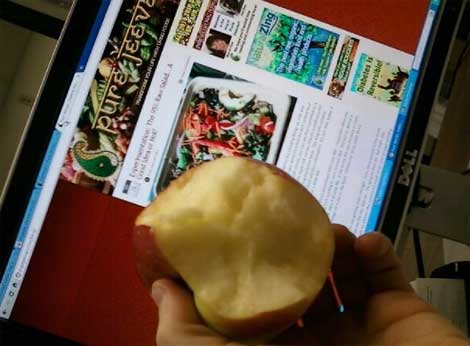
Looks dee-lish, right? ?(Okay, so maybe it's not the most appetizing pic in the world...) ?Anyway, one interesting thing about this apple is that I bought it (a whole big bag of them, actually) because it was so cheap. (I'm on a relatively tight budget these days.) ?But, if it was so cheap, how could it be so tasty? ?(And organic, too!) Well, that's where the basic law of supply and demand come in. Whenever a crop is at the peak of its season, the supply rises considerably. Instead of the store receiving X number of bushels of apples, they receive 5X or more. So, they slash prices to move that kind of volume.
Read more: Delicious Idea for Produce... Putting the Economics of Raw Foods to Work For You!


Our weekend is going to be filled with Spring cleaning. Many may not think of any type of cleaning as fun, but there's something special about Spring cleaning. Maybe it's because when we do Spring cleaning in our home, we tend to make it a family event. When we do things together as a family, even though there may be a little bickering here and there, but for the most part we have fun. There's something truly rewarding about working together as a team for something that is going to benefit everyone.
My nine days of mono meal eating are over! I'll write about the final day tomorrow.
April 14, 2008
Today I have even more energy. My tongue is coated more, however. It s not horrible, but it s definitely less red and more of a light pink. My eyes have continued to feel dry and my eyelids are heavy. What causes that, I wonder? My nails are whiter and harder, but they still break and rip when I m working around the house.

Welcome to the very first Take the Time Tuesday entry! What's Take the Time Tuesday, you may ask? Well, it's a time to meet someone special. Each Tuesday we'll introduce you to an individual or business we think might be of interest to you. So, who's in the spotlight for this very first Take the Time Tuesday entry? Pure Jeevan, of course!
Take the Time to Meet...
 Jim here... Wow, what a great week it's been here at Pure Jeevan, focusing on diabetes for five straight days!? To cap it off, I have some fun news to share:? Tomorrow is Wendi's birthday!? And, guess what ? When I asked her what she wanted to do to celebrate this year, she said she'd like to devote her special day to spreading the word about the Movement ot Reverse Diabetes Naturally. So, we made some calls and sent out some press releases.
A few venues were enthusiastically receptive, so we're hitting the streets tomorrow -- celebrating Wendi's birthday by handing out diabetes awareness literature! Here's the press release I sent to the media, which tells where we'll be. If you're from Pittsburgh, we hope you'll stop by to say hello and/or ask questions about natural diabetes reversal and of course raw foods!
= = = = = = = = = =

What do you do when you spend the night or week-end at someone's house and they're not raw. Do you take your blender and all that
Super question, Joanna!? I'm sure you also have a great answer for this. I think I do, too, but it's probably more complicated than a lot of people would like.For me, the factors that complicate the "travel to non-raw households" issue include, but are not limited to:
Before we run this blog entry, let me first announce one awesome thing:? Wendi and Kdcat are back home now!!? Yep, the trip is now officially over, and was a HUGE success. Not only did our fearless raw travelers identify Pure Jeevan's soon-to-be new home town -- Portland, Oregon! -- but Wendi and KDcat also met and made friends with hundreds of people from around the country. I'm sure Wendi will be back here on the blog with overall reflections and so forth soon. However, the trip generated so much content that it's going to take a while to catch up!? So, let's pick up with the travel narrative where we last left off. As you may recall, the girls were leaving San Luis Obispo and heading into sunny Los Angeles! Let's see what Wendi had to say, again with her travelogue:
 Wow, it's finally looking like CA with all the palm trees! After hitting and dealing with some major traffic of a large city, we arrived to the warmest welcome at the home of Debbie Young (of DebbieDoesRaw) -- a decorative greeting waiting on the door, gift bags handed to us as we walked inside, loving hugs and smiles, and the most amazing raw meal ever (samosas!, chai, pineapple lassi, mango chutney, tamarind chutney, biscotti cookies), and a snack basket waiting in our private apartment! At this stop, we were totally spoiled by Debbie and her beautiful family!
This is one of the stops I was really looking forward to, because Debbie and I have been online friends for a long time. We were able to spend a short amount of time together at the Raw Spirit Festival in 2008, and I loved her and wanted to spend more time with her and meet her lovely family in person (including their adorable dog, Malcolm).
Read more: 2010 Trip Coverage Continues: Los Angeles, California!!!

It's time for another "Makin' It Monday" installment!? This time, Pittsburgh raw foodies Joe Prostko and Tracey Anne Miller (along with videographer Heather) demonstrate their "Turbo Tornado Superfood Solution," which has (as you'll see) a *ton* of superfood ingredients. Take a look:
Read more: Makin' It Monday: Turbo Tornado Superfood Solution