Know Any Literary Animal Lovers?

Hi there PureJeevan readers! We wanted to let you know that Jim's new novel CHROO is available on Amazon. It's a crazy adventure involving a billionaire heiress, her Chihuahua BFF ("Chroo") and a host of human and animal characters. Find out more on Amazon! Here are some links:
 Picking up from the previous installment, Wendi and KDcat absolutely loved beautiful Corvallis, but ultimately felt it had too much of a small-town feel for us. So, they decided to take a road trip to the nearest big city, Eugene. KDcat and Stephanie (one of the lovely daughters of our Corvallis hosts) were enjoying their time together, so Stephanie decided to come along.
The trip from Corvallis to Eugene is but one pleasant hour's drive.The group's first stop was the Buffalo Exchange, a new and secondhand clothing store. Everyone loved the store, which offered a great selection of? fun clothes you can t usually find in other stores or thrift shops. A barely worn pair of red hi-top Converse sneakers was the highlight of this stop for KDcat. She's been wanting a pair of these exact shoes for ... well, forever! She immediately began decorating them when she had the chance (after they were disinfected, that is).
From there, they explored greater Eugene, checking out areas others had suggested. There were a lot of cute shops, but they were geographically spread out. It wasn t like the neighborhoods in Portland, where you can walk blocks and blocks with unique stores, restaurants, etc., all in a row. There was a nice vibe to Eugene, Wendi said, but something about it just didn t feel like home for us. Wendi said there weren t as many people out and about as she'd expected, but that could have been because they visited on a Sunday. Here are some pics from around town -- and then we'll talk food.
Read more: Eagerly, Everyone Euphorically Explores Eugene. Editorialization Ensues.

To help keep all of you inspired, we ve asked some
remarkable individuals to share their raw food stories with you. Enjoy!

I've already posted the recipe for this, but I wanted to talk about the orange pudding a bit. Since going raw, I've become a mostly intuitive eater. Whatever I feel like eating is what I eat. This usually means I am eating the same food for an extended period of time until I feel drawn to something different. Lately it has been the orange pudding.
I've been starting my mornings with a large bowl of it. If Jim is making lunch then I'll eat the salad or nut dip that he makes, otherwise it's orange pudding again. Then, if I didn't eat a salad during the day I usually have a salad for dinner and...a dessert of--you guessed it!--more orange pudding.

It turns out that planning a 40-day/40-night cross-country trip is a LOT of work! (Who knew ??!) Wendi and I seem to be spending every waking moment planning this thing, which may explain why we've missed a day or two's posts here on Pure Jeevan. But, we're gearing up for something absolutely amazing -- and it all starts next week!? So, if there is a quiet day or two this week, just keep in mind that the rawsome content is going to be absolutely insane here starting late next week and continuing through March into early April!
Today, we wanted to extend a huge thanks to Jeff and Helen Rose, owners of Natural Zing, for offering to sponsor the snack portion of Wendi and KDcat's trip. Jeff and Helen understand that, being a raw foodie, it can be a little tough to be on the road for such a long time. Sure, Wendi and KDcat will probably be snacking on a lot of fresh fruit, but it's also nice to have some packaged raw goodies as well while you're traveling. So, Wendi and KDcat will be loading up on some of their favorites -- botija olives, Love Force breads, Gopal's power wraps, some nut butters, some raw chocolates, and more. So, in thanking Natural Zing, we'll be running banners and so forth along with our content during Pure Jeevan's trip.
We've promised many of you that we'd share some ideas for the whole family (especially the children), so here's one idea that might prove particularly popular. In a household of two former English majors, it's only natural that we've always adored and admired alliteration. So, we may be biased to believe that these "Breathtakingly Bejeweled Blueberry Banana Breakfast Bowls" will be as beloved by your beauteous bellies as they are by ours. See what you think!
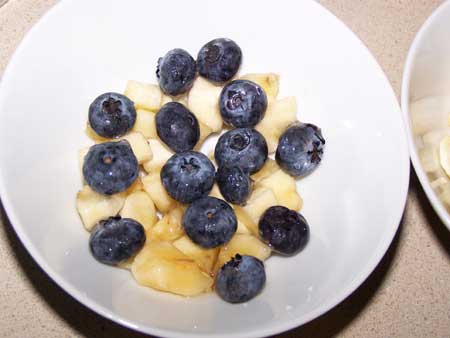
Read more: Breathtakingly Bejeweled Blueberry Banana Breakfast Bowls
Jim here... again! Isn't that what all of the Oscar-nominated actors always say -- "It's an honor to be nominated"? Yes, I think that's the usual response. Who'd have ever thought that a raw foods blog would be saying the same thing ! Well, I'm happy to report that Wendi has received two such honors lately, in addition to being selected as an honoree among one blogger's nine "top favorite raw girls on the net." Let's take a look at these one by one, shall we?

First up is the "Best of Raw 2008" awards. Wendi was nominated in the category "Favorite Raw Vegan Educator for 2008." You can vote for her here until December 30 at midnight! Show your support; vote Wendi!
In some recent Summertime Raw posts, we've focused on preparing delicious, nutritious raw foods *while* on the go. Today, however, we're doing an outing with all of the prep work done at home -- so no need to pack knives and cutting boards! We're also focusing in on a few seasonal ingredients. You'll see some really tasty uses for mint, and we'll also take a look at some wonderful edible flowers. Here's the video:
Read more: Summertime Raw: (Video) Undeniably Magical Sparkling Wonderment!
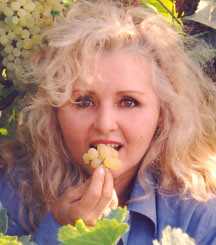
If you are in the Pittsburgh area this weekend, you are in for a real treat! Rhio will be visiting with us and she'll also be meeting with others during her two-part presentation for the Pittsburgh Raw Food Meetup on Saturday.You don't have to be a member of the meetup to enjoy this presentation. Below is information about the event you won't want to miss!
Two-Part Presentation by Rhio includes Dinner

Pure Jeevan hosts the Pittsburgh Raw Food Meetup this Sunday, November 2, at 3:00 p.m.! Click here for details and a map link. We hope you can make it. We'd love to spend time with you!
Original Comments
Below, we have included the original comments from this blog post. Additional comments may be made via Facebook, below.
I don't have time to write a real blog post, but wanted to pass along this information for anyone who eats Halloween candy, or knows of others who do. Please note that I am not the kind of person to spread false warnings. I completely trust Mike Adams as a Health Reporter and all around wonderful person. He would not spread false news...he looks into every bit of information available before sharing what he's learned with everyone else.
Mike has issued a warning about Halloween Candy. Please go to his site to find out more about it: NaturalNews.com
?
I'll leave you with an old Halloween picture of me before I started eating raw foods. Halloween used to be the day I'd dress up and feel okay being myself, because I was in costume. It's funny to me that this year I feel no need to cover up in order to be myself. Halloween is still my favorite holiday, however!
All this week we're continuing to feature a variety of answers to the question "Are Raw Foodists Crazy" from various friends of Pure Jeevan. If you're just now tuning in, please read the back story and introduction to this, as posted on Monday.But, for now, let's continue with posting more of the excellent responses sent in! Enjoy!! :-)