Know Any Literary Animal Lovers?

Hi there PureJeevan readers! We wanted to let you know that Jim's new novel CHROO is available on Amazon. It's a crazy adventure involving a billionaire heiress, her Chihuahua BFF ("Chroo") and a host of human and animal characters. Find out more on Amazon! Here are some links:

Getting Lyme Disease after regaining my health on the raw foods diet was a tough thing to accept. How could a body cure itself with a raw food diet, yet then fail to even recognize and destroy the Lyme bacteria? So many individuals have recovered from awful diseases, including cancer, by eating a raw food diet. Why, as a raw foodist, has my body been unable to easily eliminate this lyme disease?
I know Jim and I weren't the only ones wondering this. Many of you have voiced concerns, as well. Questions have been asked about how healthy my raw diet has actually been. Have I been cheating and eating cooked foods? Have I been eating too many packaged raw food snacks? Am I drinking alcohol? What have I been doing *wrong* with my diet in order for this to happen in my body? Here are some answers:
Read more: Please Share Immune Building Knowledge with Wendi!

Quick note: Jim here... So strikingly pervasive is the "winter blues of 2010" that I suspect many of my friends will think this is about them. But, it's just some thoughts, really -- not in response to anything or anyone in particular. (In fact, if anything, it's in response to something related to our dog, which we'll no doubt write about at some point.)
I sense that there is a useful blog post on the topic of "raw during tough times." However, after pondering the topic at length, I'm just not exactly sure what to say about it. I do know that quite a lot of people come to feel disappointed in themselves for straying from the healthiest path. It's a story I've read over and over on raw web sites and blogs, perhaps more frequently in the winter. It starts out the same: Someone goes raw, gets all fired up about it, and soon starts feeling youthful and vibrant again. The high lasts for a while, but then ... something happens. They slip back to cooked foods -- or worse, to junk foods. Sometimes the process repeats itself for years.

Jim here... Allow me to think out loud, philosophically, for a few moments, will you? I have a gut suspicion about something, but need to think it through a bit here. I'll start with a quote:
"There have also been a number of traditions around the world that describe a divine confusion of the one original language into several, albeit without any tower [referring to the well known story of the Tower of Babylon from the Christian Bible]. Aside from the Ancient Greek myth that Hermes confused the languages, causing Zeus to give his throne to Phoroneus, Frazer specifically mentions such accounts among the Wasania of Kenya, the Kacha Naga people of Assam, the inhabitants of Encounter Bay in Australia, the Maidu of California, the Tlingit of Alaska, and the K'iche' of Guatemala. ... The Estonian myth of "the Cooking of Languages" has also been compared."

Jim here... Here's an interesting way to finish out the week: Today just happens to be my one-year "rawniversary." That's right, for the past full year, I've existed as a 100% raw food vegan.
Sure, I'd been "high-raw" for a couple of years prior to September 18, 2008 -- and it was during those high-raw years when the bulk of my weight came off and when I kissed prescription meds goodbye (I'd been on powerful beta-blockers for my heart and blood pressure).
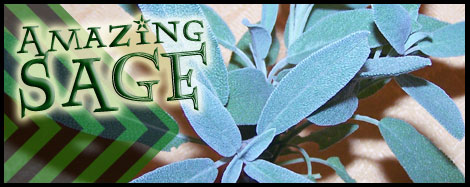
Well, we've always found the herb SAGE to be delightful in so many ways. That's why we've grown it here and elsewhere for years. Such a lovely, fragrant, sturdy, resilient herb, it's truly one of the easiest plants to communicate with -- and YES!, it truly IS a meaningful dialogue when you step out into the garden and sit among a patch of sage. All you need to do is listen carefully, and sage will speak its sage herbal wisdom to you.
I was wondering how sage came to be known as "sage" -- when all of the sources I had handy simply listed its technical name, salvia, along with its common name. Enter the great Wiki for an answer:
Read more: Please Tell Everyone: "I Read Some *Sage* Words at Pure Jeevan Today"

I received some very sad news about the holistic doctor I've been seeing during my raw journey. Dr. Amy Ruth Stine died Saturday after a rock climbing accident. This news breaks my heart. Dr. Stine was an amazing woman and doctor. She was extremely intelligent, acutely in tune with how we are all connected and one, compassionate, loving, thoughtful, and had a gift of really getting to know each patient as an individual and friend.
It was with Dr. Stine's care that I was able to track my progress with the raw food diet. She encouraged me to follow my instincts (which were telling me that raw is the way), cheered me on with the many changes that I was going through (physically, mentally, spiritually, and emotionally) over the years, and told me many times that I inspired her! Imagine how wonderful that made me feel---to be inspiring someone as wonderful as Dr. Stine.

To help keep all of you inspired, we ve asked some
remarkable individuals to share their raw food stories with you. Enjoy!
Welcome to Episode 4 of Know Your Food. Wow, the PEAR episode is here at last! Aren't you thrilled to know that? Of ALL of the fruits, veggies, nuts, seeds, herbs, etc. in the knon world, we finally got to the wonderful pear. Well, it's no surprise, when you think about it. After all, sweet, mild pears are usually among the first fruits fed to babies. So, chances are, you were fed them, too, as a toddler. So, let's dig in, shall we?
Pears contain water-soluable fiber (pectin), Vitamin A, Vitamin B1, Vitamin B2, Vitamin C, Vitamin E, Copper, Potassium, Posphorous, Folic Acid, Niacin, Iron, Magnesium, Sodium, Sulphur, Calcium, and more! They lower your blood pressure, releive inflammation, lower cholesterol via pectin, calm the stomach, cool the body, prevent cancer via anti-oxidants, boost your energy via the fructose/glucose, reduce inflammation, help your bones/calcium levels, aid in pregnancies via the folate, and much more. Pears are GREAT for you, so eat them regularly!

I'm going to be including questions and answers more often on the blog, since we've had a lot of emails from many of you saying you found last week's Q&A helpful and fun to read. I have many questions I've been saving to share with others, and more come in daily. Don't be shy if you have a question about anything that you think I'd possibly be able to help you with. Simply send me an email asking, and I'll reply to you personally. Questions that I feel might have a more general interest may be shared here on the blog (with the questioner being anonymous).
[Please email questions to me, rather than post them here on the blog: WendiDee [at] PureJeevan.com.]
A Bit of India in Pittsburgh s Back Yard?
During an intense personal journey in recent years, I ve discovered that the more I m able to know my true self, the more my perception of the world changes. As a result, my surroundings have changed as well ?people, places, directions. At one point, internal and external changes happened so rapidly, it was difficult to fully process anything; I felt overwhelmed.
Amid urges to explore so many new directions, all at the same time, it became impossible to focus. My initial instinct was to flee to India, where I could peacefully stay at an ashram and process all that was transpiring in my mind. Although circumstances kept me from traveling abroad, I knew I needed to simplify. That s when I remembered an old issue of Point of Light I d kept. I dug it out and quickly flipped through the pages? There it was: Peaceful Valley Ashram & Retreat, located just north of Pittsburgh!
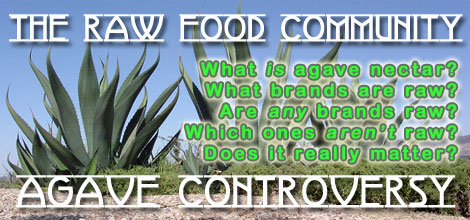
Within the raw food community, a controversy seems to have been brewing for the better part of a year! The topic: Agave nectar (also called agave syrup). Surely by now most people know what agave nectar is. For anyone who doesn't, it's a thick liquid sweetener made from, you guessed it, the agave plant.
In general, the production of tasty agave nectar involves heating the plant to a certain temperature (which varies widely according to which manufacturer is making it and which species of agave is used). The extent of this heating constitutes a significant part of the controversy (as most raw foodists believe that heating any food over a certain temperature, usually somewhere between 105 and 118 degrees fahrenheit, renders it "dead").
Read more: Pure Jeevan Explores the Raw Food Community's Agave Nectar Controversy