Know Any Literary Animal Lovers?

Hi there PureJeevan readers! We wanted to let you know that Jim's new novel CHROO is available on Amazon. It's a crazy adventure involving a billionaire heiress, her Chihuahua BFF ("Chroo") and a host of human and animal characters. Find out more on Amazon! Here are some links:
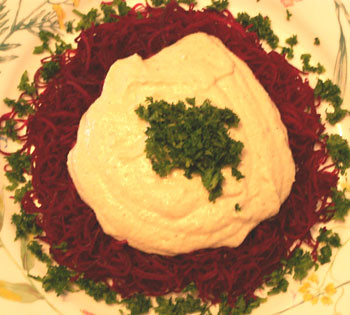
The mono meals ended and I did create that beet pasta with alfredo sauce that I was dreaming about. So, here's the recipe:
BEET PASTA
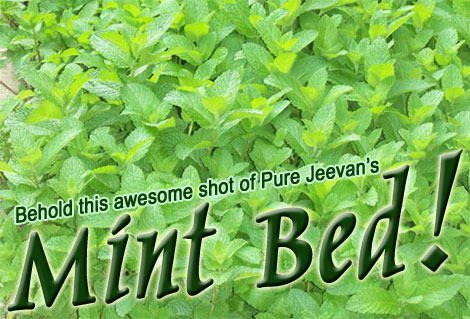
I wrote on Monday that today (Thursday), we would be discussing mint here -- specifically, harvesting some late-remaining mint from our mint bed (shown above in all its glory) and making something with it. I failed, however, to take into account that it's been getting darker earlier and earlier these days. By the time I was able to get outside and talk about mint, it was just too dark.
So, I thought I'd forego the video, and just write up some minty facts to freshen up your Thursday. To begin, I would highly encourage anyone who is new to gardening, and wants some early success, to experiment with mint (including spearmint, peppermint, and the various varietals available here and there). I can almost guarantee that you'll have some wild (and I do mean wild!) success, and will soon enjoy more mint than the law allows. It's so easily grown, and spreads around so easily (via its root system), that it would almost be considered invasive if it weren't so darned desirable and fragrant. (It's tough to walk past a mint bed without snatching up a leaf, rolling it between your fingers, and inhaling the scent deeply.)

Do you know how sometimes you meet somebody new and they tell you their name and it just doesn't seem to fit for some reason? Well, that's just not the case for the person that we'd like to introduce to you today. This person's name describes the individual she is as well as the community that she creates.
Take the Time to Meet? Happy Oasis!
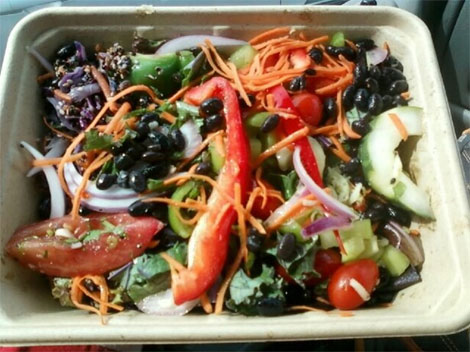
Jim here... As I hinted at last week, I decided to try changing things up a bit and seeing what I thought of it. The salad you see above included the first cooked food I've had in more than two years. If you look closely, you can see that I sprinkled on a few spoonfuls of black beans. Also, in the upper left corner, there's a small spoonful of quinoa. I don't want to give the wrong impression here: ?This blog will certainly remain a major go-to source for raw food nutrition information. It's just that, today, I want to talk about experimentation a little bit.
First, I think it's generally healthy to experiment with your diet -- especially when you get the sense that something isn't working in your current diet. The fact is, diet is a dynamic thing, not a static aspect of your life. It has to be this way because so many factors affect our physiology on a day-to-day basis. Off the top of my head, these include the facts that:
Read more: Experimentation: The 95% Raw Salad... A Good Idea or Not?
It's time for a little Phun Phriday Philosophy. (I hope you don't mind a little levity as we end this glorious week ) It just occurred to me that philosophers and self-development gurus commonly admonish against "attachments." Isn't that true ?We're attached to our egos, our possessions, our relationships. All attachments are bad, it is said. I believe one of the primary tenets (Noble Truths) of Buddhism centers on this very thing -- that our attachments cause suffering.
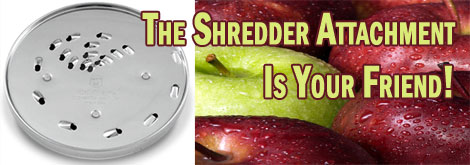
 Well, all of that may be food for thought. But, when it comes to food for your body, I'm here to tell you that attachments are GOOD -- especially, when we're talking about the shredder attachment for your food processor!? Oh, don't lie to me, fellow raw foodie (or raw aspirant, as the case may be): You know you've neglected this wonderful tool, haven't you? -- relegated it to some unimportant place in the back of a kitchen drawer somewhere, right ! Well, it's time to rediscover the shredder blade! Your mission, should you choose to accept it, is to reconnect with this delightful food processor attachment.
Read more: Are You 'Shred Up' With Your Food? If Not, Maybe You *Should* Be!
April 15, 2008
Every year my dear friend, Mamta, lets me know when Navratri is going to begin. ?It s the nine-day fast, but you don t have to change anything since you are already eating so healthy. Traditionally, Hindus used to abstain from eating during Navratri. In modern times, with everyone working and life being less relaxed, fasting isn t always something that can easily be accomplished. So, over the years Navratri has been modified by many to represent a time of eating more simply and abstaining from meat if you eat it.
This year, I had an email question from one of our readers who was asking about ways to eat simpler during the nine-days of fasting. After responding to him, it sparked in me a desire to do something this year for Navratri. I had read about eating mono meals and always thought it sounded like such a gentle way of cleansing the body, so I figured I d try it for the nine days of Navratri. To make it even easier on me, I decided to consume a different food every 24 yours, rather than eating the same thing for the full nine days. Maybe in the future I ll try that, but this time I wanted this to be as easily doable as possible.
As promised, here's today's herbal installment, a video on Oregano Oil! Verdict: It's strong, for sure, but it's not as bad as I thought it was going to be!
***** DISCLAIMER: As with all of our posts here at Pure Jeevan, and particularly those coming up over the next week and a half (which will all be tagged with a new term, "Nadi Balance"), please refer to the disclaimer that runs at the bottom of all Pure Jeevan Pages. Wendi and Jim are health researchers, educators, and extreme self-experimenters -- not doctors. ******
Nadi Balance: Part II
Even though this ground-breaking information we're sharing is not necessarily about Lyme disease, the story of Wendi's contracting, suffering, and healing from it is essential background information. So, we're going to talk about Lyme disease frequently here and in the next few posts, but know that the real, underlying story is about so much more than Lyme disease. (In fact, it's about overall health for everyone!)
Any botanists or kale experts in our readership ? Take a look:

We began this series with one possible psychological explanation of obesity, moved on to a possible philosophical explanation, and will now cover one that could be both of those, or could find classification within the emotional and/or spiritual realms. ?Wendi has often told me of hearing Dr. Gabriel Cousens speak in Sedona, Arizona, a few years ago. One remark in particular stuck with her. This may be a slight paraphrase, but Dr. Cousens said:
"There's never enough food to feed a hungry soul."
As we all know, physical hunger happens when our bodies need food -- when our stomachs are literally empty and aching for fuel to sustain our life. But, what about non-physical types of "emptiness"? Surely, we experience a kind of hunger in these cases as well.