Know Any Literary Animal Lovers?

Hi there PureJeevan readers! We wanted to let you know that Jim's new novel CHROO is available on Amazon. It's a crazy adventure involving a billionaire heiress, her Chihuahua BFF ("Chroo") and a host of human and animal characters. Find out more on Amazon! Here are some links:

When it comes to healthy eating, most of us know what is and isn't healthy for our bodies. Sure, we've been a bit confused by what the media and our government tells us, but overall I think we can all confidently say we know that consuming fresh fruits and vegetables is going to be a healthier choice than eating a McDonald's hamburger and fries. Right
But, what do we do when we're dealing with stress in our lives? What if when we're stressed we instantly head to McDonald's to eat the burger and fries we know aren't healthy for us? Or what if we consume large quantities of cakes, candies, or ice cream when we're overcome with stress

Jim here... Wow, did you read yesterday's post ? Wendi is away for a month starting today. That's like a year in Internet time, right?
So, I guess I have the blog to myself for a while. So strange... I mean, I helped her set it up back in late '07, contributed numerous articles and a lot of behind-the-scenes time along the way, and then got really involved here (regularly -- daily, even) about a year ago. But, I never "had the keys" all to myself for a long spell. I feel as though I've been entrusted with something important, you know ? I must control that strange compulsion within me to, you know, run a silly cat video or something. But, I'll resist and keep things on-point. (LOL)
Pardon the video quality there. A.J. and I shot that video at night and, although it looked decent on the camera's preview screen, the actual video came out almost totally black!? However, with a bit of video processing, we were able to salvage it. It's not optimal video, but it's at least watchable (and, hey, also conveys a little of that nighttime festival feeling).
A quick note about veganism before I share some additional info... As we've stated here many times, Pure Jeevan advocates a raw vegan lifestyle. What do we intend that to mean, exactly? Well, strictly speaking, veganism excludes all animal products, both in terms of diet and lifestyle.
All this week we're continuing to feature a variety of answers to the question "Are Raw Foodists Crazy " from various friends of Pure Jeevan. If you're just now tuning in, please read the back story and introduction to this, as posted on Monday.But, for now, let's continue with posting the rest of the excellent responses sent in! Enjoy!! :-)

Many people have asked us about the Raw Spirit Festival (RSF): What is it? When is it? Where is it? Will we be going ? So, we wanted to take a moment to answer those questions.
-
What Is It ? Well, as any long-time reader of this blog is likely aware, RSF is a very special event! Not only does it have its own web site, which we encourage you ti visit in order to learn more, but we've also devoted an entire category of the All Raw Directory to "Raw Spirit Festival Memories," a place where people can post links to blog entries, photo sets, and videos from various RSF events.
?

Hey everyone!? Just one long weekend left for Wendi and KDcat to (frantically) pack for their cross-country roadtrip. Yep, Monday night I'm dropping them on that midnight train to Portland. Wait until you see the spread of trip-snacks they're taking along. (We took some pictures of the raw foods smorgasbord sent by our generous snack sponsor, Natural Zing).
Today, since it's fun-filled Friday, I thought I'd share a little tale of frustration (although meant in kind of a funny way) relating to my own diet. You may have read my mini-manifesto a few weeks ago about my recent quest for simplicity. Well, Wendi and I have both largely maintained that kind of existence for a while now -- especially when it comes to the breakfast smoothies (pineapples galore!) and lunch salads. I have to admit that my energy seems to be trending upward very nicely!

We tried it in the past, this most unusual fruit. While in Chicago recently, we decided to give it one more try! You see, the first time we tried it we were ... let's just say "not big fans" of the infamous durian. (Here's an episode of Kevin Gianni's Renegade Health Show, shot in our home, documenting that day.) It's a stinky fruit to most, although some claim to enjoy the bizarre odor (which is sometimes described as dirty sock and propane gas smell). If you can get past the smell to give it a taste, you'll be greeted by a taste as strange as the odor. Wendi describes it as a sweet onion pierogie, but each person seems to have a different opinion about this odd fruit.
In this current video our raw friend Debbie Gedayloo-Bennett, whom we met in Chicago, jumped at the opportunity to hang out for a bit of a durian experience. Debbie is on the pro-durian side of the fence that divides those who love and those who hate the alien-like fruit. Wendi was still sitting on the fence, not making up her mind after the initial taste with Kevin and Annmarie. Jim was adamantly sitting far from the love side of the fence, refusing to even attempt approaching the pro side. Debbie was a pro in opening this spiny fruit, so she agreed to open it while on video so that we could share the experience and knowledge with all of you.
Jim here... A health-conscious friend of mine was feeling sick today. And, while I certainly do not advocate harping on the sick, I did have a very mild discussion with her when she phoned me for some advice. I asked, "Do you know what cognitive dissonance is "
"I'm not sure," she replied.

Here it is, the new year. I've never been excited about the end of one year and the beginning of the next, but this time it's different.So many things have changed in our lives here at Pure Jeevan, bringing us to this point in time--a time that we are ready for and fully embrace. This year is going to be RAWmazing!
Many plans and projects have been started over the past few years, and this is the year that will see many of them fully blossom. The beauty of these projects is that they are about so much more than just us, or just you, our lovely readers. Our mission is to help as many people as possible to wake up from a life that's only partially being lived.We believe there are many tools that can be used to fully wake up and embrace life; one of them is eating a raw food diet. We raw foodists know that there is a lot more to life than what we've been taught to believe and expect, and many of us are helping others learn this beautiful fact. We are shaking up many of the core beliefs on which most of us have based our lives. I strongly believe that many of us in the raw food movement can say: We Are The Ones! We are the ones who are here to make positive changes, to help others fully embrace life, and to have fun, fun, fun! Why waste even one more day of your precious life doing something you don't enjoy doing? It's time to have fun, to feel the love that exists within and all around us, and to help others experience the same! So, are you in ?Do you want to join us on this grand adventure of creating a blissful life for not only ourselves, but for the rest of the world, as well?
Read more: Acknowledging Changes and Growth: 2008 / 2009, Part 3

We've promised many of you that we'd share some ideas for the whole family (especially the children), so here's one idea that might prove particularly popular. In a household of two former English majors, it's only natural that we've always adored and admired alliteration. So, we may be biased to believe that these "Breathtakingly Bejeweled Blueberry Banana Breakfast Bowls" will be as beloved by your beauteous bellies as they are by ours. See what you think!
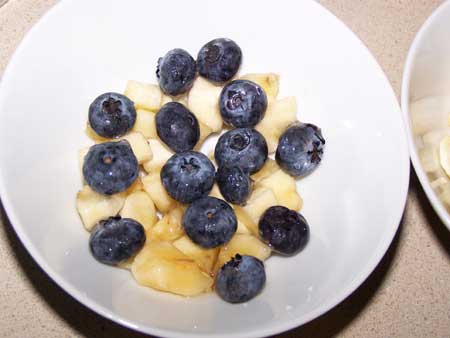
Read more: Breathtakingly Bejeweled Blueberry Banana Breakfast Bowls
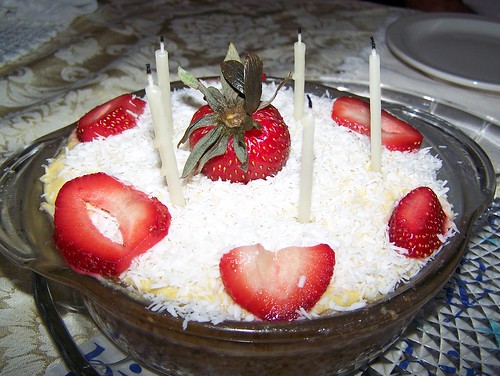
What better way to start our Fun-Filled Friday than by celebrating Jim's birthday ! He worked for half the day and now he's home for a long weekend. So far we've had a nice lunch (cashew/macadamia cheese with red peppers and celery) and birthday pie (mango and pineapple!) after singing "Happy Birthday" to him! This evening we'll have veggie stir-not-fry, since that's what Jim has requested. I prepared it earlier and it's in the dehydrator to marinade and get a bit warm.